Frederick Leveson-Gower
| Name | Frederick Leveson-Gower |
| Title | British politician (1819-1907) |
| Gender | Male |
| Birthday | 1819-05-03 |
| nationality | United Kingdom of Great Britain and Ireland |
| Source | https://www.wikidata.org/wiki/Q5498271 |
| pptrace | View Family Tree |
| LastUpdate | 2025-11-26T23:22:37.399Z |
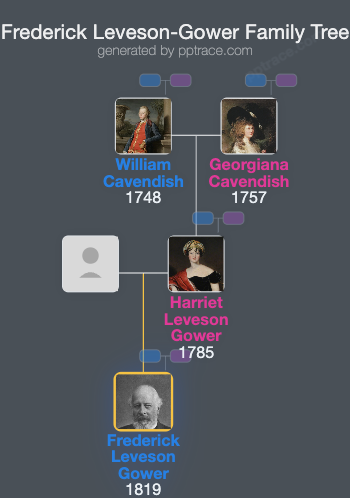
Family Tree
Tap  to expand more relatives
Introduction
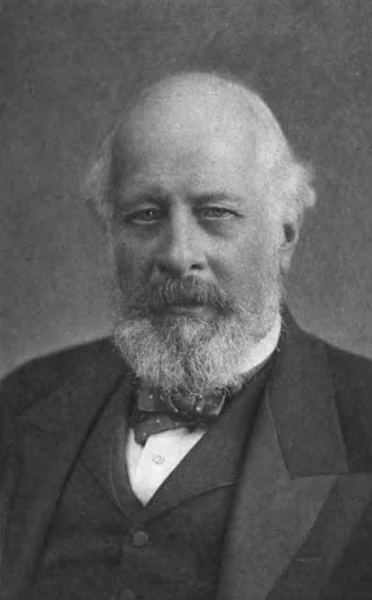
Hon. Edward Frederick Leveson-Gower, DL, JP (3 May 1819 – 30 May 1907), commonly known as Freddy Leveson, was a British barrister, politician, and member of the Leveson-Gower aristocratic family.
**Early Life**
Frederick Leveson-Gower was born in 1819 as the third son and youngest child of Granville Leveson-Gower, 1st Earl Granville, and Lady Harriet Elizabeth Cavendish. His maternal grandparents were Lady Georgiana Spencer and William Cavendish, 5th Duke of Devonshire. He had two brothers: his eldest brother, Granville, succeeded as Earl Granville; his other brother, William, died at age 16 after suffering from paralysis for several years. His sisters included Lady Georgiana Fullerton, a novelist, and Lady Susan, who married George Pitt-Rivers, 4th Baron Rivers.
In his childhood, Leveson-Gower initially resided at his father's residence in Wherstead. In 1824, when his father became ambassador to France, he moved with his family to the British embassy in Paris, where he was acquainted with Henri, comte de Chambord. At age eight, he was sent to a school in Brighton, after which he attended Eton College. He left Eton in 1835 and received private education for two years before matriculating at Christ Church, Oxford, in 1837. He completed his Bachelor of Arts degree in 1840 and obtained a Master of Arts in 1844.
**Legal and Political Career**
Following his Grand Tour, Leveson-Gower studied law and was called to the bar at the Inner Temple in 1845, practising on the Oxford circuit. In May 1847, he was elected to the House of Commons as a Member of Parliament (MP) for Derby, with backing from his uncle William Cavendish, 6th Duke of Devonshire. However, the election was declared void on petition in July 1847, and he did not contest the subsequent by-election.
From 1851 to 1852, Leveson-Gower served as a précis writer in the Foreign Office. In 1852, through the influence of his cousin George Sutherland-Leveson-Gower, 2nd Duke of Sutherland, he was elected MP for Stoke-upon-Trent, a position he held until 1857. In 1856, he participated in a special diplomatic mission to Russia alongside his brother Granville. He lost his parliamentary seat in the 1857 general election but was then elected as MP for Bodmin, representing that constituency until his retirement from Parliament in 1885.
**Public Service**
Leveson-Gower served as a Justice of the Peace for Surrey and was appointed Deputy Lieutenant for the county, holding these roles throughout his later life.
**Personal Life**
In 1850, Leveson-Gower traveled to India. Upon his return, he married Lady Margaret Compton, daughter of Spencer Compton, 2nd Marquess of Northampton, on 1 June 1851. They had two children; however, only one survived to adulthood: Sir George Granville Leveson-Gower (1858–1951), who became a Member of Parliament for North West Staffordshire and Stoke-upon-Trent. Their first child, an unnamed daughter born stillborn on 8 February 1854 at 145 Piccadilly, did not survive.
Lady Margaret died of measles contracted during her pregnancy, three days after the birth of their son, at the age of 28. Leveson-Gower never remarried and remained a friend of William Ewart Gladstone and his wife during his later years. He died in 1907 at the age of 88.
**References and External Links**
Additional information about Edward Frederick Leveson-Gower's contributions in Parliament and portraits is available through the Hansard archives and the National Portrait Gallery in London.