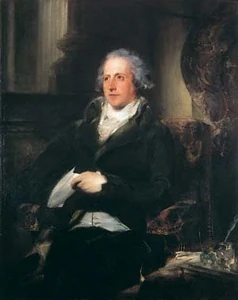
William Eden, 1st Baron Auckland
| Name | William Eden, 1st Baron Auckland |
| Title | Irish politician (1745-1814) |
| Gender | Male |
| Birthday | 1745-04-03 |
| nationality | Great Britain |
| Source | https://www.wikidata.org/wiki/Q333449 |
| pptrace | View Family Tree |
| LastUpdate | 2025-11-26T23:27:13.053Z |
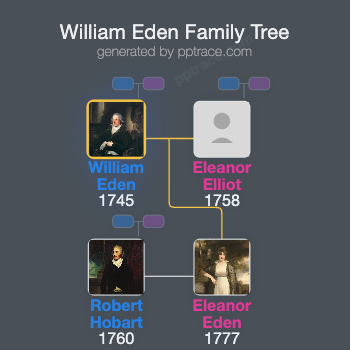
Family Tree
Tap  to expand more relatives
Introduction
William Eden, 1st Baron Auckland, PC (Ire), FRS, was born on April 3, 1745, and died on May 28, 1814. He was a British diplomat and politician active during the late 18th and early 19th centuries. Eden was a member of the influential Eden family. His father was Sir Robert Eden, 3rd Baronet, of Windlestone Hall in County Durham, and his mother was Mary Davison, daughter of William Davison. His siblings included Sir John Eden, 4th Baronet; Sir Robert Eden, 1st Baronet of Maryland; and Morton Eden, 1st Baron Henley.
Eden's education included attendance at Durham School, Eton College, and Christ Church, Oxford. He was called to the bar at Middle Temple in 1768. In 1771, he published "Principles of Penal Law" and gained recognition as an authority on commercial and economic matters.
In 1772, Eden accepted the position of Under-Secretary of State for the North, serving until 1778. He represented Woodstock as a Member of Parliament from 1774 to 1784 and was a Lord of Trade from 1776 to 1782. During the American War of Independence, he was involved in efforts to improve prisoner treatment and served as a commissioner on a diplomatic mission to North America with the Earl of Carlisle, which was unsuccessful. He also headed British intelligence operations in Europe during the war, managing a budget that reached £200,000 by 1778.
Upon returning in 1779, Eden published "Four Letters to the Earl of Carlisle." In 1780, he became Chief Secretary for Ireland, a position he held until 1782. That year, he was admitted to the Irish Privy Council. Between 1781 and 1783, he represented Dungannon in the Irish House of Commons. From 1783 to 1784, he served as Joint Vice-Treasurer of Ireland and established the National Bank there.
Eden continued as MP for Heytesbury from 1784 to 1793. In 1784, he was sworn into the British Privy Council. His diplomatic posts included envoy to France (1785–1787), ambassador to Spain (1787–1789), and ambassador to the Netherlands (1789–1793). In 1789, he was elevated to the Peerage of Ireland as Baron Auckland. He retired from public service in 1793, receiving a pension of £2,300, and was granted the title of Baron Auckland of West Auckland in the Peerage of Great Britain.
During his retirement at Beckenham, Auckland maintained a friendship with William Pitt the Younger, who was also his neighbor at Holwood House. With Pitt's approval, he published "Remarks on the Apparent Circumstances of the War" in 1795 to influence public opinion toward peace. In 1798, he joined Pitt’s government as Joint Postmaster General. He publicly criticized Pitt’s resignation in 1801 and served under Henry Addington afterward. His friendship with Pitt ended in 1804 when Pitt excluded him from his administration, although Auckland's pension was increased.
Later, Auckland served as President of the Board of Trade under Lord Grenville during the Ministry of All the Talents (1806–1807). His "Journal and Correspondence," published posthumously in 1861–1862, provides insights into the political history of that period.
Several geographic locations and places are named after him, including the Auckland Islands south of New Zealand and Eden Quay in Dublin.
In his personal life, William Eden married Eleanor Elliot, daughter of Sir Gilbert Elliot, 3rd Baronet, in 1776. They had six sons and eight daughters. Notable children included Eleanor Agnes Eden, who was publicly linked to William Pitt the Younger; Catharine Isabella Eden; Elizabeth Charlotte Eden; Caroline Eden; William Eden, MP for Woodstock; George Eden, 1st Earl of Auckland; and others. He was the grandfather of T. E. Lawrence through his descendants. His sons William Eden and Henry Eden died young, and his daughter Emily Eden was a poet and novelist.
William Eden died in May 1814 and was succeeded by his eldest surviving son, George Eden, who was later created Earl of Auckland in 1839. His wife Eleanor died in May 1818.