Eric Phipps
| Name | Eric Phipps |
| Title | British diplomat (1875-1945) |
| Gender | Male |
| Birthday | 1875-10-27 |
| nationality | United Kingdom |
| Source | https://www.wikidata.org/wiki/Q831031 |
| pptrace | View Family Tree |
| LastUpdate | 2025-11-26T23:31:57.089Z |
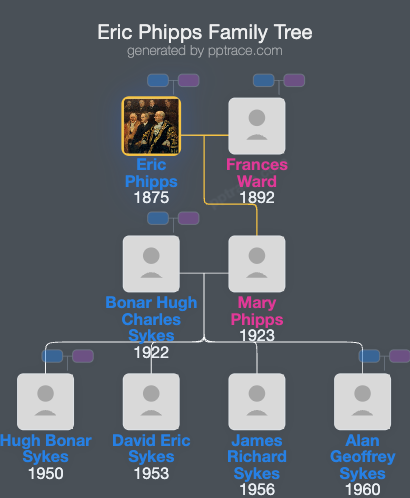
Family Tree
Tap  to expand more relatives
Introduction
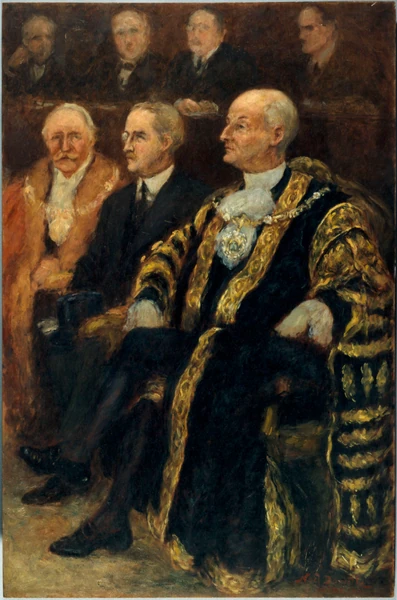
Sir Eric Clare Edmund Phipps (27 October 1875 – 13 August 1945) was a British diplomat who served in various diplomatic posts throughout his career.
Early Life and Education
He was born to Sir Constantine Phipps, who later became the British Ambassador to Belgium, and Maria Jane Miller Mundy. His lineage includes notable ancestors such as Henry Phipps, 1st Earl of Mulgrave; Lieutenant-General Sir Colin Campbell, a participant in the Battle of Waterloo; and Rear-Admiral Sir John Hindmarsh, who served as a lieutenant on HMS Phoebe during the Battle of Trafalgar. As a child, Phipps traveled across Europe accompanying his parents to their diplomatic postings.
He was educated at King's College, Cambridge, and the University of Paris, from which he graduated.
Diplomatic Career
Phipps entered the British Diplomatic Service after passing the competitive examination in January 1899. His first posting was as an attaché in Paris in October 1899, with subsequent promotions and postings including Constantinople (1905), Rome (1906), and as private secretary to Sir Francis Bertie, the British Ambassador to France, in 1909. He served on the staff of the British delegation at the Versailles Conference in 1919 and held various roles, including chargé d'affaires and minister plenipotentiary, in Brussels and Paris during the 1920s.
In June 1928, Phipps was appointed Envoy Extraordinary and Minister Plenipotentiary to Austria, marking his first independent diplomatic posting.
Ambassador to Germany
In 1933, Phipps was appointed British Ambassador to Germany during a period marked by the rise of Adolf Hitler and the Nazi regime. He held the role until 1936. During his tenure, he expressed views that aligned with policies later characterized as appeasement and believed the League of Nations was vital to preventing another war. His dispatches included warnings regarding Germany's military expansion and the character of Hitler's government. For example, in January 1934, he described Hitler's policies as straightforward and suggested that Germany's leadership sought strength through direct means.
He observed Hitler cautiously, noting that Hitler could be either moderate or possibly mad, and presented a questionnaire to Hitler in May 1936, which asked whether Germany intended to respect existing European territorial and political arrangements. Neither Hitler nor other German leaders responded to this inquiry.
Ambassador to France
In 1937, Phipps was posted to Paris as the British Ambassador to France. His communication with London often reflected the influence of French Foreign Minister Georges Bonnet. During the crisis over Czechoslovakia in 1938, Phipps reported that the best elements within France opposed war with Germany, but he also expressed doubts about France's willingness or capacity to engage in conflict. He commented on Bonnet's internal political maneuvers, including a purge of officials opposed to his policies.
Later Life and Retirement
Phipps retired in November 1939 due to ill health and resided at West Stowell House near Marlborough, Wiltshire. He maintained memberships in clubs such as White's, the St James’s Club, the Turf Club, and the Beefsteak Club.
Honours and Personal Life
He was awarded numerous honours throughout his career, including appointments as CMG (1920), CVO (1922), KCMG (1927), GCMG (1934), GCVO (1939), and GCB (1941). He was also sworn into the Privy Council in 1933, granting him the style "The Right Honourable." His decorations included the Grand Cross of the Legion of Honour and the Commander of the Order of Leopold II of Belgium. In 1943, he served as High Sheriff of Wiltshire.
Phipps married twice; first to Yvonne de Louvencourt in 1907, who died in 1909, and then to Frances Ward in 1911. He had six children with his second wife. His children included Mervyn Phipps, a Lieutenant-Colonel; Alan Phipps, a Royal Navy Lieutenant killed in action in 1942; and others who married into notable families.
He died of a pulmonary embolism following a prostatectomy at the London Clinic in 1945.
Descendants
Through his second son Alan, Phipps was the grandfather of Major-General Jeremy Phipps (1942–2021).