Yinxiang
| Name | Yinxiang |
| Title | the thirteenth son of the Kangxi Emperor ; awarded ninth "iron-cap" hereditary status (1686-1730) |
| Gender | Male |
| Birthday | 1686-11-16 |
| nationality | Qing dynasty |
| Source | https://www.wikidata.org/wiki/Q831169 |
| pptrace | View Family Tree |
| LastUpdate | 2025-10-27T03:40:56.971Z |
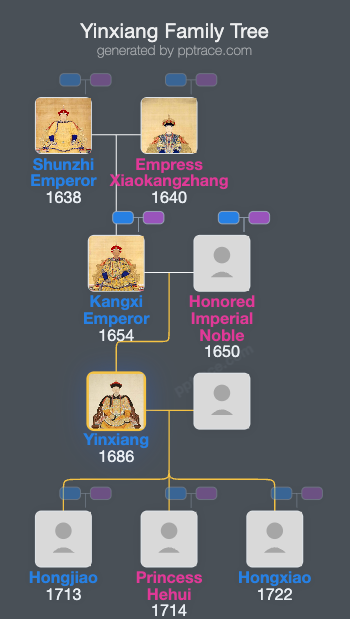
Family Tree
Tap  to expand more relatives
Introduction
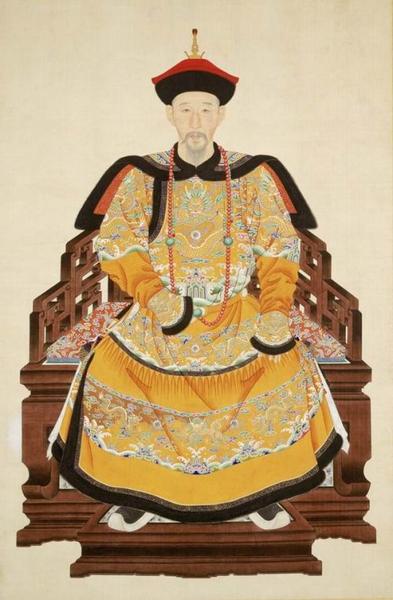
Yinxiang (16 November 1686 – 18 June 1730), also known as Prince Yi, was a Manchu prince of the Qing dynasty. He was born into the Aisin-Gioro clan as the thirteenth son of the Kangxi Emperor. His mother was Imperial Noble Consort Jingmin, the daughter of the military commander Haikuan from the Bordered White Banner. Yinxiang had two younger sisters with the same mother. His mother died when he was 14 years old, after which he was raised by Consort De, the biological mother of Yinzhen, who later became the Yongzheng Emperor. This familial connection fostered a close relationship between Yinxiang and Yinzhen from an early age.
Yinxiang received education in the arts and classics, instructed by Fahai, the second son of Tong Guogang, who was the maternal uncle of the Kangxi Emperor. Fahai also served as the imperial tutor to Yinti, the 14th prince of the same mother as Yinzhen. Both of Yinxiang's sisters died young shortly after being designated as hesuo princesses and marrying Mongol princes.
Despite being favored by Kangxi, Yinxiang was not granted a noble title during the emperor’s reign in 1709; his younger brother Yinti was awarded the title of beizi. Between 1712 and 1722, primary sources largely omit mention of Yinxiang, and it appears he did not achieve notable accomplishments during these years, although he did have several children.
Following the death of Kangxi in 1722, Yinzhen ascended the throne as the Yongzheng Emperor. That same year, Yinxiang was granted the title "Prince Yi of the First Rank" (怡親王), a peerage among the Qing dynasty’s twelve "iron-cap" princely titles, making it perpetually inheritable. His personal name was changed to "Yunxiang" (允祥) to avoid naming taboo with the emperor's personal name Yinzhen (胤禛). As a supporter of the Yongzheng Emperor, Yinxiang worked to assist in state affairs despite poor health. He was appointed overseer of the three vaults of the Ministry of Revenue and was dispatched in 1725 to oversee water-related issues in Zhili Province, including flood control and transportation. Yinxiang died in June 1730, after which the Yongzheng Emperor awarded him a posthumous name and declared a three-day mourning period. His title was granted "iron-cap" status, ensuring perpetual inheritance without rank reduction, a privilege shared by only twelve princes in Qing history.
Yinxiang's succession as Prince Yi established a peerage that could be passed down indefinitely. His sixth-generation descendant, Zaiyuan, served as a regent during the reign of the Tongzhi Emperor but was later ousted in a coup.
His family included his primary consort from the Joogiya clan, with whom he had several children, such as Hongdun, Hongjiao, Princess Hehui, Hongxiao, and Hongkuang. He also had secondary consorts from the Gūwalgiya, Fuca, and Usun clans, and was known to have had a mistress from the Šigiya clan and another from the Nara clan.
Yinxiang has been portrayed in various television dramas and films, including "Legend of YungChing" (1997), "Yongzheng Dynasty" (1999), "Palace" (2011), "Scarlet Heart" (2011), and "The Palace" (2013).