Webb Hayes
| Name | Webb Hayes |
| Title | United States Army Medal of Honor recipient |
| Gender | Male |
| Birthday | 1856-03-20 |
| nationality | United States of America |
| Source | https://www.wikidata.org/wiki/Q5825508 |
| pptrace | View Family Tree |
| LastUpdate | 2025-11-17T06:40:42.976Z |
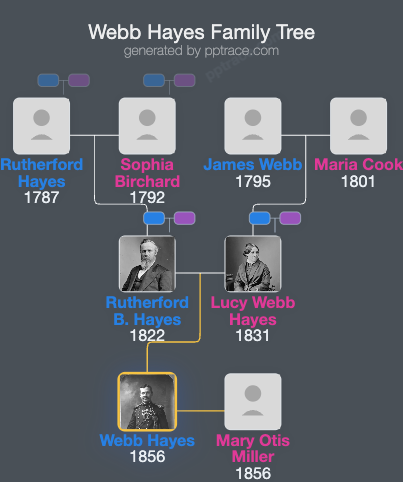
Family Tree
Tap  to expand more relatives
Introduction
James Webb Cook Hayes was born on March 20, 1856, in Cincinnati, Ohio. He was the second son of Rutherford B. Hayes, who served as the 19th President of the United States, and Lucy Webb Hayes. Hayes's early childhood was marked by exposure to military life due to his father's service during the American Civil War. From the age of five, Hayes spent six months each winter at his father's encampments, primarily at Camp White in West Virginia. During this time, he developed a close relationship with General George Crook, the commander of the unit, who became his godfather. Crook instructed him in activities such as hunting, fishing, and survival skills. In later years, Hayes and Crook participated in annual hunting trips into the Rocky Mountains.
Hayes attended Cornell University from 1873 to 1875 and was a member of the Delta Kappa Epsilon fraternity. He left Cornell to serve as his father Rutherford B. Hayes's secretary during his tenure as governor of Ohio, and continued in this role when his father was elected President of the United States. In 1881, Hayes moved to Cleveland, Ohio, where he became the treasurer of the Whipple Manufacturing Company. In 1887, he co-founded the National Carbon Company, a precursor to Union Carbide, serving as its vice president for many years.
He was instrumental in establishing the Rutherford B. Hayes Presidential Center, the first presidential library, which was founded in 1916 at Spiegel Grove, Ohio. James Webb Cook Hayes died on July 26, 1934, in Marion, Ohio, and was buried at Spiegel Grove, the family estate in Fremont, Ohio.
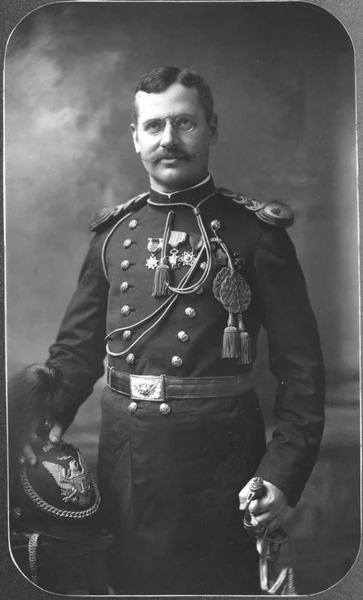
Hayes served in the United States military across three major conflicts: the Spanish–American War, the Philippine–American War, and World War I. He was a member of the First Cleveland Troop, later known as Troop A of the Ohio National Guard. During the Spanish–American War, he was appointed major in the First Ohio Cavalry and participated in the Santiago de Cuba Campaign, where he was wounded during the crossing of the San Juan River and the assault on San Juan Hill. He was subsequently promoted to lieutenant colonel and reassigned to the 31st United States Volunteer Infantry, serving in the Philippines. At Vigan, Luzon, on December 4, 1899, he performed an act that earned him the Medal of Honor; he pushed through enemy lines alone during the night to assess the situation and later reported back, securing assistance for his beleaguered comrades.
Following his service in the Philippines, Hayes participated in various military campaigns, including the China Relief Expedition during the Boxer Rebellion and acting as an observer in the Russo-Japanese War. During World War I, he was promoted to colonel and served as a special agent for the U.S. State Department in France, and later held an administrative position on the Italian front. After the war, he attained the rank of brigadier general.
James Webb Cook Hayes was a member of the Ohio Commandery of the Military Order of the Loyal Legion of the United States, based on the service of his uncle, Lieutenant Colonel J. T. Webb, in the Union Army. He was also affiliated with the Military Order of Foreign Wars. Notably, Hayes was one of only two sons of U.S. Presidents to receive the Medal of Honor; the other was Theodore Roosevelt Jr. Both medals were awarded after their respective presidents' terms, with no evident influence of nepotism.
His Medal of Honor citation reads: "Pushed through the enemy's lines alone, during the night, from the beach to the beleaguered force at Vigan, and returned the following morning to report the condition of affairs to the Navy and secure assistance." The medal was issued on December 17, 1902.