Princess Margaret Of Connaught
| Name | Princess Margaret Of Connaught |
| Title | British princess (1882-1920); Crown Princess of Sweden as the first wife of the future King Gustaf VI Adolf |
| Gender | Female |
| Birthday | 1882-01-15 |
| nationality | United Kingdom of Great Britain and Ireland |
| Source | https://www.wikidata.org/wiki/Q158173 |
| pptrace | View Family Tree |
| LastUpdate | 2025-11-12T01:18:07.028Z |
Family Tree
Tap  to expand more relatives
Introduction
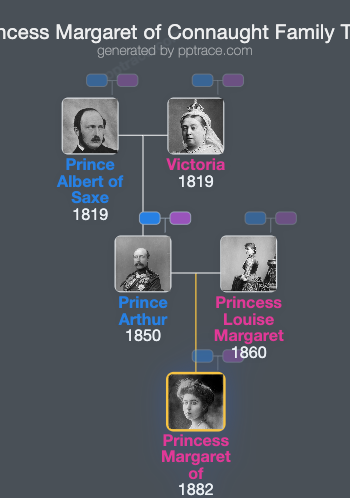
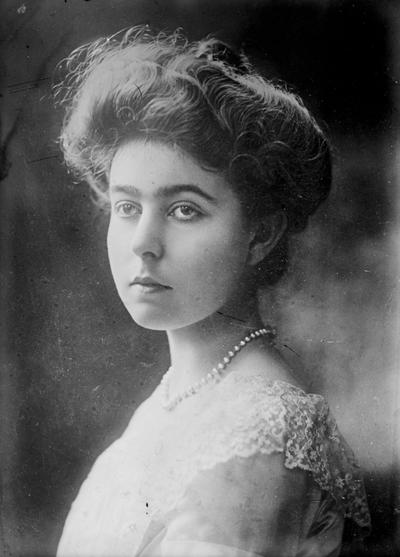
Princess Margaret of Connaught (Margaret Victoria Charlotte Augusta Norah) was born on 15 January 1882 at Bagshot Park. She was the elder daughter of Prince Arthur, Duke of Connaught, and Princess Louise Margaret of Prussia. Her paternal grandmother was Queen Victoria of the United Kingdom. She was baptized in the Private Chapel at Windsor Castle on 11 March 1882 by the Archbishop of Canterbury. Her godparents included Queen Victoria, the German Emperor, the German Crown Princess, her maternal grandparents, the Duchess of Cambridge, the Prince of Wales, and Prince Charles of Prussia.
Margaret was confirmed in Windsor Castle’s Private Chapel in March 1898. Known informally to her family as "Daisy," she grew up participating in family vacations and wedding events. Notably, she served as a bridesmaid at her cousin’s wedding, the Duke and Duchess of York, on 6 July 1893.
In January 1905, Margaret and her younger sister Princess Patricia of Connaught, both considered among Europe's most eligible princesses at the time, accompanied their parents on a visit to Portugal. The Portuguese royal family expected one of the sisters to potentially marry into their monarchy. During a subsequent trip to Egypt and Sudan, Margaret met Prince Gustaf Adolf of Sweden, the future Gustaf VI Adolf, grandson of King Oscar II of Sweden. Originally, Patricia was considered a suitable match for Gustaf Adolf, but he and Margaret developed an immediate mutual affection. Gustaf Adolf proposed to Margaret during a dinner at the British Consulate in Egypt, which she accepted.
Their marriage took place on 15 June 1905 at St. George's Chapel, Windsor Castle. Her bridesmaids included Princess Patricia of Connaught, Princess Beatrice of Saxe-Coburg and Gotha, Princess Victoria Eugenie of Battenberg, and Princess Mary of Wales. Following their wedding, the couple honeymooned at Adare Manor in Ireland before arriving in Sweden on 8 July 1905.
The marriage produced five children: Prince Gustaf Adolf, Duke of Västerbotten (who predeceased his father); Sigvard Bernadotte, Count of Wisborg; Ingrid, who became Queen of Denmark; Prince Bertil, Duke of Halland; and Carl Johan Bernadotte, Count of Wisborg. Margaret was actively involved in her children’s upbringing, favoring direct child-rearing over nursery care.
Upon her husband’s ascension to the throne as King Gustaf V in 1907, Margaret became Crown Princess. Her marriage was characterized as a happy love match. She adapted to Swedish customs by learning the Swedish language, studying Swedish history and social welfare, and engaging in various sports, including skiing, ice skating, hockey, tennis, and golf. She was also interested in art, especially the works of Claude Monet, as well as gardening, contributing to the creation of gardens at Sofiero Palace.
Margaret published two books about gardening: "Vår trädgård på Sofiero" ("Our Garden at Sofiero") in 1915 and "Från blomstergården" ("From the Flower Garden") in 1917. During World War I, she organized a sewing society to support the Red Cross, trained girls for agricultural work, and worked to assist prisoners and war-affected relatives, demonstrating a pro-British stance contrasting with her mother-in-law's pro-German attitude.
She died suddenly from blood poisoning (sepsis) on 1 May 1920, which was her father’s 70th birthday. Prior health issues included measles and mastoid surgery, and she had developed erysipelas under her ear leading to sepsis. She was eight months pregnant with her sixth child at the time. Her death occurred amidst reports of unhappiness and rumors of suicide, though no evidence supports such claims. Her obituary noted that she wished to be buried in her wedding dress and veil, holding a crucifix, with no lying-in-state.
In 2021, an exhibition titled "Daisy. Crown Princess Margareta, 1882–1920" was held at the Royal Palace in Stockholm. The British rose breeder David C. H. Austin released Rosa 'Crown Princess Margareta' in 2000, honoring her as an accomplished landscape gardener who contributed significantly to the gardens at Sofiero Castle.
Princess Margaret was a member of several honors, including the Royal Order of Victoria and Albert (Second Class), the Imperial Order of the Crown of India (Companion), and the Lady of Justice of the Order of the Hospital of St. John of Jerusalem, awarded in July 1905. Upon her marriage, she adopted arms representing her status as a Swedish princess with an inescutcheon of her previous arms, which was later removed in 1917 by King George V.