Sir Henry William Carr
| Name | Sir Henry William Carr |
| Title | British army officer (1777-1821) |
| Gender | Male |
| Birthday | 1777-10-06 |
| nationality | — |
| Source | https://www.wikidata.org/wiki/Q21079110 |
| pptrace | View Family Tree |
| LastUpdate | 2025-11-26T12:32:44.118Z |
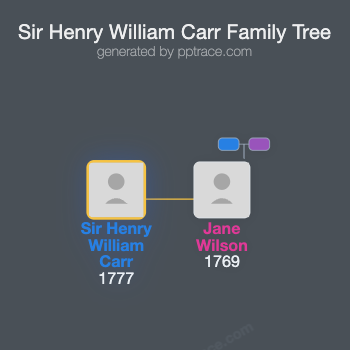
Family Tree
Tap  to expand more relatives
Introduction
Sir Henry William Carr (6 October 1777 – 10 August 1821) was a British Army officer. He was born in Twickenham, where his father, Reverend Colston Carr (1740–1822), managed a private school. His mother was Elizabeth Bullock (1747–1826). Carr was the second son in his family; his elder brother was Robert James Carr, who served as bishop of Chichester and of Worcester, and his eldest sister, Elizabeth Anne Carr, married Sir James Martin Lloyd.
Carr's father initially intended for him to pursue a career at Coutts Bank, but he chose to join the British Army instead. He enlisted in the newly established 83rd Foot regiment. His early military service included postings to the West Indies, where he participated in the Second Maroon War in Jamaica and campaigns in Santo Domingo. During these engagements, he was wounded, resulting in a prolonged convalescence.
In 1802, the 83rd Foot was recalled to the United Kingdom. The regiment was not active again until 1809, when it was deployed to Lisbon to oppose the French invasion of Portugal. Carr fought at the Second Battle of Porto and the Battle of Talavera. In 1810, the regiment participated in the Battle of Bussaco. The commanding officer was promoted to lead a Portuguese brigade, and Carr, then a Major, took command of the 2nd Battalion of the 83rd Foot.
In 1811, the 83rd gained recognition at the Battle of Fuentes de Oñoro. In the spring of 1812, Anglo-Portuguese forces advanced into Spain, capturing Almeida and Ciudad Rodrigo, and then besieged Badajoz. A notable achievement was a night assault led by Carr that captured the town's castle, leading to the French surrender of Badajoz. For this, Carr was promoted to Lieutenant-Colonel.
Subsequently, the regiment participated in the Battle of Salamanca in July 1812, where Carr's horse was shot from under him. In 1813, the allies defeated the French at Vitoria, and Carr was one of two officers awarded a medal for his leadership during the battle. The regiment continued into France, fighting at Nivelle and Gave d'Oloron.
In February 1814, Carr participated in the Battle of Orthez, where he was wounded by a musket ball that grazed his jaw and lodged in his throat, leaving him permanently affected. The regiment's final engagement of the war was at Toulouse in April 1814.
Carr received several honors following his military service. On 2 January 1815, he was appointed a Knight Commander of the Order of the Bath. On 23 May 1815, he obtained royal permission to wear the Order of the Tower and Sword, Portugal's highest decoration, of which he had been made a Knight.
In his personal life, while stationed in Jamaica in 1799, Carr married Ann Whitehorne Rose, the widow of Edward Chambers and daughter of Major-General James Rose. Ann had two children from her previous marriage. Carr and Ann had a son named Colston Rose Carr in 1801, though subsequent records about him are unknown. Ann left Carr for another man and died in childbirth.
After the war ended in 1814, Carr returned to his family home at Ealing. In 1815, he married Jane Wilson (1769–1844), a widow of Spencer Perceval, who was the prime minister assassinated in 1812. Jane was an affluent widow with twelve children and a large house. Carr was considered unfit for active service after 21 years of continuous military engagement and the severity of his wartime wound. He died at the age of 44, and his remains were interred at Feltham, where a memorial marks his burial site.