Henry Lascelles, 6th Earl Of Harewood
| Name | Henry Lascelles, 6th Earl Of Harewood |
| Title | British peer; husband of Mary, Princess Royal |
| Gender | Male |
| Birthday | 1882-09-09 |
| nationality | United Kingdom |
| Source | https://www.wikidata.org/wiki/Q2653986 |
| pptrace | View Family Tree |
| LastUpdate | 2025-11-12T01:18:46.012Z |
Family Tree
Tap  to expand more relatives
Introduction
Henry George Charles Lascelles, 6th Earl of Harewood (9 September 1882 – 24 May 1947), was a British peer and military officer. He was born at 43 Belgrave Square in London, the son of Henry Lascelles, 5th Earl of Harewood, and Lady Florence Bridgeman, daughter of Orlando Bridgeman, 3rd Earl of Bradford.
Lascelles inherited his peerage in 1929 upon the death of his father. Prior to that, he was known by the courtesy title of Viscount Lascelles. His family estate history included the sale of the Hanover Square townhouse in 1893 and the purchase of a London residence at 13 Upper Belgrave Street in 1894, which later was used by his mother after his father's death.
In 1916, Lascelles received a considerable inheritance from his great-uncle, the 2nd Marquess of Clanricarde, valued at approximately £2,750,000 gross, with a net worth of about £2 million after taxes. This inheritance provided an estimated annual income of £80,000.
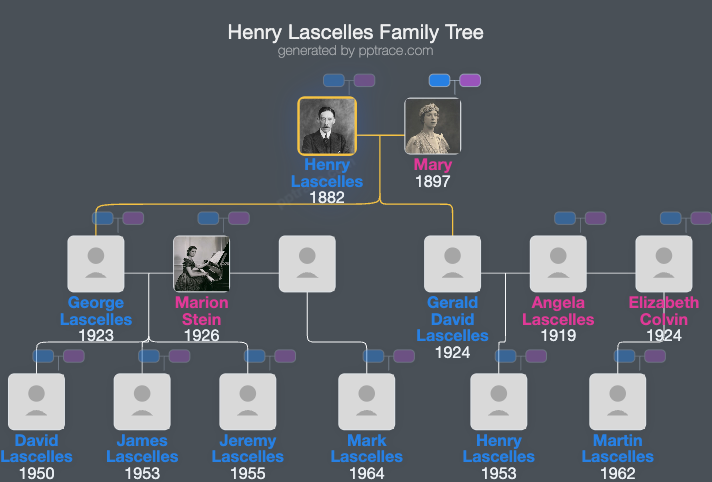
Lascelles married Princess Mary, daughter of King George V and Queen Mary, on 28 February 1922 at Westminster Abbey. Their marriage produced two children: George Henry Hubert Lascelles, who became the 7th Earl of Harewood, born in 1923, and Gerald David Lascelles, born in 1924. The family divided their time among several residences, including Chesterfield House in London, Goldsborough Hall, and Harewood House in Yorkshire.
His military career commenced after education at Eton College and the Royal Military College, Sandhurst. He was commissioned as a second lieutenant in the Grenadier Guards in 1902 and served until 1905. He served as an aide-de-camp in Canada and as an honorary attaché in Paris. With the outbreak of World War I, he joined the Yorkshire Hussars in 1913 and was promoted to lieutenant in 1914. He served on the Western Front, was wounded multiple times, participated in battles such as the Second Battle of Givenchy and Battle of Loos, and was awarded the Distinguished Service Order and the French Croix de Guerre. He achieved the rank of major and retired from active service in 1924.
Lascelles was involved in various public and voluntary roles after the war. He served as Lord Lieutenant of the West Riding of Yorkshire from 1927 until his death in 1947. He was president of the Yorkshire Rural Community Council and the Royal Agricultural Society of England (1929). He was also interested in equestrian pursuits, serving as Master of the Bramham Moor Hounds, as a steward of the Jockey Club, and as co-editor of the publication Flat Racing in 1940.
He held the office of Grand Master of the United Grand Lodge of England from 1942 until 1947. Politically, he contested the Keighley by-election in 1913 as a Conservative Unionist candidate but was not successful. He later became a member of the House of Lords upon inheriting his earldom.
Lascelles died of a heart attack at Harewood House on 24 May 1947 at the age of 64. He was interred in the family vault at All Saints' Church, Harewood. His estate was valued at approximately £1.4 million with about £800,000 in death duties payable.
His widow, Princess Mary, survived him until 1965. The estate's valuation and inheritance details were documented in probate. There is a scholarly belief that Virginia Woolf modeled the character of Archduke Henry in her novel "Orlando" on Lascelles, reflecting her romantic interest in him. He has been portrayed in modern media, such as the 2019 film "Downton Abbey," where he was played by Andrew Havill.
Lascelles received numerous honours, including the Knight of the Garter, Knight Grand Cross of the Royal Victorian Order, and foreign awards such as the Croix de Guerre, Grand Cross of the Order of Muhammad Ali (Egypt), and the Order of St. Olav (Norway). His arms and lineage trace back through notable aristocratic ancestors.