Richard Nixon
| Name | Richard Nixon |
| Title | President of the United States from 1969 to 1974 |
| Gender | Male |
| Birthday | 1913-01-09 |
| nationality | United States of America |
| Source | https://www.wikidata.org/wiki/Q9588 |
| pptrace | View Family Tree |
| LastUpdate | 2025-11-17T06:44:33.514Z |
Family Tree
Tap  to expand more relatives
Introduction
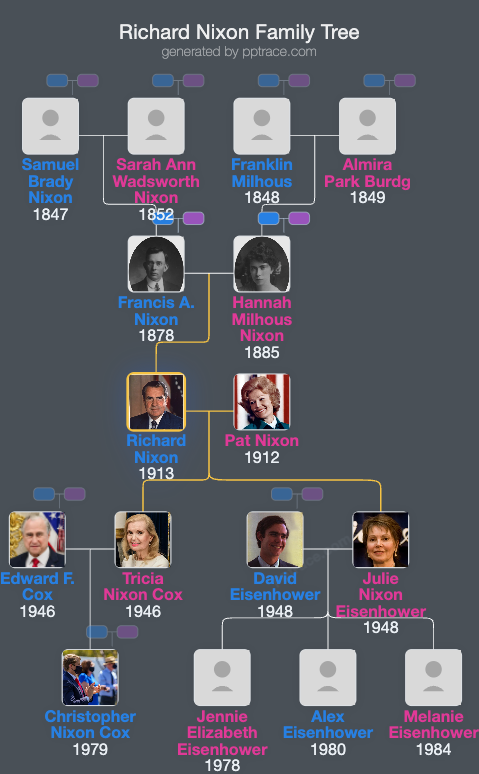
Richard Milhous Nixon was born on January 9, 1913, in Yorba Linda, California, to Francis A. Nixon and Hannah (Milhous) Nixon. His family was of Quaker faith, and his father was a Methodist who converted to Quakerism. Nixon's early childhood was marked by economic hardship; the family owned a lemon ranch that failed in 1922, prompting a move to Whittier, California. His upbringing was influenced by Quaker principles, including abstinence from alcohol, dancing, and swearing.
He had four brothers: Harold, Donald, Arthur, and Edward. Richard was named after Richard the Lionheart, one of his brothers after British monarchs. A childhood diagnosis of a lung scar from pneumonia and a family history of tuberculosis affected his participation in sports. He attended East Whittier Elementary School, where he served as president of his eighth-grade class. For high school, he transferred to Whittier High School, where he graduated third in his class of 207 students.
Nixon was offered a tuition scholarship to Harvard University but remained in California to care for his brother Harold, who suffered from tuberculosis. He enrolled at Whittier College in September 1930, where he played on the basketball team and was an active debater, founding the Orthogonian Society after being snubbed by an existing literary society. During college, he earned a Bachelor of Arts degree in history, graduating summa cum laude in 1934.
After college, Nixon attended Duke University School of Law, where he received a scholarship, was elected president of the Duke Bar Association, and graduated third in his class in June 1937. His academic performance was distinguished, and he was admitted to the bar in North Carolina and California.
In 1938, Nixon returned to California to practice law, opening a small legal office. In 1940, he married Pat Ryan, whom he had met in high school; they had two daughters, Patricia and Julie. Nixon's early career included work as a lawyer and a government investigator, leading to his service in the Naval Reserve during World War II.
His political career began with his election to the U.S. House of Representatives in 1946, representing California’s 12th congressional district. During his time in Congress, he gained recognition for his work on the Alger Hiss case, which established his reputation as a staunch anti-Communist. He was elected to the United States Senate in 1950.
In 1952, Nixon was selected as the Republican vice-presidential candidate alongside Dwight D. Eisenhower. He served as Vice President from 1953 to 1961, during which he increased the prominence of the vice presidency. After an unsuccessful bid for the presidency in 1960, Nixon announced his retirement from politics following a defeat in the 1962 California gubernatorial race. He re-entered the presidential race in 1968, won the election, and was inaugurated as the 37th President of the United States in 1969.
Throughout his presidency, Nixon implemented policies such as reducing U.S. involvement in Vietnam, fostering détente with the Soviet Union and China, and overseeing the Apollo 11 Moon landing. Domestic policy initiatives included establishing the Environmental Protection Agency and passing significant environmental laws, such as the Endangered Species Act and the Clean Air Act. He also enacted the Twenty-sixth Amendment, lowering the voting age to 18, and ended the gold standard by removing the dollar's direct convertibility to gold in 1971.
Nixon was re-elected in 1972 in a landslide victory. His second term included support for Israel during the Yom Kippur War and involvement in the Watergate scandal, which led to his resignation on August 9, 1974. Post-presidency, Nixon authored numerous books, traveled extensively, and engaged in diplomatic activities, gradually working to rehabilitate his public image. He suffered a stroke on April 18, 1994, and died four days later on April 22, 1994.