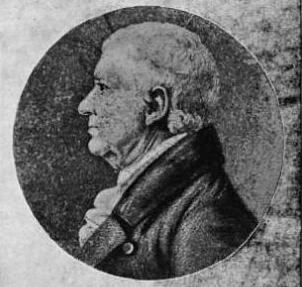
William Fitzhugh
| Name | William Fitzhugh |
| Title | American politician 1741-1809 |
| Gender | Male |
| Birthday | 1741-08-24 |
| nationality | United States of America |
| Source | https://www.wikidata.org/wiki/Q8009122 |
| pptrace | View Family Tree |
| LastUpdate | 2025-11-17T06:36:40.947Z |
Family Tree
Tap  to expand more relatives
Introduction
William Fitzhugh was born on August 24, 1741, in King George County, Virginia. He was a member of the First Families of Virginia, with his family tracing descent from Bardolph, Lord of Ravensworth, in Richmondshire during the time of William the Conqueror. His great-grandfather, William Fitzhugh (1650–1701), emigrated from England to Virginia around 1671, establishing Bedford plantation in the Northern Neck region. He was a lawyer and tobacco planter, and the first Fitzhugh to sit in the Virginia House of Burgesses in 1677. The family accumulated extensive land holdings, totaling approximately 54,000 acres at his death, mostly in Northern Virginia.
William Fitzhugh's familial connections included service in the House of Burgesses by his ancestors, notably his grandfather and father, both named William Fitzhugh, and his great-uncle Henry Fitzhugh, who served in the House of Burgesses representing Stafford County. His maternal lineage included Robert "King" Carter, Virginia’s largest landowner of the period, and his mother was a daughter of Carter, later marrying Colonel Nathaniel Harrison of "Brandon" in Prince George County, Virginia.
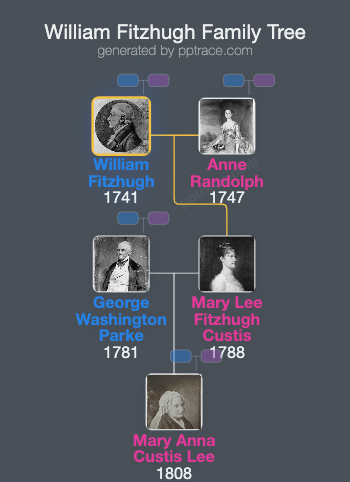
Fitzhugh received a private education typical of his social class. During childhood, he lost an eye due to an accident involving a horse riding crop. He married Ann Bolling Randolph (1747–1805), a member of another prominent Virginia family, daughter of Peter Randolph and Lucy Bolling, and a relative of Thomas Jefferson. They had several daughters, and their only son was William Henry Fitzhugh.
As a planter, Fitzhugh managed large estates in Virginia’s Northern Neck and northern suburbs of Washington, D.C., utilizing enslaved labor. In 1771, he completed Chatham Manor in Stafford County, where he engaged in experimental farming, horse breeding, and racing. He was a well-connected figure who maintained a close relationship with George Washington, serving together on the Pohick Church vestry and visiting frequently until Washington’s death in 1799. Fitzhugh was the last individual outside of Mount Vernon that Washington visited.
During the late 18th century, Fitzhugh’s landholdings included enslaved persons across several Virginia counties, as documented in the 1787 tax census. His residential moves included relocating from near Fredericksburg to Alexandria following the establishment of the national capital along the Potomac River. In Fairfax County, he acquired much of the estate of his cousin Col. Henry Fitzhugh and built Ravensworth mansion in 1796, which burned around 1925.
Around 1799, Fitzhugh purchased a house at 607 Oronoco Street in Alexandria, built in 1795 by John Potts Jr. His son, William Henry Fitzhugh, inherited the property and rented it to the Lee family, including Robert E. Lee.
In his political career, Fitzhugh served as a legislator first in the Virginia House of Burgesses from King George County between 1772 and 1775. After the American Revolution, he participated in Virginia’s revolutionary conventions and served in the Virginia House of Delegates representing Stafford County starting in 1777. From 1781 to 1785, he was a member of the Virginia Senate representing Westmoreland, Stafford, and King George Counties. His last term in the House of Delegates was in 1787–1788.
In 1797, Fitzhugh was a candidate for Virginia's 18th congressional district, and in 1789, he served as a presidential elector for Virginia’s electoral vote, casting one of ten votes for George Washington.
Fitzhugh's family connections included a daughter, Mary Lee Fitzhugh, who married George Washington Parke Custis in 1804; their daughter, Mary Anna Randolph Custis, married Robert E. Lee in 1831.
William Fitzhugh died on June 6, 1809, at the age of 69. He was initially buried at Ravensworth estate; following the destruction of the mansion, his remains were moved to the Pohick Church cemetery in Lorton, Virginia.