Sidney Wortley Montagu
| Name | Sidney Wortley Montagu |
| Title | English Member of Parliament (1650-1727) |
| Gender | Male |
| Birthday | 1650-07-28 |
| nationality | Kingdom of England |
| Source | https://www.wikidata.org/wiki/Q26212967 |
| pptrace | View Family Tree |
| LastUpdate | 2025-11-26T12:23:26.226Z |
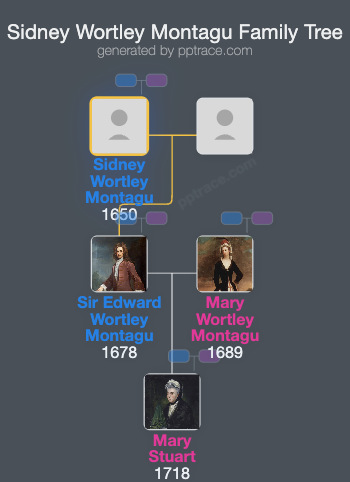
Family Tree
Tap  to expand more relatives
Introduction
Sidney Wortley Montagu was born on 28 July 1650 and died on 9 November 1727. His residences included Wortley in Yorkshire and Walcot in Northamptonshire. He was a British coal-owner and a politician affiliated with the Whig party. His parliamentary service spanned from 1679 to 1727, during which he served in both the English and later the British House of Commons. Although he was an active figure in the coal industry, his contributions in Parliament were limited.
He was the second son of Edward Montagu, 1st Earl of Sandwich, who was also a Member of Parliament, and his wife Jemima Crew, daughter of John Crew, 1st Baron Crew of Stene. As his father's favored child, Montagu received a more liberal education compared to his younger brothers. His early education took place at Twickenham under Dr. Fuller by 1660, followed by attendance at the académie du Plessis in Paris from 1662 to 1664. In 1665, he accompanied his father during the Battle of Vågen. Between 1666 and 1671, he traveled through Flanders, Germany, Italy, France, and Spain, where his father served as an envoy in 1667.
In 1675, Montagu became an ensign in the Royal Foot Guards, which later became part of the Grenadier Guards. Around 1676, he married Anne Newcomen, his father's ward, who was raised at Hinchingbrooke. She was the illegitimate daughter and heir of Sir Francis Wortley, 2nd Baronet of Wortley, Yorkshire, who died in 1666. Following his marriage, Montagu adopted the additional surname Wortley.
Montagu developed extensive mining interests in Durham and Northumberland, reportedly acquiring leases on episcopal lands through connections with Nathaniel Crew, Bishop of Durham.
Politically, Wortley Montagu's influence was primarily based on his family's standing in the Midlands. He was first elected as Member of Parliament for Huntingdon in February 1679, after a contested election. During the First Exclusion Parliament, he was a member of the committee of elections and privileges, but he did not speak publicly or participate in divisions on the exclusion bill. He held roles as Commissioner for assessment in Huntingdonshire and Huntingdon from 1679 to 1680. He was returned as MP for Huntingdon in the August 1679 election but remained inactive during the second Exclusion Parliament. In 1680, he served as Deputy Lieutenant for the West Riding for a year. He was returned again in February 1681 and participated in the third exclusion parliament's elections committee.
In the 1685 general election, after a brief canvass in Huntingdon, he withdrew from contesting. Initially disapproving of William of Orange's landing, Montagu supported the Glorious Revolution following reports of James II's army desertion. During this period, he participated in local military operations in Sheffield and signed a Yorkshire petition for a free Parliament.
He was returned as MP for Huntingdon at the 1689 Convention Parliament, supporting measures such as the disabling clause in bills related to restoring corporations. His wife converted to Roman Catholicism and went abroad; he obtained royal assent for a bill concerning maintenance for their children if his wife survived him.
Montagu held positions including Deputy Lieutenant for the West Riding from 1688, Justice of the Peace for Northamptonshire, and Commissioner for assessment across multiple counties. He was a trustee for his nephew Edward Montagu, 3rd Earl of Sandwich, which strengthened his electoral influence in Huntingdon. Between 1690 and 1715, he maintained a consistent presence in elections, often controlling at least one parliamentary seat for Huntingdon, despite internal disputes.
He remained an inactive Member in Parliament for much of his career, focusing on his business interests. He served as MP for Camelford in 1696 and later for Peterborough from 1698 onwards, representing the Whig interest. He supported the Whig Junto faction in early 1700, and participated in votes on various legislation, including naturalization bills and impeachment proceedings.
In 1710, he supported the impeachment of Henry Sacheverell. He experienced electoral defeats but was active in lobbying and coal trade interests, particularly as part of coal cartels. Notably, in 1710, he petitioned against legislation aimed at dissolving coal trade combinations, leveraging his influence within the industry.
Later, he served as joint High Steward of Northallerton and held other local offices. In 1713, he succeeded his son as Member for Huntingdon, maintaining influence in the borough. He supported the Whig government through subsequent elections and votes, including for the septennial bill in 1716.
His coal interests remained significant, and he was involved in forming the Grand Allies cartel in 1726, which dominated the coal trade for the remainder of the century.
Sidney Wortley Montagu died on 9 November 1727. His second son, Edward, inherited his coal holdings and estates. He also had grandchildren through his deceased son John and had two surviving daughters.