Lou Gao Lang
| Name | Lou Gao Lang |
| Title | Japanese bureaucrat and industrialist during the Meiji period, renowned for government service, cultural pursuits, and involvement in early Japanese industry. |
| Gender | Male |
| Birthday | — |
| nationality | Japan |
| Source | https://www.wikidata.org/wiki/Q108111587 |
| pptrace | View Family Tree |
| LastUpdate | 2025-11-27T11:16:14.794Z |
Family Tree
Tap  to expand more relatives
Introduction
Rokutaka Akira (born August 8, 1847 (Kōka 4), died at an unknown date) was a Japanese bureaucrat and industrialist of the Meiji period. His family register was noted as Tokyo Prefecture samurai class. His courtesy name was Atsusaburō.
He was born as the third son of Yanagon Yōan, a physician serving the Omura Domain in Hizen Province. At the age of 11, he succeeded his uncle's Rokuke family. The Rokuke family was originally of Ming descent and had historically served as Chinese interpreters in Nagasaki. In 1859 (Ansei 6), following the death of his adoptive father Norijirō, Rokutaka was appointed to serve as a Chinese interpreter. Training for interpreters included Chinese (Nanjing pronunciation) and classical Chinese studies, with English added due to contemporary demands. He studied Chinese under Zheng Gǎnfǔ and Ujūjirō (later Zheng Yǒngníng), as well as under Yingchuan Bōzō and Takao Kazusaburō. For English, he learned from Hirai Gijūrō (Kishō) and He Lìzhīnuò, and also studied English with Guido Frubeck and Channing Williams (founder of Rikkyo University).
After the Meiji Restoration, Rokutaka began serving in Hyōgo Prefecture, then transferred to the Ministry of Finance's Tax Bureau. Subsequently, he was appointed to an administrative role in Kanagawa Prefecture, and later rejoined the Ministry of Finance's Customs Bureau. During the Japanese expedition to Taiwan in 1874 (Meiji 7), he was appointed as a seventh-rank military steersman in the Army Ministry and accompanied Tōkoku Saigō, the Taiwan Governor, handling administration in the southern regions. He temporarily returned to Japan due to illness but rejoined the Ministry of Finance the following year, receiving a service citation for his contributions to the Taiwan expedition.
In 1881 (Meiji 14), he was awarded the Junior Sixth Court Rank and was appointed as a secretary in the Ministry of Finance. In 1884 (Meiji 17), he received the Single Guangxu Emperor Order. The following year, 1885 (Meiji 18), he received the Constitution Proclamation Commemorative Medal, was promoted to Grand Secretariat, and was awarded the Sixth Rank, Sixth Class of the Order of the Rising Sun, and the Order of the Sacred Treasure. In 1892 (Meiji 25), he resigned due to health reasons.
After resigning, he engaged in management as president of the Tokyo Shimbun, served as a director of the North and East Petroleum Company (later New Japan Petroleum, now ENEOS), a representative partner of Hakodate Land, and an auditor for Hakata Bay Railway and Steamship.
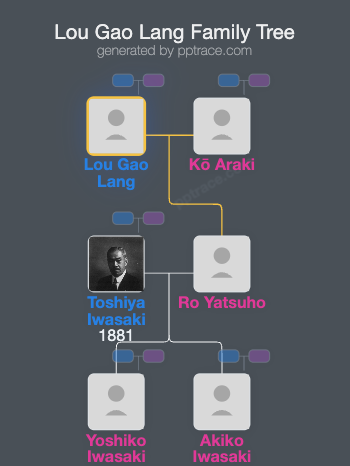
In his personal life, he was fond of calligraphy, painting, and collecting antiques. His wife, Kō (from Nagasaki, eldest daughter of Araki Shōzō), his eldest son, Sadekichi (owner of Kashima Randen Hall), daughters Wato (from Nagasaki, wife of Araki Shunjirō), and Shigee (wife of Narukawa Naoyoshi, eldest son of Narukawa Yōtarō), fifth and sixth daughters (including Hachihō, wife of Iwasaki Shunya), and his grandson Yoshio, are known.
【Notes and references are omitted as they are not included in the original text】