Jian Chengyan
| Name | Jian Chengyan |
| Title | Cili wealthy merchant |
| Gender | - |
| Birthday | 1871-01-01 |
| nationality | — |
| Source | https://baike.baidu.com/item/蹇承晏/20866813 |
| pptrace | View Family Tree |
| LastUpdate | 2025-10-01T11:02:38.116Z |
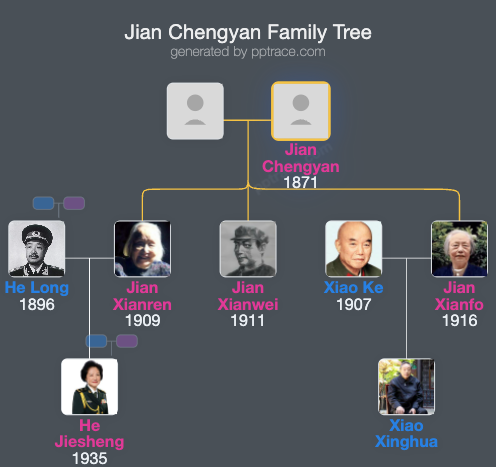
Family Tree
Tap  to expand more relatives
Introduction
Jian Chengyan, whose date of birth is unknown, was an outstanding figure in modern Chinese history who paid close attention to national affairs and cared deeply about the fate of the people. According to historical records, he possessed profound insight into the country's future and security, and actively supported his children in devoting themselves to revolutionary causes. Among Jian Chengyan's family members, four of his children participated in the Chinese revolutionary activities.
His eldest son, Jian Xian, was highly active in the revolutionary cause and sacrificed himself in 1932 in the Hunan-Hubei Western Soviet Area. In the context of China's revolutionary history at the time, Hunan-Hubei Western Soviet was an important base and center of revolution led by the Chinese Communist Party. Jian Xian's sacrifice reflected his determination and pursuit in the revolution. His second son, Jian Xianchao, died in 1936 during the Long March on the Qinghai-Tibet Plateau. The Long March was a strategic withdrawal by the Chinese Communist Party and the Red Army to escape enemy encirclement, demonstrating Jian Xianchao's spirit of sacrifice in challenging circumstances.
His daughter, Jian Xianren, joined the revolution in 1927—earlier than her brother's time of sacrifice—showing the family's early commitment to the revolutionary cause. Her participation indicates the family's support for the national and ethnic liberation efforts. Another daughter, Jian Xianfo, joined the Red Army in 1934, continuing the family’s revolutionary tradition.
The revolutionary activities of Jian Chengyan and his family members reflect their significant role in China's revolutionary history and their contributions to the cause of national independence and ethnic liberation. To this day, detailed accounts of their specific deeds and individual stories remain part of historical memory, and their personal contributions have become an important component of the study of China’s revolutionary history.