William Rickman
| Name | William Rickman |
| Title | American political leader (died 1783) |
| Gender | Male |
| Birthday | 1731-00-00 |
| nationality | United States of America |
| Source | https://www.wikidata.org/wiki/Q8017571 |
| pptrace | View Family Tree |
| LastUpdate | 2025-11-16T10:07:33.457Z |
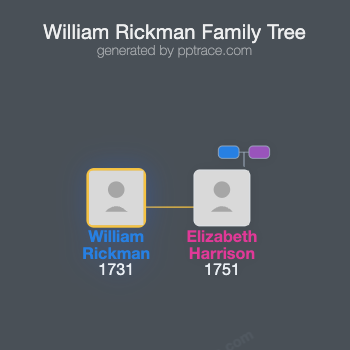
Family Tree
Tap  to expand more relatives
Introduction
William Rickman (circa 1731 – 1783) was an American medical figure notable for his service during the American Revolutionary War. He served as the Director and Surgeon of the Continental Hospital of the Continental Army in Virginia and is recognized as the first overseer of the Continental Army hospitals in the state.
Born in England, Rickman was the son of Robert Rickman (1683–1743) and Tamar Reynolds (1684–1779). His early career included serving as a surgeon aboard the Royal Navy ship HMS Launceston until approximately October 16, 1769, after which he sailed from Sheerness, England, to the Virginia Capes. Following his naval service, Rickman settled in Charles City County, Virginia, in 1769, where he established a medical practice. In addition to his medical work, he held the position of justice of the peace in Charles City County and was recognized as a patriot.
On May 5, 1775, Rickman married Elizabeth "Betsey" Harrison (1751–1791), daughter of Benjamin Harrison V, a signer of the Declaration of Independence and owner of Berkeley Plantation. Elizabeth was the elder sister of William Henry Harrison, who later became the ninth President of the United States. According to records from the National Park Service, Sons of the American Revolution (SAR), and Daughters of the American Revolution (DAR), William Rickman did not have known descendants. His association with the Kittiewan Plantation House makes him the first recorded owner of what was later known as Kittiewan House Plantation.
During the burgeoning conflicts leading to independence, Rickman engaged with revolutionary activities. He attended meetings in Williamsburg discussing American liberties and served on committees including one for Charles City County. His medical expertise was called upon during military engagements; notably, he treated a wounded soldier in April 1776 at Sandy Point, which resulted in a medical bill of £16.13.3, raising concerns about the funding of military medical care.
Rickman was appointed as a physician to the Continental troops in Virginia, receiving his appointment on May 18, 1776, with a recommendation from Benjamin Harrison and an official signature from John Hancock. His role included serving as the Director and Surgeon of the Continental Hospital system in Virginia. He was also designated deputy director of hospitals for the Southern Department. Rickman participated in efforts to establish suitable hospital facilities, including a temporary hospital in Williamsburg and a hospital outside Williamsburg at Vineyard, operational by May 1779.
Throughout his service, Rickman was involved in decision-making regarding hospital locations and administration, often facing logistical challenges and the need for resource management. His health declined during the war, and he requested retirement in April 1780. By the latter part of his service, there were criticisms regarding the organization of hospitals; William Brown, reporting to General George Washington, noted that Rickman favored general hospitals with sick and wounded patients housed together, which Brown considered less efficient than segregated treatment. Brown also expressed concerns about logistical issues, such as the delayed delivery of supplies for the troops due to inadequate record-keeping.
William Rickman died in 1783. His burial place or exact date of death is not specified in the available records.