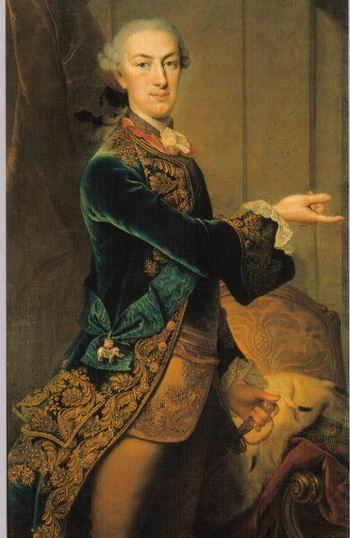
William I, Elector Of Hesse
| Name | William I, Elector Of Hesse |
| Title | Landgrave of Hesse-Kassel 1785 – 1821 |
| Gender | Male |
| Birthday | 1743-06-03 |
| nationality | Q529605 |
| Source | https://www.wikidata.org/wiki/Q506216 |
| pptrace | View Family Tree |
| LastUpdate | 2025-11-12T01:15:39.972Z |
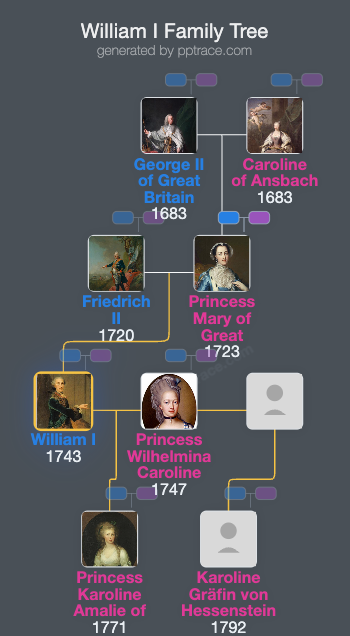
Family Tree
Tap  to expand more relatives
Introduction
William I, Elector of Hesse (German: Wilhelm I., Kurfürst von Hessen), was born on June 3, 1743, in Kassel, in the Holy Roman Empire. He was the eldest surviving son of Frederick II, Landgrave of Hesse-Kassel, and Princess Mary of Great Britain, daughter of King George II of Great Britain. William died on February 27, 1821, in Kassel.
Early Life
William belonged to the House of Hesse. His father’s marriage to Princess Mary was troubled; Frederick II abandoned the family in 1747 and converted to Catholicism in 1749, leading to an annulment of their marriage in 1755. Following this, William's grandfather, Landgrave William, granted the county of Hanau to William’s mother and her children. As a result, William was technically the reigning prince of Hanau during his early years, with regency administered by his mother. Between 1747 and 1751, William and his brothers resided with their mother, the landgravine Mary, and were supported by Protestant relatives, moving to Denmark after 1747 and living with Princess Mary’s sister Louise of Great Britain until her death in 1751.
Marriage and Family
On September 1, 1764, William married his first cousin, Wilhelmina Caroline of Denmark and Norway, daughter of King Frederick V of Denmark and Norway. The marriage took place at Christiansborg Palace, and the couple resided primarily in Denmark for approximately two decades. In 1785, upon inheriting the landgraviate from his father, William moved to Kassel. Before becoming landgrave, William was granted the Principality of Hanau, which he inherited after the extinction of its ruling family; however, this territory was predominantly Catholic, which was unpopular among the largely Protestant population.
William and Wilhelmina Caroline had four children:
- Marie Friederike (1768–1839), married Duke Alexius Friedrich Christian of Anhalt-Bernburg
- Karoline Amalie (1771–1848), married Duke Augustus of Saxe-Gotha-Altenburg
- Friedrich (1772–1784), died in childhood
- Wilhelm (1777–1847), succeeded William as landgrave
Reign
William became Landgrave of Hesse-Kassel on October 31, 1785, following the death of his father. At that time, he was reputed to have inherited extensive wealth, one of the largest fortunes in Europe. In 1769, he engaged Mayer Amschel Rothschild as his "Hoffaktor" to oversee estates and tax collection, establishing the foundation for the Rothschild family's banking dynasty. Their relationship, formalized in 1801, was instrumental in financing efforts during the Napoleonic Wars, including efforts to obscure the extent of William’s wealth from Napoleon.
In 1803, William was elevated to the title of His Royal and Serene Highness The Prince-Elector of Hesse. His territory was annexed by the Kingdom of Westphalia in 1807 under Napoleon's brother, Jérôme Bonaparte. William fled to Denmark with his family and resided in exile until the defeat of Napoleon. Following the Battle of Leipzig in 1813, he was restored to his position. Subsequently, he initiated construction of the Chattenburg Palace in Kassel, which was not completed before his death.
Political and societal involvement included membership in the Tugendbund, a quasi-Masonic secret society founded after the 1808 Battle of Jena–Auerstedt. He attempted to declare himself King of the Chatti but was denied recognition at the Congress of Aix-la-Chapelle (1818). Instead, he retained the style of grand duke as "Royal Highness." Despite the dissolution of the Holy Roman Empire in 1806 and the subsequent political landscape, William chose to retain the title of Elector, although Hesse-Kassel was never elevated to a kingdom and remained an Electorate until annexed by Prussia in 1866.
William I ruled until his death in 1821. He was succeeded by his son, Wilhelm.
Illegitimate Children
William fathered numerous illegitimate children with various mistresses, providing financial support to over twenty recognized offspring. These children included Wilhelm von Heimrod and Karl von Heimrod with Charlotte Christine Buissine, and several others with Rosa Dorothea Ritter and Karoline von Schlotheim. Among his known illegitimate offspring was Colonel João Guilherme Resse, linked to the engineer Johann Heinrich Resse.
Ancestry
William's paternal lineage traces back to the House of Hesse, while his maternal lineage includes British royal connections through his mother, Princess Mary of Great Britain.