George Fitzwilliam
| Name | George Fitzwilliam |
| Title | British Member of Parliament (1757-1786) |
| Gender | Male |
| Birthday | 1757-02-28 |
| nationality | Great Britain |
| Source | https://www.wikidata.org/wiki/Q26857635 |
| pptrace | View Family Tree |
| LastUpdate | 2025-11-26T12:25:43.959Z |
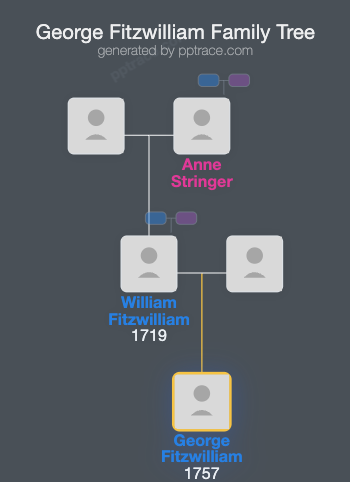
Family Tree
Tap  to expand more relatives
Introduction
George Fitzwilliam was born on 28 February 1756 and died on 6 May 1786. He was a member of the British Parliament during the late 18th century. Fitzwilliam was the younger son of William Fitzwilliam, 3rd Earl Fitzwilliam, and his wife Anne. Anne was the sister of Charles Watson-Wentworth, the 2nd Marquess of Rockingham.
His education included attendance at Eton College and Trinity Hall, Cambridge. Following his schooling, he served in the 1st Troop of Horse Grenadier Guards, a regiment of the British Army.
In selecting parliamentary candidates, his familial connections played a role. His brother, William Fitzwilliam, the 4th Earl Fitzwilliam, proposed him as a candidate for the constituency of Grimsby at the general election in 1780. However, his uncle, Charles Watson-Wentworth, the 2nd Marquess of Rockingham, declined to provide financial support for the campaign. Subsequently, Fitzwilliam was elected as a Member of Parliament for Richmond in a by-election, a seat he obtained through replacing Sir Lawrence Dundas. Fitzwilliam's sister, Charlotte, was married to Thomas Dundas, son of Sir Lawrence Dundas, establishing a familial connection to the previous MP.
During his tenure in the House of Commons, Fitzwilliam is recorded to have voted against parliamentary reform in May 1783. His political stance and voting record influenced his brother Lord Fitzwilliam’s decision not to nominate him for the constituency of York in subsequent elections, including a by-election later in 1783 and the general election of 1784. Following these events, Fitzwilliam's career in Parliament ended, and he left the House of Commons. There are no records indicating that he made any speeches during his time as an MP.
Fitzwilliam remained unmarried at the time of his death. He passed away two years after leaving Parliament, in 1786.