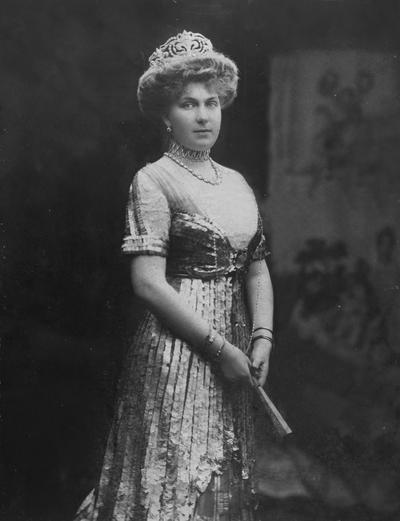
Victoria Eugenie Of Battenberg
| Name | Victoria Eugenie Of Battenberg |
| Title | Queen consort of Spain (1887-1969) |
| Gender | Female |
| Birthday | 1887-10-24 |
| nationality | United Kingdom |
| Source | https://www.wikidata.org/wiki/Q160001 |
| pptrace | View Family Tree |
| LastUpdate | 2025-11-12T01:18:00.450Z |
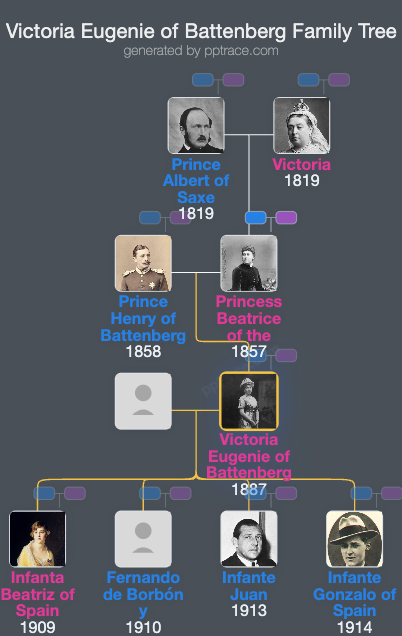
Family Tree
Tap  to expand more relatives
Introduction
Victoria Eugenie Julia Ena of Battenberg was born on 24 October 1887 at Balmoral Castle in Aberdeenshire, Scotland. She was the youngest granddaughter of Queen Victoria and Prince Albert of Saxe-Coburg and Gotha. Her father was Prince Henry of Battenberg, the fourth child and third son of Prince Alexander of Hesse and Julia, Princess of Battenberg. Her mother was Princess Beatrice, the fifth daughter of Queen Victoria and Prince Albert. Ena belonged to the Battenberg family, a morganatic branch of the House of Hesse-Darmstadt. She was born with the rank of Highness due to a Royal Warrant issued by Queen Victoria in 1886, which elevated her family’s status from Serene Highness to Highness. She was baptized in the Drawing Room at Balmoral, with multiple royal and European nobles as godparents.
Her early childhood was spent within Queen Victoria's household, and she was raised in Windsor Castle, Balmoral, and Osborne House on the Isle of Wight. When she was six, she suffered a severe concussion after being thrown from her pony at Osborne, which was closely monitored by Queen Victoria’s physicians. Ena was close to her grandmother, Queen Victoria, who described her as "the little treasure." Her father died in 1896 while on military service in Africa. After Queen Victoria's death in 1901, Ena’s family moved to Kensington Palace in London.
In 1905, during a visit to the United Kingdom by King Alfonso XIII of Spain, Ena caught his attention at a dinner hosted by her uncle, King Edward VII. Alfonso and Ena's courtship developed, despite objections from Alfonso’s mother, Queen Maria Christina, who preferred that her son marry within the Spanish aristocracy and had reservations about Ena's morganatic family background and religion. Alfonso was Roman Catholic, while Ena was Anglican; she also faced concerns regarding hemophilia, a hereditary disease in Queen Victoria’s descendants. Despite these obstacles, Alfonso persisted in his interest.
The marriage was officially agreed upon in 1906. A treaty between Spain and the United Kingdom was signed in London, stipulating the marriage and Ena’s subsequent renunciation of British succession rights due to her conversion to Roman Catholicism. The treaty included financial provisions for Ena's support and explicitly stated her forfeiture of British hereditary rights, reflecting her conversion’s impact on her status in Britain. Ena converted to Catholicism in March 1906 at Miramar Palace in San Sebastián. Her marriage to King Alfonso XIII took place on 31 May 1906 at the Royal Monastery of San Jerónimo in Madrid.
Shortly after their wedding, an assassination attempt known as the Morral affair occurred, in which anarchist Mateu Morral threw a bomb at the royal carriage, but Ena was unharmed as she turned her head at the moment of the explosion.
Ena became Queen of Spain from her marriage until the proclamation of the Second Spanish Republic on 14 April 1931. Her life as queen was marked by the birth of seven children, including the heir apparent, Alfonso, Prince of Asturias, who inherited hemophilia, which Ena also carried. Her relationship with King Alfonso XIII deteriorated over time amid reports of infidelity and her disapproval of certain Spanish customs like bullfighting. Ena engaged in charitable work, particularly with hospitals and the Spanish Red Cross, and was honored with various orders and decorations, including the Golden Rose by the Pope and the Order of Queen Maria Luisa.
Following the fall of the monarchy, Ena and her family went into exile in France and Italy, residing in Lausanne, Switzerland, among other locations. She attended the baptism of her grandson Juan Carlos in Rome in 1938. Her husband, Alfonso XIII, died in 1941, and Ena was compelled to leave Italy in 1942 due to political issues. She returned briefly to Spain in 1968 to serve as godmother at a royal baptism. Ena died in Lausanne on 15 April 1969 at aged 81. Her remains were initially interred in Lausanne and later re-interred in the Royal Vault at the Royal Monastery of San Lorenzo de El Escorial near Madrid.