Mary Gladstone
| Name | Mary Gladstone |
| Title | Daughter of William Gladstone |
| Gender | Female |
| Birthday | 1847-01-01 |
| nationality | United Kingdom |
| Source | https://www.wikidata.org/wiki/Q6779642 |
| pptrace | View Family Tree |
| LastUpdate | 2025-11-26T23:30:16.261Z |
Family Tree
Tap  to expand more relatives
Introduction
Mary Drew (née Gladstone), born on 23 November 1847 and deceased on 1 January 1927, was a British political secretary, writer, and hostess. She was the daughter of William Ewart Gladstone, who served as the Prime Minister of the United Kingdom. Drew is notably recognized for her role as an advisor, confidante, and private secretary to her father, as well as for gaining some political influence through controlling access to him.
Family Background:
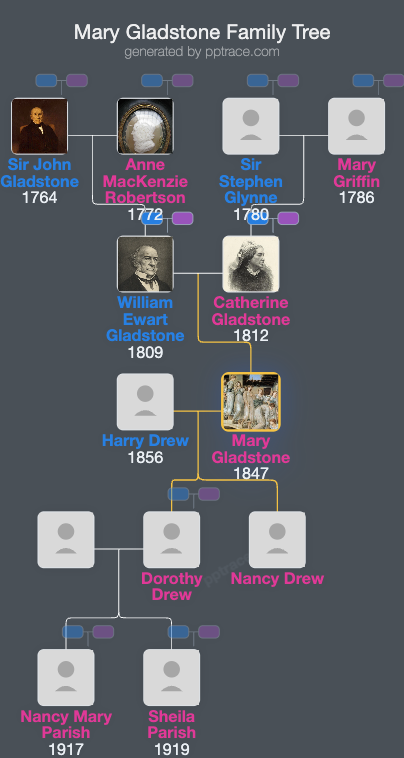
The Gladstone family was characterized by its size and eccentricity. Her mother was Catherine Glynne, and her maternal aunt was Mary, Lady Lyttelton. Both women married on the same day in the same church and often housed their large families together. Lord Lyttelton, her uncle, described the household as lively, noting "seventeen children upon the floor, all under the age of twelve, and consequently all inkstands, books, carpets, furniture, ornaments, in intimate intermixture and in every form of fracture and confusion." The family included seven Gladstone children and twelve Lyttelton children.
William Ewart Gladstone’s social and political activities included significant efforts, such as his work aiding prostitutes in London, which was considered controversial at the time. His sister’s radical religious conversion to Roman Catholicism and subsequent behavior, including using Protestant tracts as lavatory paper, further distinguished the family’s unconventional reputation.
Mary Gladstone's upbringing was affluent but unconventional. She and her sister Helen, who was also privileged, had a personal maid, Auguste Schlüter. Gladstone, characterized by her studious nature, was her father’s favorite among his children. Despite her academic limitations, her resourcefulness earned her the nickname “Von Moltke.” She experienced unreciprocated romantic infatuations and ultimately accepted her life as a spinster.
Political Career:
In 1880, when her father was beginning his third term as Prime Minister at age seventy, Gladstone appointed her as one of his Downing Street secretaries. This position positioned her as an influential figure within political circles, serving as the primary gatekeeper to her father.
Marriage:
On 2 February 1886, at age 38, Gladstone married Reverend Harry Drew, a curate of Hawarden who was ten years her junior. Their wedding took place at St. Margaret’s Church, Westminster, with attendees including the Prince and Princess of Wales, their sons, and Lord Rosebery. The couple initially resided at Hawarden Castle, her family estate. They had one surviving daughter, Dorothy Mary Catherine Drew, born on 11 March 1890, known as “Dossie,” who was particularly favored by her grandfather.
Later Life and Decline in Influence:
Following William Ewart Gladstone’s retirement from the office of Prime Minister in 1894, Mary Gladstone’s political influence diminished. Although she maintained close friendships with Lord Rosebery, her capacity to influence political affairs was limited thereafter.
Diaries and Personal Writings:
Gladstone was a diligent diarist, meticulously recording her father’s meetings and her own observations of political events in the late 19th century. Her collection of diaries and letters, collectively known as "The Mary Gladstone Papers," has been a valuable resource for biographers. Some of her writings, including her diaries and letters, were published by Lucy Masterman in 1930 under the title "Mary Gladstone (Mrs. Drew), Her Diaries and Letters." Her diaries served as both a record of events and a personal emotional outlet. Notably, her journaling decreased after her marriage, with a seven-year hiatus between 1904 and 1911, resuming only after her husband's death.
Her writing style was marked by her eccentric grammar, including the use of long dots as periods. Masterman edited her published diaries to remove some personal idiosyncrasies and banal entries, preserving only portions deemed suitable for publication.
References:
Her life and work have been documented in various biographies and studies, including Sheila Gooddie’s 2003 biography "Mary Gladstone: A Gentle Rebel," and Phyllis Weliver’s 2017 work "Mary Gladstone and the Victorian Salon: music, literature, liberalism."