John Aspinwall Roosevelt
| Name | John Aspinwall Roosevelt |
| Title | American businessman, son of Franklin D. Roosevelt (1916-1981) |
| Gender | Male |
| Birthday | 1916-03-13 |
| nationality | United States of America |
| Source | https://www.wikidata.org/wiki/Q6219636 |
| pptrace | View Family Tree |
| LastUpdate | 2025-11-29T01:01:06.728Z |
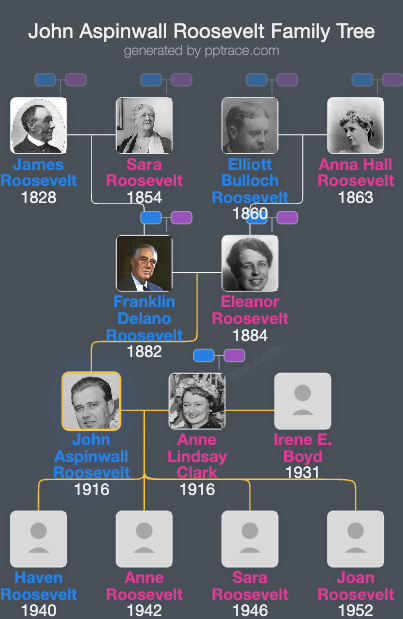
Family Tree
Tap  to expand more relatives
Introduction
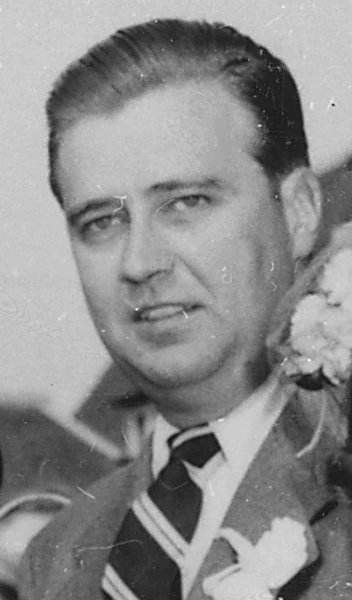
John Aspinwall Roosevelt II was born on March 13, 1916, and died on April 27, 1981. He was an American businessman and the sixth and last child of Franklin D. Roosevelt, the 32nd President of the United States, and Eleanor Roosevelt.
Early Life and Education
Roosevelt was the youngest child in his family. His surviving siblings included Anna Eleanor Roosevelt, James Roosevelt II, Elliott Roosevelt, and Franklin D. Roosevelt, Jr. He grew up on the Roosevelt estate in Hyde Park, New York. His early education included attendance at The Buckley School and Groton School.
Family Dynamics
Roosevelt's relationship with his parents was influenced by multiple factors. While he and his next oldest sibling, Franklin Jr., were close to their mother, Eleanor Roosevelt, others suggest that his father's disability resulted in less emotional connection with his parents compared to his older siblings. Family members noted that Roosevelt was considered the son least like his father both politically and personally. Biographer James Roosevelt observed that John had a "smoothest, least exciting life" among the siblings and was "the most thoughtful and businesslike."
Impact of Paralyzing Illness
When Roosevelt was five years old, Franklin D. Roosevelt contracted a paralytic illness, which confined him to a wheelchair. Eleanor Roosevelt, aware of her husband's condition, actively sought to provide physical activities for her children, including swimming, skating, camping, and traveling to Europe.
Pre-World War II Activities
Before the onset of World War II, Roosevelt's activities included working in the forests of Tennessee for the Tennessee Valley Authority during his junior year at Harvard University. A biography noted that he believed in the influence and connections over personal achievement, although this was considered more appropriate for other family members. After graduating from Harvard, he worked at Filene's Department Store in Boston.
Military Service
On the eve of World War II, Roosevelt initially sought conscientious objector status but ultimately joined the U.S. Navy, serving from 1941 to 1946. He was commissioned as an ensign and served on the aircraft carrier USS Wasp, achieving the rank of lieutenant commander and earning the Bronze Star.
Postwar Career and Business Activities
Following the war, Roosevelt worked in California as the Regional Merchandising Manager for Grayson & Robertson Stores in Los Angeles. In 1953, he became a partner in a Beverly Hills financial company but soon returned to Hyde Park to reside at the family estate. He was involved in various business ventures, including representing Haitian dictator François "Papa Doc" Duvalier during the 1950s and serving as a public relations consultant for Haiti.
Political and Public Service
Although Roosevelt did not pursue elected office, he served on multiple organizational boards, including the Boy Scouts of America, the Eisenhower Exchange Fellowship, Roosevelt University, the State University of New York, and the Governmental Affairs Committee. His political affiliation changed from Democratic to Republican in 1947, and he supported Dwight D. Eisenhower's presidential campaign in 1952, which led to familial disagreements.
Family Relations and Later Life
Roosevelt's residence near Eleanor Roosevelt’s Val-Kill estate allowed her to live there until her death in 1962. He maintained the papers from her Hyde Park and New York residences after her passing. His association with his family, especially his brother Elliott, was strained at times. Roosevelt's presence in Hyde Park facilitated Eleanor Roosevelt’s residence there until her death.
Uranium Industry Involvement
During the Cold War, Roosevelt became an officer and director of the Standard Uranium Company, one of the first publicly traded uranium companies, registered in 1954. He also partnered with Benjamin Swig and Louis B. Mayer in uranium investments in Utah.
Later Years and Philanthropy
In 1956, Roosevelt began consulting for Bache & Company, eventually becoming a vice-president before retiring in 1980. His philanthropic efforts included fundraising for the National Foundation for Infantile Paralysis and serving on the boards of various organizations. After Eleanor Roosevelt's death, he divorced and remarried; he sold the Val-Kill properties in 1970 and moved to an estate in Tuxedo, New York.
Personal Life
Roosevelt’s middle name, Aspinwall, was derived from his great-grandmother, Mary Rebecca Aspinwall. He married Anne Lindsay Clark on June 18, 1938, with whom he had four children: Haven Clark Roosevelt, Anne Sturgis "Nina" Roosevelt, Sara Delano "Sally" Roosevelt, and Joan Lindsay Roosevelt. The marriage ended in divorce in 1965. Subsequently, Roosevelt married Mrs. Irene Boyd McAlpin.
Death and Burial
John Aspinwall Roosevelt II died of heart failure in 1981 and was buried in Saint James Episcopal Churchyard.