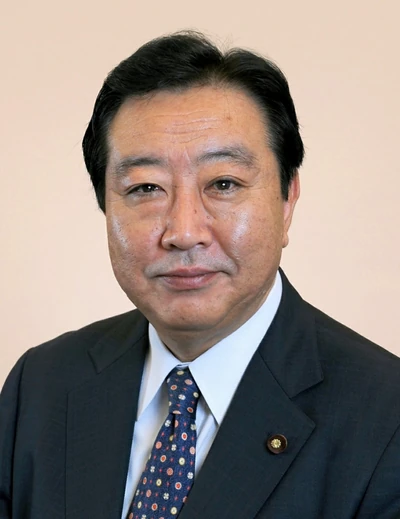
Yoshihiko Noda
| Name | Yoshihiko Noda |
| Title | Prime Minister of Japan from 2011 to 2012 |
| Gender | Male |
| Birthday | 1957-05-20 |
| nationality | Japan |
| Source | https://www.wikidata.org/wiki/Q57647 |
| pptrace | View Family Tree |
| LastUpdate | 2025-11-17T06:48:50.095Z |
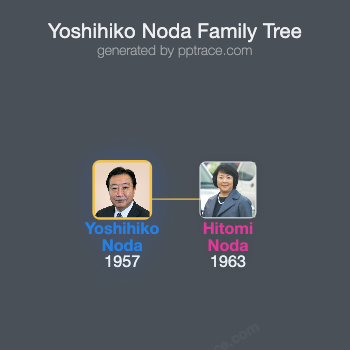
Family Tree
Tap  to expand more relatives
Introduction
Yoshihiko Noda (野田 佳彦, Hepburn: Noda Yoshihiko) was born on May 20, 1957, in Funabashi, Chiba Prefecture, Japan. He is a Japanese politician who has been a member of the House of Representatives since 2000. As of 2023, he is the leader of the Constitutional Democratic Party of Japan (CDP). Noda served as the Prime Minister of Japan from September 2, 2011, to December 26, 2012.
Early Life and Education
Noda's father was a paratrooper in the Japan Self-Defense Forces. Unlike many Japanese politicians, he has no family connections to Nagatachō, the center of political power in Japan. His parents had limited financial means and were unable to host a wedding reception. Noda graduated from Chiba Prefectural Funabashi Senior High School in 1975. He then attended Waseda University, where he obtained a Bachelor of Arts degree in Political Science in 1980. Subsequently, he was accepted into the Matsushita Institute, founded by Kōnosuke Matsushita, the founder of Panasonic, with the purpose of developing future civic leaders in Japan.
While attending the Matsushita Institute, Noda worked part-time as a household gas meter reader in Chiba Prefecture to better understand his future constituents. In 1987, at the age of 29, Noda was elected to the assembly of Chiba Prefecture.
Political Career
Noda entered national politics in 1993, when he was elected to the Japanese Diet as one of four members representing Chiba 1st district, as a member of the Japan New Party, which was later dissolved. Following electoral reforms in 1994 that abolished multi-member districts, he contested the Chiba 4th district in the 1996 elections but was defeated. He subsequently joined the Democratic Party of Japan (DPJ), successfully contesting Chiba 4th district in the 2000 election.
Within the DPJ, Noda held positions such as its Diet affairs chief and head of public relations. In October 2005, he publicly criticized Prime Minister Jun'ichirō Koizumi's stance on Japanese Class A war criminals but supported Koizumi's visits to Yasukuni Shrine. During the DPJ's control of the Diet following the 2009 general election, Noda served as senior vice finance minister under Prime Minister Yukio Hatoyama. In June 2010, he was appointed Minister of Finance under Prime Minister Naoto Kan, a role in which he promoted fiscal conservatism and efforts to reduce Japan's public debt.
As finance minister, Noda was involved in foreign exchange interventions for the first time in six years, purchasing over 2 trillion yen worth of dollars in January 2011 to counteract the yen's appreciation.
Prime Ministership
Following the resignation of Naoto Kan in August 2011, Noda was elected leader of the DPJ after a runoff against Banri Kaieda, thereby becoming the Prime Minister. His tenure was marked by managing the aftermath of the 2011 Tōhoku earthquake and tsunami. During his leadership campaign, Noda gave a speech likening himself to a dojo loach, a bottom-feeding fish, emphasizing his working-class background and his commitment to diligent effort.
Noda prioritized Japan's security alliance with the United States and aligned himself with U.S. foreign policy interests. On the 66th anniversary of Japan's surrender in World War II, he stated that Japanese Class A war criminals convicted by the Allies were not legally war criminals under his view, aligning with previous administrations' stances.
Nuclear policy remained a key issue during Noda's premiership; he confirmed Japan's ongoing phase-out of nuclear power, refraining from building new plants or extending the operation of existing ones, although some reactors were restarted in 2012 to meet energy demands.
Another significant initiative was Japan's participation in negotiations for the Trans-Pacific Partnership (TPP), announced in November 2011. His government also dealt with the territorial dispute over the Senkaku Islands, where the Tokyo Metropolitan Government aimed to purchase the islands from private owners, a move opposed by China and criticized by Noda. In September 2012, the Japanese government purchased the islands from private owners, asserting sovereignty, which elicited objections from China.
Economically, Noda promoted an increase in Japan's consumption tax from 5% to 10%. The legislative process for this tax hike involved political negotiations and survival through a no-confidence vote in August 2012. He pledged to call an early election afterward and stated that he would resign if he failed to pass the tax increase.
Resignation and Post-Premiership
The 2012 general election resulted in a decisive loss for the DPJ. Noda announced his resignation as party leader in December 2012. He was succeeded as Prime Minister by Shinzo Abe of the Liberal Democratic Party on December 26, 2012.
Following the dissolution of the DPJ's political grouping and mergers within opposition parties, Noda became an independent. He later joined the Constitutional Democratic Party of Japan (CDP) in 2021. In 2024, Noda was elected as the president of the CDP, defeating incumbent leader Kenta Izumi and former leader Yukio Edano.
Under Noda's leadership, the CDP achieved its best electoral result in history during the 2024 Japanese general election, reducing the ruling Liberal Democratic Party's coalition to a minority.