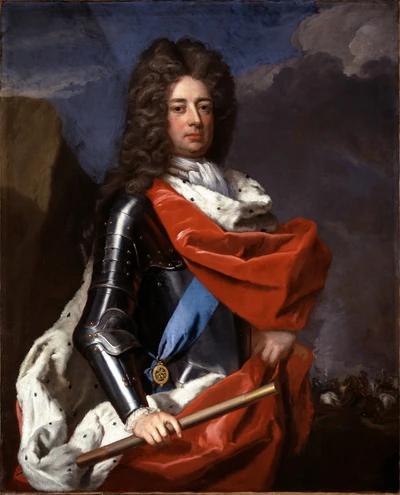
John Churchill, 1st Duke Of Marlborough
| Name | John Churchill, 1st Duke Of Marlborough |
| Title | English soldier and statesman (1650-1722) |
| Gender | Male |
| Birthday | 1650-05-26 |
| nationality | Great Britain |
| Source | https://www.wikidata.org/wiki/Q153803 |
| pptrace | View Family Tree |
| LastUpdate | 2025-11-26T23:21:46.022Z |
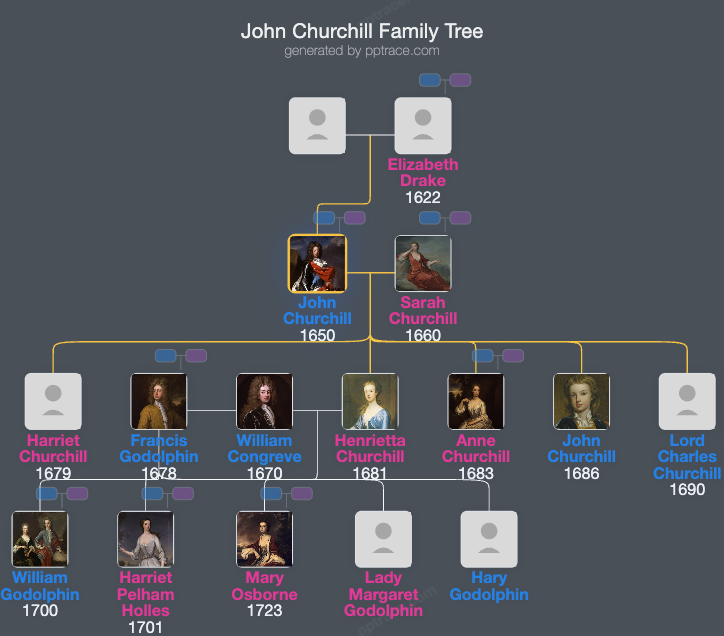
Family Tree
Tap  to expand more relatives
Introduction
John Churchill, 1st Duke of Marlborough, 1st Prince of Mindelheim, 1st Count of Nellenburg, was born on 26 May 1650 and died on 16 June 1722 (Old Style calendar). He was a British military officer and statesman, originating from a gentry family. Churchill served as a page at the court of the House of Stuart under James, Duke of York, through the 1670s and early 1680s. His early career involved military service and diplomatic activity, with notable participation in campaigns during the 1670s.
His family background includes Sir Winston Churchill of Glanvilles Wootton, Dorset, and Elizabeth Drake of Ash, Devon. Churchill was a descendant of Edward I through Joan of Acre. His father served with the Royalist army during the Wars of the Three Kingdoms and was later a Member of Parliament and Commissioner for Irish Land Claims. The family came into significant wealth in 1665 when Arabella Churchill became maid of honour to Anne Hyde and had an affair with James, Duke of York, who was subsequently appointed to various positions, facilitating the Churchills’ rise.
Churchill’s military service included participation in the Franco-Dutch War beginning in 1672. He was present at the Battle of Solebay in 1672 and was commissioned as a Captain in the Duke of York's Admiralty Regiment. He served with the French army, notably under Marshal Turenne, in campaigns in the Rhineland, including the sieges of Maastricht and other engagements. Around 1675, Churchill married Sarah Jennings, who came from a similar minor Royalist gentry background. They had five children who survived to adulthood: Henrietta Churchill, Lady Anne Churchill, John Churchill (later Marquess of Blandford), Elizabeth, and Mary.
In the late 1670s, Churchill's political and military career advanced amidst the broader context of European alliances and internal English political crises. He was elected Member of Parliament for Newtown in 1679 and spent several years in exile following the Exclusion Crisis. Nonetheless, he was made Lord Churchill of Eyemouth in 1682 and gained command roles, including colonel of the King's Own Royal Regiment of Dragoons.
During the reign of James II, Churchill was involved in various political and military activities, including suppressing the Monmouth Rebellion in 1685. He distinguished himself at Sedgemoor, leading to his promotion to Major General and the colonelcy of the Third Troop of Life Guards. He was also created Baron Churchill of Sandridge, sitting in the House of Lords.
Following James II's accession in 1685, and amidst Catholic favoritism, Churchill navigated the political upheaval, aligning with the Protestant interest. His service and loyalty during the Glorious Revolution led to his initial favor under William III, who appointed him as deputy in the Southern Netherlands prior to the War of the Spanish Succession.
Churchill’s marriage to Sarah Jennings, a confidante of Princess Anne, influenced his political standing, contributing to his elevation to the rank of Duke and his appointment as captain-general of British forces. His leadership in key battles during the War of the Spanish Succession, including the Battles of Blenheim (1704), Ramillies (1706), Oudenarde (1708), and Malplaquet (1709), established his reputation as a prominent military leader.
He was a central figure in European military coalition efforts against France under Louis XIV, demonstrating skills in organization, logistics, and diplomacy. His career was affected by political shifts, including his fall from office following Queen Anne’s quarrel with his wife, Sarah Jennings, and his subsequent exile. He returned to favor following the accession of George I in 1714 but suffered a stroke in 1716 that ended his active service.
Throughout his military and political career, Marlborough’s leadership contributed significantly to Britain's emergence as a major European power, and he is regarded by historians as one of the notable military commanders in history.