Noboru Takeshita
| Name | Noboru Takeshita |
| Title | 74th Prime Minister of Japan (1924-2000) |
| Gender | Male |
| Birthday | 1924-02-26 |
| nationality | Japan |
| Source | https://www.wikidata.org/wiki/Q315561 |
| pptrace | View Family Tree |
| LastUpdate | 2025-11-17T06:47:22.035Z |
Family Tree
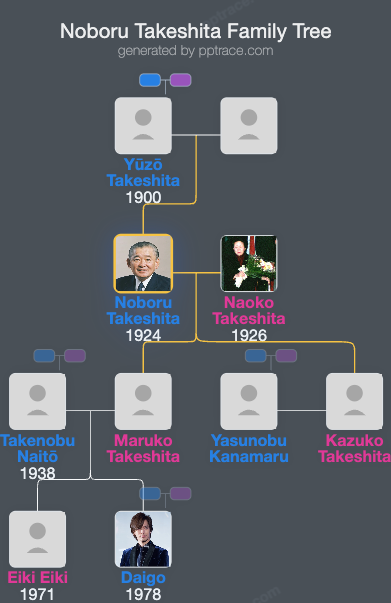
Tap  to expand more relatives
Introduction
Noboru Takeshita (竹下 登, Takeshita Noboru) was a Japanese politician, born on 26 February 1924 in Unnan, Shimane Prefecture, Japan. He died on 19 June 2000. Takeshita served as the Prime Minister of Japan from 1987 to 1989.
Early Life and Education:
Takeshita was the only son of Yūzō Takeshita, a sake brewer, and his first wife, Yuiko. His family had a longstanding tradition in sake brewing, and he was the 20th head of the Takeshita family. He attended Waseda University in Tokyo. During the Pacific War, he was drafted into the Imperial Japanese Army and served as an instructor. His first wife, Masae Takeuchi, committed suicide while he was away during the war. Following the war, Takeshita remarried to Naoko Endō, a distant relative. Before entering politics, he worked as an English teacher and managed a high school judo team. As a young judo competitor, he was given the nickname "master of the draw" for his ability to evade defeat and avoid easy victories.
Political Career:
Takeshita began his political career serving as a local assemblyman in Shimane Prefecture from 1951. In the 1958 general elections, he was elected to the House of Representatives as a member of the Liberal Democratic Party (LDP), aligning with the faction of Kakuei Tanaka. He developed a close alliance with Shin Kanemaru and became Tanaka’s primary fundraiser, focusing on public works projects in Shimane. He held several significant government positions, including chief cabinet secretary from 1971 to 1974, minister of construction in 1976, and minister of finance from 1979 to 1980 and again from 1982 to 1986. During his tenure as finance minister, he signed the Plaza Accord in 1985, which influenced the appreciation of the Japanese yen.
In the mid-1980s, amid political challenges faced by Tanaka following his arrest and conviction in the Lockheed bribery scandal, Takeshita formed the Soseikai study group within the LDP, supporting a faction that grew to include many of Tanaka's followers. By 1987, Takeshita had consolidated a significant faction within the LDP, inheriting much of Tanaka's political support base.
Premiership (1987–1989):
In November 1987, Takeshita became president of the LDP and subsequently served as Prime Minister of Japan. His administration conducted diplomatic efforts, including formalizing development assistance funds for ASEAN countries and engaging in discussions on debt relief for developing nations. His government was characterized by economic stability initially but faced challenges such as rising trade tensions, increased foreign workforce migration, and widening trade imbalances. Notable legislative actions included the introduction of Japan's first consumption tax in 1988 and liberalization policies in various markets. His tenure was marred by the Recruit scandal, which led to his resignation in 1989.
Later Years and Death:
Following his resignation, Takeshita was implicated in issues of insider trading and corruption but was never formally charged. He remained influential within the LDP, mentoring future leaders such as Sōsuke Uno, Toshiki Kaifu, and Keizō Obuchi. His faction, later known as Heisei Kenkyūkai, continued under different leaderships after his death. Takeshita died of respiratory failure after long-term hospitalization in June 2000, shortly before he intended to retire from the Diet. During his lifetime, he was awarded honors including the Grand Cordon of the Order of the Chrysanthemum (posthumously in 2000) and the Golden Pheasant Award from the Scout Association of Japan in 1991.
Family:
Takeshita was married twice and had three daughters. His only son, Rikidō, died shortly after birth in 1954. His grandchildren include singer Daigo (formerly Daigo☆Stardust) and manga artist Eiki Eiki. His younger half-brother, Wataru Takeshita (1946–2021), was a reporter with NHK and later an aide to Noboru Takeshita, then entering politics himself.
Honors:
- Grand Cordon of the Order of the Chrysanthemum (2000, posthumous)
- Golden Pheasant Award of the Scout Association of Japan (1991)