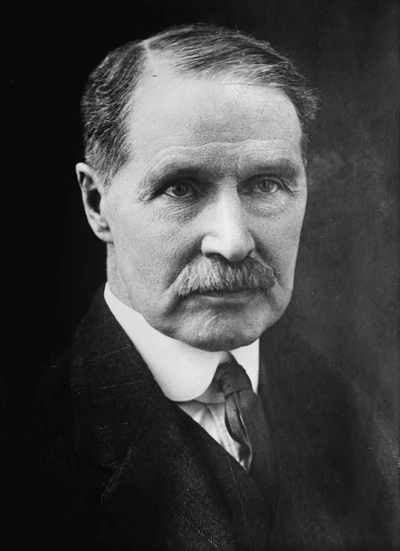
Bonar Law
| Name | Bonar Law |
| Title | former Prime Minister of the United Kingdom (1858-1923) |
| Gender | Male |
| Birthday | 1858-09-16 |
| nationality | United Kingdom of Great Britain and Ireland |
| Source | https://www.wikidata.org/wiki/Q166663 |
| pptrace | View Family Tree |
| LastUpdate | 2025-11-26T23:31:54.503Z |
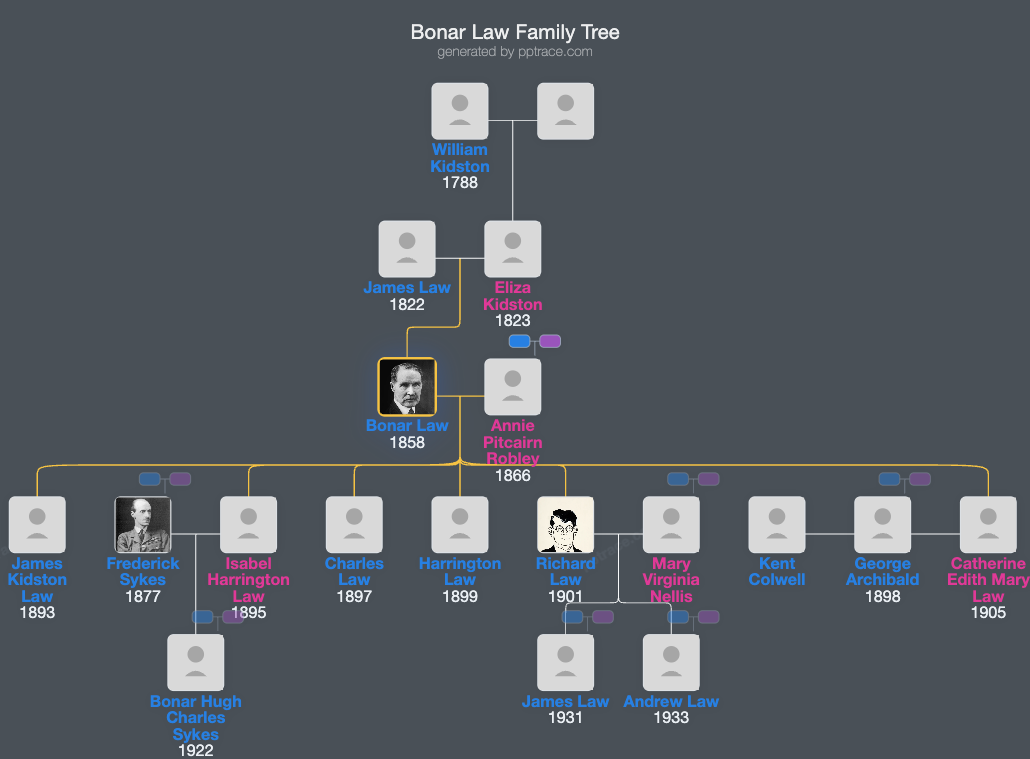
Family Tree
Tap  to expand more relatives
Introduction
Andrew Bonar Law was born on September 16, 1858, in Kingston (now Five Rivers), New Brunswick, which was then a British colony and is now part of Canada. His father was Reverend James Law, a minister of the Free Church of Scotland, and his mother was Eliza Kidston Law. Law was of Scottish and Irish (primarily Ulster Scots) descent. Following his mother's death in 1861, his aunt Janet Kidston, residing in Helensburgh, Scotland, took responsibility for his upbringing. In 1870, after his father's remarriage, Law moved to Scotland to live with his aunt, departing from Kingston and never returning there.
Law attended Gilbertfield House School in Hamilton and later the High School of Glasgow, where he demonstrated academic aptitude, particularly excelling in languages such as Greek, German, and French. He developed an interest in chess during his school years, eventually competing with notable amateur players. At age sixteen, he left school to work as a clerk at Kidston & Sons, a merchant firm managed by his relatives, with the intent of gaining a commercial education.
In 1885, the Kidston brothers retired and merged their firm with the Clydesdale Bank. Law then secured a partnership in William Jacks, an iron merchant based in Glasgow, which he effectively managed. His management skills allowed him to develop the business into one of the most profitable iron merchants in Scotland. Law supplemented his business career by attending lectures at Glasgow University and participating in the Glasgow Parliamentary Debating Association, honing skills that would later benefit his political career.
In 1890, Law married Annie Pitcairn Robley, the daughter of a Glasgow merchant. The couple married on March 24, 1891, and together they had six children: James Kidston Law (1893–1917), Isabel Harrington Law (1895–1969), Charles John Law (1897–1917), Harrington Law (1899–1958), Richard Kidston Law (1901–1980), and Catherine Edith Law (1905–1992). Notably, two of his sons, James and Charlie, served as officers in the military and were killed during World War I.
Law's entry into politics occurred in 1897, when he was selected as the Conservative Party candidate for the Glasgow Bridgeton constituency. He later stood for election in Glasgow Blackfriars and Hutchesontown. Despite the working-class composition of the constituency, Law's political orientation aligned with Conservative policies. His political career advanced when, in 1902, he was appointed Parliamentary Secretary to the Board of Trade. He remained active in opposition politics after the 1906 general election and joined the Shadow Cabinet.
In 1911, Law was appointed to the Privy Council. He became the leader of the Conservative Party and Leader of the Opposition when the party's leadership was contested between Walter Long and Austen Chamberlain; Law was chosen after both withdrew to avoid a split within the party. He prioritized tariff reform and opposed Irish Home Rule, playing a significant role in delaying the passage of the Third Home Rule Bill, which contributed to the political tensions leading up to World War I.
During the war, Law held the position of Secretary of State for the Colonies in H. H. Asquith’s coalition government from May 1915 to December 1916. After Asquith's resignation, Law became Chancellor of the Exchequer under Prime Minister David Lloyd George but resigned in early 1921 due to health issues. In October 1922, amidst Conservative dissatisfaction with Lloyd George's coalition, Law expressed only tepid support for the government’s policies regarding Chanak. Consequently, he was elected leader of the Conservative Party and was appointed Prime Minister in October 1922 after the party voted to end the coalition.
Law's tenure as Prime Minister lasted 211 days, making it one of the shortest in British history. His government secured a clear majority in the 1922 general election and engaged in negotiations with the United States concerning war loans. Law's health deteriorated due to throat cancer, and he resigned in May 1923. He passed away later that year on October 30, 1923.