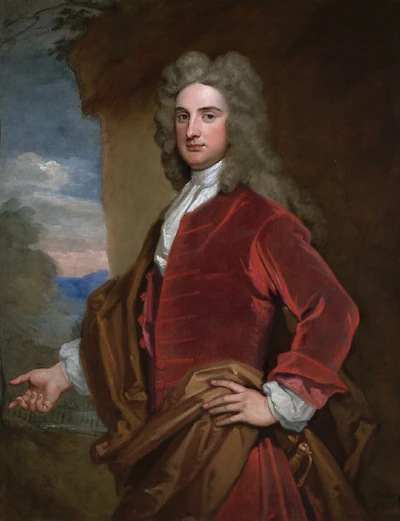
Sir John Rushout, 4th Baronet
| Name | Sir John Rushout, 4th Baronet |
| Title | British politician |
| Gender | Male |
| Birthday | 1685-02-06 |
| nationality | — |
| Source | https://www.wikidata.org/wiki/Q16859523 |
| pptrace | View Family Tree |
| LastUpdate | 2025-11-26T23:21:07.992Z |
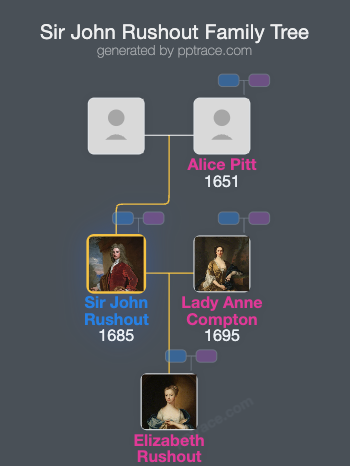
Family Tree
Tap  to expand more relatives
Introduction
Captain Sir John Rushout, 4th Baronet (6 February 1685 – 2 February 1775), was a British Army officer and a Whig politician who served as Member of Parliament (MP) for multiple constituencies over a span of more than five decades, from 1713 to 1768. He held the distinction of being the Father of the House from 1762 until 1768.
Early Life and Family Background:
John Rushout was born on 6 February 1685. He was the fourth son of Sir James Rushout, 1st Baronet, and Alice Pitt, daughter of Edmund Pitt. His elder brother, James Rushout, succeeded to the baronetcy upon their father's death. Rushout was educated at Eton College, graduating in 1698.
Military Career:
Rushout joined the English Army, beginning his service as a cornet in the Royal Horse Guards in 1705. He was promoted to the rank of lieutenant in 1706 and became a captain in 1710. On 21 September 1711, he inherited the baronetcy following the death of his nephew, the third baronet, along with most of the family estates in Worcestershire. He resigned his military commission in January 1712, citing reasons related to political policy and the potential dismissal of Whig officers under the Duke of Ormond's administration.
Marriage:
In 1729, Rushout married Lady Anne Compton, the sixth daughter of George Compton, 4th Earl of Northampton.
Political Career:
Rushout was elected as a Whig MP for Malmesbury in a by-election on 20 April 1713 with the backing of Lord Wharton. In his early parliamentary career, he voted against the French commerce bill (June 1713), opposed the expulsion of Richard Steele (March 1714), and supported the Whigs during various votes. He also stood unsuccessfully for Evesham in 1713 but was elected unopposed for Malmesbury again during the general election.
At the 1715 general election, he was returned as MP for Malmesbury and voted against the septennial bill but supported the repeal of the Occasional Conformity and Schism Acts. In the 1722 election, Rushout was elected for both Malmesbury and Evesham but was unseated at Malmesbury on petition, subsequently taking his seat at Evesham. He initiated parliamentary inquiries into the Atterbury plot and sponsored the complaint leading to Lord Macclesfield's impeachment.
Rushout aligned with William Pulteney against Walpole, actively participating in opposition activities. He introduced a bill against election bribery in 1726, which was ultimately unsuccessful. He was elected for Evesham in 1727 and became a significant figure in the opposition Whig faction, acting as Pulteney's second in his duel with Lord Hervey (1731). He played a role in the passage of the Molasses Act and was connected with opposition efforts during the excise bill crisis (1733).
He was returned again for Evesham in 1734 and supported increased allowances to Frederick, Prince of Wales (1737). Known for his frequent speaking in Parliament, Rushout continued serving as MP for Evesham through subsequent elections in 1741 and 1747, aligning himself with the Leicester House party and later seeking peerages and positions associated with the royal succession.
Government Positions and Later Life:
Under Pelham's ministry, Rushout was appointed Treasurer of the Navy in 1743 and was made a Privy Counsellor in 1744. He was dismissed from office later in 1744 amid political shifts. During this period, he opposed the Queen of Hungary's subsidy and held up payments to the navy for several months. He was involved in efforts to form the "short-lived ministry" in 1746 but was not appointed to a leadership role.
In the later years, Rushout was returned for Evesham in 1747, 1754, and 1761, often contesting fiercely. He became the longest-serving MP, earning the title of Father of the House in 1762. He spoke on various issues, including Wilkes's privilege and general warrants, and generally maintained a voting record consistent with opposition to the Grenville ministry.
Retirement and Death:
Rushout retired from Parliament at the 1768 general election due to age. He died on 2 February 1775, leaving behind a son, John, who succeeded to the baronetcy, and two daughters.
References:
The biography relies on historical records and the Oxford Dictionary of National Biography.