George Montagu-Dunk, 2nd Earl Of Halifax
| Name | George Montagu-Dunk, 2nd Earl Of Halifax |
| Title | British politician (1716–1771) |
| Gender | Male |
| Birthday | 1716-10-06 |
| nationality | Great Britain |
| Source | https://www.wikidata.org/wiki/Q3760605 |
| pptrace | View Family Tree |
| LastUpdate | 2025-11-26T23:25:01.612Z |
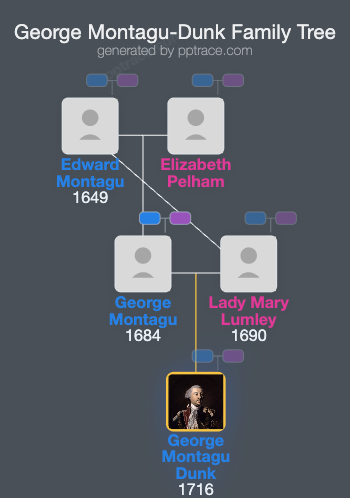
Family Tree
Tap  to expand more relatives
Introduction
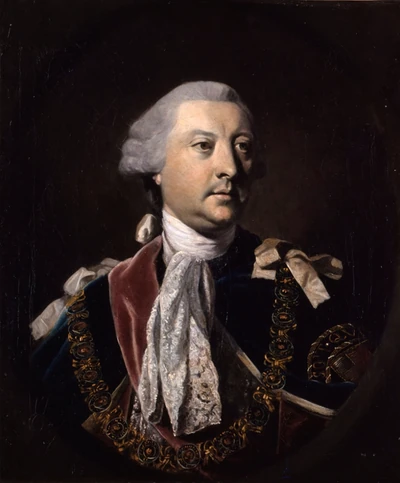
George Montagu-Dunk, 2nd Earl of Halifax (6 October 1716 – 8 June 1771), was a British statesman during the Georgian era. He was the son of the 1st Earl of Halifax and was styled Viscount Sunbury until he succeeded his father in 1739. Halifax received education at Eton College and Trinity College, Cambridge. In 1741, he married Anne Richards, who had inherited a considerable fortune from Sir Thomas Dunk, leading him to adopt the Dunk surname.
Halifax initially served as an official in the household of Frederick, Prince of Wales. He was appointed Master of the Buckhounds and later became President of the Board of Trade in 1748. During this tenure, he contributed to the founding of Halifax, Nova Scotia, named after him, and played a role in promoting trade with North America. The city of Halifax, Nova Scotia, became the colonial capital under his influence. In 1757, he entered the Cabinet as a Secretary of State after an unsuccessful attempt to become Secretary of State.
In March 1761, Halifax was appointed Lord Lieutenant of Ireland. He also served as First Lord of the Admiralty for a period. In October 1762, he was appointed Secretary of State for the Northern Department, and in 1763, he transferred to the Southern Department. During this period, he was one of the three ministers entrusted by King George III to manage affairs during the premiership of Lord North.
His political career included actions such as authorizing a raid on John Entick's home in 1762, which was later declared unlawful in the case of Entick v. Carrington. In 1763, Halifax signed the general warrant used to arrest John Wilkes and others involved with The North Briton, a controversial publication. He played a significant role in excluding the King's mother, Augusta, Princess of Wales, from the Regency Bill of 1765.
Halifax left office in July 1765 but returned to the Cabinet in January 1770 as Lord Privy Seal. He was recently reappointed as Secretary of State when he died in 1771. Halifax was also known for his interest in cricket; he led Northamptonshire in matches during 1741 and helped establish the Northamptonshire & Huntingdonshire team.
Religiously opposed to slavery, Halifax refused investments linked to the transatlantic slave trade. He publicly supported colonial rights during various conflicts with Parliament, making him popular among North American colonies such as Massachusetts Bay, North Carolina, and Virginia. His political career was marred by scandal, especially related to his mistress, Anna Maria Faulkner, who was alleged to have sold government positions.
Halifax was buried in Horton, Northamptonshire. An effigy and memorial plaque are located in Westminster Abbey, and a memorial obelisk stands at Chicksands Wood in Bedfordshire. Collections of over 4,000 pamphlets related to the union of England and Scotland, civil war, and Restoration, known as the Lansdowne and Halifax tracts, are held at University College London. Many of these works were authored pseudonymously by Daniel Defoe and Jonathan Swift.
Various locations are named in his honor, including the municipality of Halifax and Halifax County in Nova Scotia; the Halifax River in Florida; Halifax and Halifax County in North Carolina; Halifax in Virginia and Vermont; as well as Halifax Bay in Luderitz Bay, Dunk Island in Queensland, and Montague Island in New South Wales.