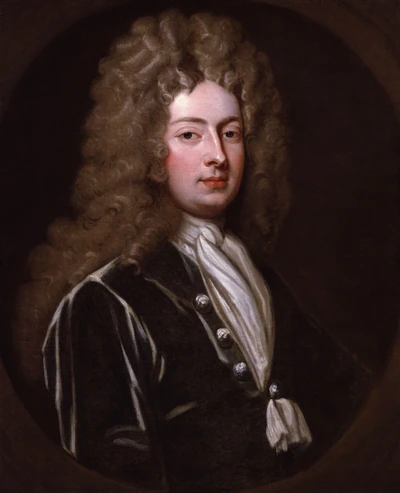
William Congreve
| Name | William Congreve |
| Title | British writer (1670-1729) |
| Gender | Male |
| Birthday | 1670-01-24 |
| nationality | Great Britain |
| Source | https://www.wikidata.org/wiki/Q366805 |
| pptrace | View Family Tree |
| LastUpdate | 2025-11-26T23:21:47.002Z |
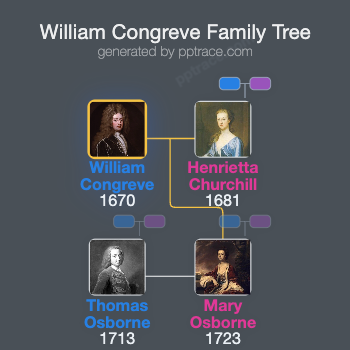
Family Tree
Tap  to expand more relatives
Introduction
William Congreve (24 January 1670 – 19 January 1729) was an English playwright, satirist, and poet. He was born in Bardsey, a village in the West Riding of Yorkshire. Although some sources contest his place of birth, a baptism record confirms his birth date as 10 February 1669 (1670 by modern calendar reckoning). His parents were Colonel William Congreve (1637–1708) and Mary Browning (born circa 1636–1715). In 1672, his family moved to London, and subsequently to Youghal, an Irish port town.
Congreve attended Kilkenny College, where he met Jonathan Swift, and later studied at Trinity College Dublin. He moved to London with the intention of studying law at the Middle Temple but pursued literature, drama, and the fashionable social scene instead. Early in his career, Congreve used the pseudonym Cleophil; under this name, he published "Incognita: or, Love and Duty reconcil'd" in 1692, when he was approximately 17 years old. This work garnered recognition among literary circles and facilitated his entry into the field.
He was connected with the literary gathering at Will's Coffeehouse in Covent Garden, where he met John Dryden, who became a mentor and supporter. Congreve's relationship with Dryden helped foster his development as a dramatist. His familial ties included a distant relation to Lady Elizabeth Hastings, owner of Ledston Hall, for whom he wrote articles published in the Tatler magazine.
William Congreve's literary career flourished during the early 1690s, a period marked by the emergence of Restoration comedy, characterized by its satire and witty dialogue. His first play, "The Old Bachelor," was produced at the Theatre Royal, Drury Lane, in 1693. It was initially successful, receiving praise from Dryden. His subsequent plays included "The Double-Dealer" (1693), which was less successful, and "Love for Love" (1710), which was well-received. His most renowned work, "The Way of the World," was first staged in March 1700; despite its initial lukewarm reception, it is now regarded as a central piece of Restoration comedy literature.
Congreve also authored the tragedy "The Mourning Bride" (1697), which enjoyed significant popularity during its time but is less esteemed today. From 1693 to 1700, he produced five plays, establishing himself as a prominent figure in the genre of comedy of manners. He served as a manager at Lincoln's Inn Fields Theatre and was appointed as a commissioner for licensing hackney coaches, reflecting his standing in contemporary society.
Despite his success, Congreve's active playwriting career was relatively brief. Changes in public taste and moral concerns regarding theatrical content are believed to have contributed to his retreat from the stage. Following his last play in 1700, he focused on other literary pursuits, including translating Molière's works and writing librettos for operas. He also engaged in political activities as a member of the Whig Kit-Kat Club and held a political appointment in Jamaica in 1714, granted by King George I.
Congreve remained unmarried throughout his life. He maintained personal friendships with prominent actresses and noblewomen, notably Anne Bracegirdle and Henrietta Godolphin, Duchess of Marlborough. There is evidence suggesting that the Duchess had a daughter, Mary (1723–1764), who is believed to be Congreve's illegitimate descendant.
In his later years, Congreve suffered from gout and cataracts. In September 1728, he was involved in a carriage accident from which he never fully recovered. He died in London on 19 January 1729 and was buried in Poet's Corner at Westminster Abbey.
William Congreve's legacy endures as a significant figure in English literature, particularly for pioneering the satirical comedy of manners during the Restoration period. His works continue to be studied and performed, with his memorable quotations sometimes misattributed to other writers.