Byrd Spilman Dewey
| Name | Byrd Spilman Dewey |
| Title | writer |
| Gender | Female |
| Birthday | 1856-02-16 |
| nationality | United States of America |
| Source | https://www.wikidata.org/wiki/Q15996235 |
| pptrace | View Family Tree |
| LastUpdate | 2025-11-17T06:39:34.037Z |
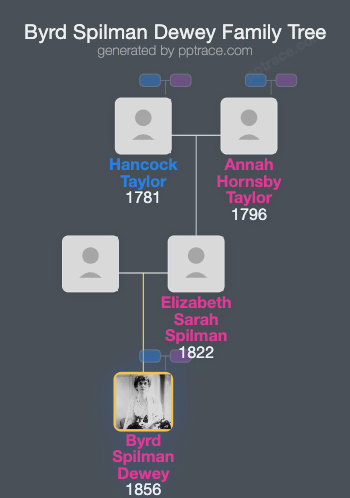
Family Tree
Tap  to expand more relatives
Introduction
Byrd "Birdie" Spilman Dewey, née Julia Bird Spilman, was born on February 16, 1856, in Covington, Kentucky. Her parents were Jonathan Edwards Spilman, an attorney, composer, and Presbyterian minister, and Eliza Sarah Taylor. Her maternal great-grandfather was Colonel Richard Taylor, the father of President Zachary Taylor. Dewey attended school in Kentucky, including Maysville College and the Sayre Institute (Sayre School), where she studied literature, music, art, and languages.
In 1866, her mother died following a fire aboard the steamboat Bostona No. 3 in Maysville. In 1877, Dewey moved with her family to Salem, Illinois, where her father’s new pastorate was located. She married Frederick Sidney Dewey on September 25, 1877, in Salem. Fred Dewey was a distant cousin of Admiral George Dewey and Melvil Dewey, inventor of the Dewey Decimal System.
The Deweys relocated to Florida in 1881 due to Fred Dewey’s respiratory health issues caused by his Civil War service. Their first destination was Jacksonville, where they initially considered properties in the St. Augustine area. They purchased 20 acres of land in Zellwood to grow vegetables and establish an orange grove, but by 1883, the land was deemed unsuitable. They subsequently sold the property and moved to Eustis; Fred Dewey took a bookkeeping position there. Dissatisfied with life in Eustis, they returned to Jacksonville, where Fred worked for the T.V. Cashen Lumber Company.
In 1885, Dewey gave birth to their only child, Elizabeth Dewey, who died as an infant. In 1887, the Deweys became involved with the Lake Worth Country, a developing region around Lake Worth. They filed a homestead claim for 76 acres near Lake Mangonia, cultivating coconuts, tamarind, pineapple, avocado, sugar apple, and guava. Fred Dewey sailed across Lake Worth daily to Palm Beach for employment.
Dewey’s writing career began with contributions to the Florida Farmer and Fruit Grower newspaper in 1887, under the pen name Aunt Judith Sunshine. She also published articles in the Christian Union, including "On Toast" and other household tips, as well as short stories and advice columns in Good Housekeeping between 1889 and 1895. In 1891, she became the first columnist for Guy Metcalf’s The Tropical Sun, writing the weekly column "The Sitting Room" under the pseudonym "Aunt Judith." Her writings focused on housekeeping, family life, recipes, and philosophy.
Her first book, *Bruno*, was published in 1899 by Little, Brown & Company. The autobiographical novel, featuring her own life and her husband’s, sold over 100,000 copies in its first year and was widely reviewed positively. It became a standard school reader in several American states. She published two additional books: *The Blessed Isle and its Happy Families* in 1907, which told stories of her pets and homestead life, and *From Pine Woods to Palm Groves* in 1909, a serialized account of her early years in Palm Beach County. Her later work included short stories and articles, such as "Some Bird Notes" published in the Florida Naturalist in 1927. In 2014, her complete works were compiled into *The Collected Works of Byrd Spilman Dewey*.
Dewey’s involvement in land development began with her investments in South Florida real estate. In 1892, she purchased 160 acres at the south end of Lake Worth from George H. K. Charters for $700. In 1895, William S. Linton, a Michigan congressman, offered her $6,000 for the land; however, Linton fell insolvent in 1897, leading the Deweys to file a foreclosure and subsequently recover their property. After settling the legal issues, the Deweys filed the plat for the Town of Boynton on September 26, 1898, along with a separate plat for Dewey's subdivision.
The Deweys built their initial residence, Spilman Cottage, in Boynton, serving as a weekend home. They planted the first orange grove in Boynton along the coastal canal and contributed lots for community facilities, including a Methodist church. Their activities and land transactions played a significant role in the early development of the town.
Byrd Spilman Dewey continued her philanthropic and environmental work, notably with the Florida Audubon Society. She lived in Florida from 1881 until her death on April 1, 1942. In recognition of her contributions, she was a finalist for the Florida Women’s Hall of Fame in 2013 and 2017.