Toshiaki Ōkubo
| Name | Toshiaki Ōkubo |
| Title | Japanese historian (1900-1995) |
| Gender | Male |
| Birthday | 1900-01-25 |
| nationality | Japan |
| Source | https://www.wikidata.org/wiki/Q11431927 |
| pptrace | View Family Tree |
| LastUpdate | 2025-11-17T06:48:26.257Z |
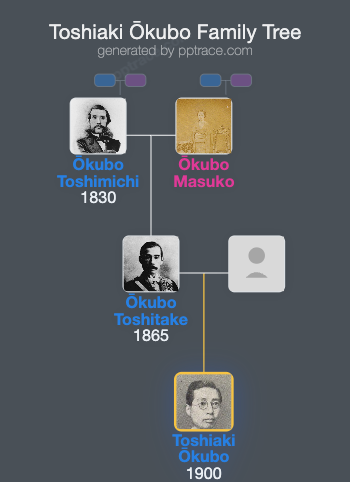
Family Tree
Tap  to expand more relatives
Introduction
Toshiaki Okubo (born January 25, 1900 – December 31, 1995) was a Japanese historian and a member of the kazoku (marquis family). He was born in Ushigome Ward, Tokyo City, Tokyo Prefecture (present-day Shinjuku Ward, Tokyo). His father was Toshi Taro Okubo, the third son of Toshi Taro Okubo, and his mother was Sakae, the eldest daughter of Rentarō Kondo. Details about his siblings are unknown.
His educational background includes graduating from Gakushuin Elementary School in 1913, Gakushuin Middle School in 1918, and Gakushuin High School in 1922. He later entered the Faculty of Economics at Kyoto Imperial University but withdrew after three years due to illness. In 1926, he entered the Department of Japanese History at the Faculty of Literature, Tokyo Imperial University, graduating in 1928. His graduation thesis was titled "Modern Tendencies in the Policies of Warring States Feudal Lords." During his time at Tokyo Imperial University, he worked in the Japanese History Research Laboratory and was involved in compiling the "Fiftieth Anniversary History of Tokyo Imperial University."
In terms of career, in 1935 he was appointed as a lecturer at Meiji University’s Faculty of Law upon the recommendation of Takeo Osatake. He subsequently participated in the compilation of the "Sixtieth Anniversary History of the Imperial Academy" and the "Fiftieth Anniversary History of the House of Peers." In 1938, he served as an editor for the compilation of these two histories.
In 1943, upon the death of his father, Toshi Taro, he inherited the title of marquis and became a member of the House of Peers on September 1 of that year. Following the abolition of the House of Peers after World War II, he lost his position as a legislator. Throughout wartime and after, he adopted a critical stance towards the imperial nationalistic view of history, advocating for modern history research based on empirical methodology. His research spanned a wide array of fields including political history, cultural history, and education history, with particularly notable achievements in the history of universities and historiography.
After the war, he served as a professor at Nagoya University and Rikkyo University, advancing research on modern Japanese history. He participated in editing the national history textbook "Kuni no Ayumi" alongside Saburō Kuniyoshi, Akio Okada, and Yoshitaka Morisue, contributing to the sections on modern and contemporary history relevant to elementary school curriculum. Additionally, he was involved as a scholar group member in the production of NHK’s television series "Japan’s Postwar."
He also engaged in collecting materials and conducting research, providing valuable documents related through connections with descendants of influential figures from the Meiji Restoration. His research covered broad aspects of political, cultural, and educational history.
He received honors including the Junior Fifth Rank in 1929, the Senior Fifth Rank in 1935, and the Junior Fourth Rank in 1943.
Regarding his family, his wife was Yaeko, the eldest daughter of Viscount Kuninori Yoneda, and his eldest son is Toshi Tadayasu Okubo.