George Walpole
| Name | George Walpole |
| Title | British soldier and politician (1758-1835) |
| Gender | Male |
| Birthday | 1758-06-20 |
| nationality | United Kingdom of Great Britain and Ireland |
| Source | https://www.wikidata.org/wiki/Q5545841 |
| pptrace | View Family Tree |
| LastUpdate | 2025-11-26T12:21:48.861Z |
Family Tree
Tap  to expand more relatives
Introduction
George Walpole was born on 20 June 1758 and died in May 1835. He was a British Army officer and politician. He gained recognition for his involvement in the Second Maroon War in Jamaica during 1795. Later, he served as a member of the British Parliament, representing Derby from 1797 to 1806 and Dungarvan from 1807 until 1820. Between 1806 and 1807, he held the position of Under-Secretary of State for Foreign Affairs.
Early Life and Education:
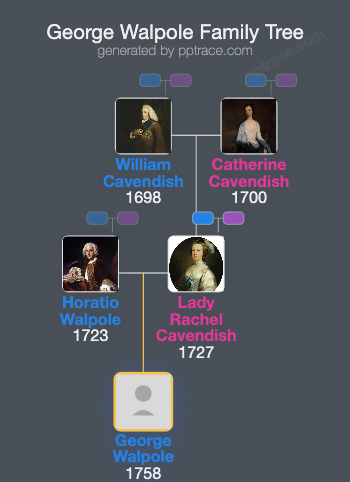
George Walpole was the third son of Horatio Walpole, 1st Earl of Orford, and Lady Rachel Cavendish, who was the third daughter of William Cavendish, 3rd Duke of Devonshire. His grandfather was Horatio Walpole, 1st Baron Walpole. Walpole attended Eton College from 1769 to 1776.
Military Career:
Walpole was commissioned as cornet in the 12th Light Dragoons on 12 May 1777. He was promoted to lieutenant in the 9th Dragoons on 17 April 1780. He returned to the 12th Light Dragoons as captain-lieutenant on 10 December 1781, and later transferred to the 8th Light Dragoons on 13 August 1782. On 25 June 1785, Walpole attained the rank of major in the 13th Light Dragoons. He became lieutenant-colonel of this regiment on 31 October 1792.
Participation in the Second Maroon War:
In 1795, Walpole traveled with the 13th Light Dragoons to the West Indies and participated in suppressing the Jamaican Maroon insurrection known as the Second Maroon War. The Maroons of Trelawny Town, numbering fewer than 700 and allied with approximately 400 runaway slaves, challenged colonial authority. The terrain complicated military operations and several detachments faced ambushes, resulting in the deaths of their commanders.
From October 1795, Walpole was entrusted with command of the military operations in Jamaica, receiving the local higher rank of major-general. His leadership involved employing strategic dispositions and capturing several Maroon stockades (called "cockpits"). He secured alliances with the Accompong Maroons, who trained their allies in tracking. Walpole adopted a scorched-earth policy combined with pack dogs to weaken the Trelawny Maroons, leading to their eventual negotiations and surrender in December 1795. The treaty offered amnesty, land settlement options, and the promise that they would not be exiled from the island. Walpole was initially promised a gift of five hundred guineas for his efforts, but he declined it, and his letter of refusal was later expunged from the parliamentary records.
He was promoted to colonel in the British Army on 3 May 1796 but retired the following year.
Political Career:
Walpole was elected as Member of Parliament for Derby in 1797 and served until 1806. While in Parliament, he maintained support for the Trelawny Maroons' interests, advocating for their fair treatment even when they were in Nova Scotia after their exile. He engaged in correspondence and efforts to improve their living conditions.
He was a supporter of Charles James Fox and voted for reform. Walpole was present as the second in the duel between George Tierney and William Pitt on 27 May 1798. When Fox became Foreign Secretary, Walpole was appointed Under-Secretary of State for Foreign Affairs on 20 February 1806, though he served only until Fox's death. Subsequently, he was appointed comptroller of cash in the excise office, a position he held permanently. He served as MP for Dungarvan from 1807 to 1820.
In 1807, Walpole spoke against the transatlantic slave trade in the House of Commons, referencing the potential for revolts like the Haitian Revolution, based on his knowledge of slave resistance among the Maroons.
Personal Life:
While in Jamaica, Walpole fathered a daughter named Mary Walpole, born in 1796, with a Maroon woman. He resided at 14 Queen Street, Mayfair, London. Walpole died unmarried in May 1835 at the age of 76.