John George Walker
| Name | John George Walker |
| Title | Confederate States Army general |
| Gender | Male |
| Birthday | 1821-07-22 |
| nationality | United States of America |
| Source | https://www.wikidata.org/wiki/Q6235165 |
| pptrace | View Family Tree |
| LastUpdate | 2025-11-17T06:38:28.357Z |
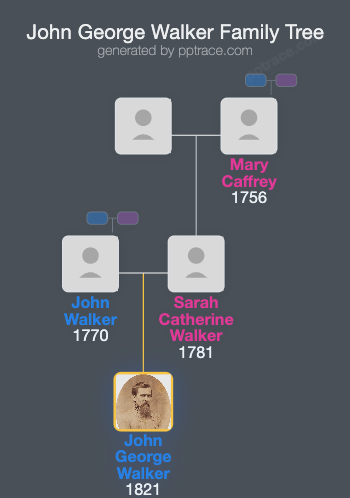
Family Tree
Tap  to expand more relatives
Introduction
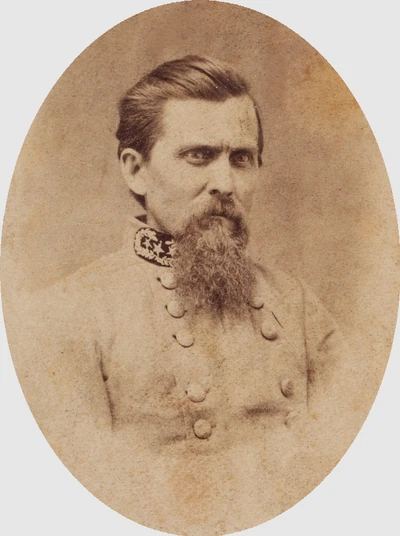
John George Walker (July 22, 1821 – July 20, 1893) was a Confederate military officer during the American Civil War. He was born in Jefferson City, Missouri. His mother, Sarah Caffery Walker, was a niece of Rachel Jackson, the wife of President Andrew Jackson. His father, John Walker, belonged to a political family originating from Kentucky and Missouri, with two brothers, George Walker and David Walker, who served in the United States Congress. Walker was raised in the St. Louis area and graduated from the institution that would become Washington University in 1844.
Walker entered the United States Army as a first lieutenant of the Regiment of Mounted Rifles in 1846. His military service included participation in the Mexican-American War, where he was breveted to captain for actions at San Juan de los Llanos and was wounded at Molino del Rey. He attained the full rank of captain in June 1851. In 1858, he married Sophie Baylor, a member of the family associated with the naming of Baylor University. Walker remained in the United States Army until July 1861, when he resigned to join the Confederate States Army as a major in the cavalry.
During the Civil War, Walker was promoted within the Confederate Army. In August 1861, he was appointed commander of the 8th Texas Cavalry, serving in the Department of North Carolina. In September 1861, he was promoted to colonel, and by January 1862, he had achieved the rank of brigadier general. He participated in the Peninsula Campaign as part of Brigadier General Theophilus H. Holmes’s division and was wounded at the Battle of Malvern Hill. His division occupied Loudoun Heights, overlooking Harpers Ferry, West Virginia, until its surrender to Stonewall Jackson on September 15, 1862.
In November 1862, Walker was promoted to major general and transferred to the Trans-Mississippi Department, where he commanded twelve Texas regiments totaling approximately 12,000 men. These regiments, known as "Walker's Greyhounds," were trained at Camp Nelson in Arkansas. They were known for their rapid movement capabilities. From November 1862 until the end of the war, the Greyhounds consisted exclusively of soldiers from Texas and remained within the Trans-Mississippi Department.
In March 1863, Lt. Gen. Edmund Kirby-Smith assigned Walker's division to Maj. Gen. Richard Taylor’s command in Western Louisiana. The division was tasked with attacking Union supply lines on the Louisiana side of the Mississippi River, opposite Vicksburg, Mississippi. Walker's troops engaged Union forces at the Battle of Young's Point and the Battle of Milliken's Bend on June 6, 1863. These engagements included some of the earliest combat involving African-American Union troops. Subsequently, Walker's troops supported Taylor's efforts to attack New Orleans, although requests for assistance were denied by higher Confederate command.
In 1864, Walker participated in the Red River Campaign, contributing to the Confederate victory at the Battle of Mansfield on April 8. Later, he was directed to oppose Union General Frederick Steele and fought at the Battle of Jenkins' Ferry on April 30, 1864. His forces then returned to join Taylor's pursuit of Union forces in Louisiana.
Later in the war, Walker was assigned to command different districts within the Trans-Mississippi Department, including the District of Western Louisiana and, ultimately, the District of Texas, New Mexico, and Arizona. Following the conclusion of the Civil War, Walker fled to Mexico for several months. In August 1865, he traveled to London, England, where his wife later joined him. There, he engaged in business activities.
Walker later served as the United States Consul in Bogotá, Colombia, and as a Special Commissioner to the Pan-American Convention. He died in Washington, D.C., on July 20, 1893, and was interred in the Stonewall Cemetery in Winchester, Virginia.