Herbert Studd
| Name | Herbert Studd |
| Title | English cricketer (1870-1947) |
| Gender | Male |
| Birthday | 1870-12-26 |
| nationality | United Kingdom |
| Source | https://www.wikidata.org/wiki/Q5735695 |
| pptrace | View Family Tree |
| LastUpdate | 2025-11-26T12:55:03.156Z |
Family Tree
Tap  to expand more relatives
Introduction
Herbert William Studd was born on 26 December 1870 and died on 8 August 1947. He was a British Army officer and an English first-class cricketer.
Education and Cricket Career:
Herbert Studd was educated at Eton College and Trinity College, Cambridge. As a cricketer, he was a right-handed batsman. His first-class cricket debut occurred in 1890 for Middlesex against the touring Australians. During this match, he took his only first-class wicket, dismissing Jack Blackham. This match remained his sole appearance for Middlesex. In the same season, he played two matches for the Marylebone Cricket Club (MCC), facing Cambridge University and Oxford University.
In 1895, Studd toured Ireland with the MCC, playing a single first-class match against Dublin University, during which he scored 71 runs, marking his maiden first-class half-century. This match was his final appearance for the MCC. Over three matches for the club, he accumulated 132 runs at an average of 26.40, with a top score of 71.
In 1898, he joined Hampshire and debuted in the County Championship against Leicestershire, scoring 49 and 44. Later that season, he scored 60 runs against Sussex, his second half-century. His last first-class match was against Warwickshire later in 1898. For Hampshire, he played five matches, scoring a total of 217 runs at an average of 31.00, with a highest score of 60. Overall, across all first-class matches, he scored 352 runs at an average of 27.07.
Military Career:
On 25 July 1891, Herbert Studd was commissioned into the Coldstream Guards as a second lieutenant. He was promoted to lieutenant on 2 January 1897. During the Second Boer War (1899–1902), he served in South Africa, participating in operations in the Orange Free State, the Transvaal, and Cape Colony. Notable battles he was involved in included Belmont, Enslin, Modder River, Magersfontein, Poplar Grove, Driefontein, Diamond Hill, Bergendal, and Komatipoort during August 1900.
For his service, he was promoted to captain on 11 February 1900 and received several honors, including the Queen's South Africa Medal with six clasps, the King's South Africa Medal with two clasps, a mention in despatches, and the Distinguished Service Order (DSO). He returned to the United Kingdom in August 1902.
Subsequently, Studd attended the Staff College in 1905 and served as Deputy Assistant Adjutant-General in the London District from 1905 to 1909. From 1912 to 1914, he was GSO2 at the War Office. During World War I, he was severely wounded and was mentioned in despatches twice. He received several awards, including the Companion of the Order of St Michael and St George (CMG), Companion of the Order of the Bath (CB), and foreign honors such as the Legion of Honour (France), the Order of Leopold (Belgium), the Croce di Guerra (Italy), and the Order of the Crown of Italy.
He was promoted to lieutenant-colonel, brevet colonel, and temporary brigadier-general. During the war, he commanded the 19th Reserve Brigade and later the 180th Brigade. He served as Chief of Staff of XI Corps from 1916 to 1917 and was the chief of the British section of the Supreme War Council from 1917 to 1919. After the war, he returned to England to command his regiment in 1919. He retired in 1923 due to ill health caused by wounds and was granted the honorary rank of brigadier-general.
Family:
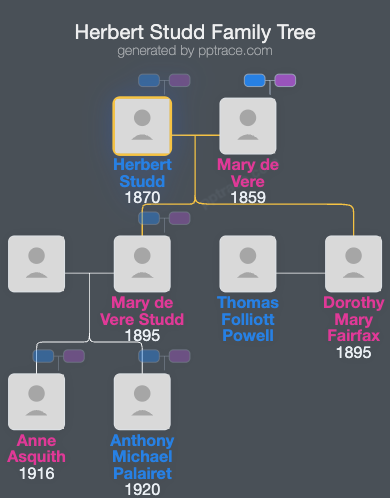
Herbert Studd was the son of Edward Studd, a wealthy planter who, after returning from India, leased Tedworth House in Tidworth, Wiltshire. In 1894, he married Mary Cole (née de Vere), granddaughter of Sir Aubrey de Vere, 2nd Baronet, and widow of Major William Cole of the 3rd Dragoon Guards. The couple had two daughters. Mary Cole died in 1930, and Herbert Studd later remarried Alice Maude Tullis.
Honors and Awards:
Herbert Studd received numerous honors, including the Companion of the Order of the Bath (CB), Companion of the Order of St Michael and St George (CMG), the Distinguished Service Order (DSO), and various foreign decorations such as the Legion of Honour, the Order of Leopold, the Croce di Guerra, and the Order of the Crown of Italy. He also received the Queen's South Africa Medal with six clasps, the King's South Africa Medal with two clasps, and was mentioned in despatches multiple times.
He passed away in Bayswater, London, on 8 August 1947.