John Freeman
| Name | John Freeman |
| Title | British politician (1915-2014) |
| Gender | Male |
| Birthday | 1915-02-19 |
| nationality | United Kingdom |
| Source | https://www.wikidata.org/wiki/Q4356465 |
| pptrace | View Family Tree |
| LastUpdate | 2025-11-26T23:34:15.136Z |
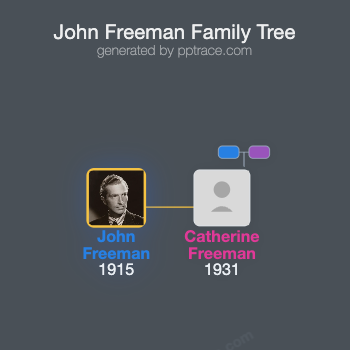
Family Tree
Tap  to expand more relatives
Introduction
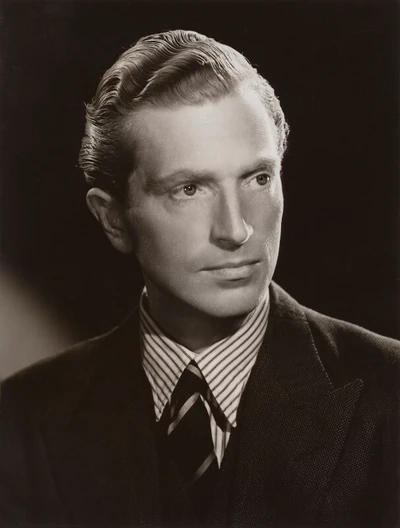
John Horace Freeman (19 February 1915 – 20 December 2014) was a British politician, diplomat, broadcaster, and military officer. He served as the Labour Member of Parliament (MP) for Watford from 1945 to 1955.
**Early Life and Education**
Freeman was born in a house located in the Regent's Park area of London. His date of birth was 19 February 1915. His father was a barrister. During his childhood, Freeman's family relocated to Brondesbury. He attended Westminster School in the early 1930s, where he joined the Labour Party as a student. He later earned a degree from Brasenose College, University of Oxford. After completing his education, Freeman worked briefly at the advertising firm Ashley Courtenay.
**Military Service**
During the Second World War, Freeman served actively in several theaters, including the Middle East, North Africa, Italy, and North West Europe. He enlisted in the Coldstream Guards and was commissioned into the Rifle Brigade in 1940. He served in Britain's 7th Armoured Division, known as the "Desert Rats." Notably, Bernard Montgomery described him as "my best brigade major." In 1943, Freeman was appointed Member of the Order of the British Empire (MBE). His military service was distinguished, and he received recognition for his contributions during the war.
**Political Career**
Following his return to Britain after the war, Freeman was selected as the Labour candidate for Watford. He was elected to Parliament in the 1945 general election. In September 1947, he was appointed Vice-President of the Army Council, the overseeing body of the British Army. Initially aligned with the Bevanite left-wing faction of the Labour Party, he was also supported by Hugh Dalton, who was known for identifying talented young MPs. Freeman advanced rapidly in his political career but resigned from his ministerial positions in 1951 along with Aneurin Bevan and Harold Wilson over disagreements related to National Health Service charges. He did not stand for re-election in the 1955 general election.
**Journalism and Public Media**
Later, Freeman became involved in broadcasting and journalism. He was a presenter on the television program "Panorama" and served as editor of the "New Statesman" from 1961 to 1965. He also hosted the BBC Television interview program "Face to Face." During his tenure, Freeman expressed critical views of Richard Nixon, describing him in 1962 as “a man of no principle whatsoever except a willingness to sacrifice everything in the cause of Dick Nixon.” He later depicted Nixon as "a discredited and outmoded purveyor of the irrational and inactive" in the pages of the "New Statesman."
**Diplomatic Service**
Under Prime Minister Harold Wilson, Freeman was appointed High Commissioner to India from 1965 to 1968. He was made a member of the Privy Council of the United Kingdom in 1966. Subsequently, he served as the British Ambassador to the United States from 1969 to 1971. According to Henry Kissinger's memoirs, Freeman's appointment created an awkward situation during Richard Nixon's presidency, given predictions of a Democratic victory in the 1968 election. Despite this, Wilson did not remove Freeman, and Nixon's first official visit to Britain in 1969 included a dinner where Nixon acknowledged Freeman in a toast, strengthening diplomatic relations. Freeman became friends with Kissinger, and he was reportedly the only ambassador invited to White House social occasions during his first term.
**Later Career and Views**
Freeman served as Chairman of London Weekend Television from 1971 until his retirement in 1984 and was President of ITN between 1976 and 1981. In 1981, he published an article criticizing the British government's interventionist broadcasting policies and expressing views associated with free-market liberalism. From 1985 to 1990, he held the position of Visiting Professor of International Relations at the University of California, Davis. Freeman was made an honorary fellow of Brasenose College, Oxford, in 1968.
**Later Life and Death**
In later years, Freeman provided commentary on bowls for Granada Television. He retired to Barnes, London, and later moved to a military care home in south London in 2012. Upon the death of Morgan Morgan-Giles in May 2013, Freeman became the oldest surviving former MP. Following the death of Tony Benn in March 2014, he was recognized as the last surviving member elected to Parliament in 1945, the last survivor of the 1950 Parliament, and the last MP to have served under King George VI. Freeman passed away on 20 December 2014 at the age of 99.