John Parke Custis
| Name | John Parke Custis |
| Title | American politician (1754-1781) |
| Gender | Male |
| Birthday | 1754-11-27 |
| nationality | United States of America |
| Source | https://www.wikidata.org/wiki/Q1701323 |
| pptrace | View Family Tree |
| LastUpdate | 2025-11-17T06:44:17.537Z |
Family Tree
Tap  to expand more relatives
Introduction
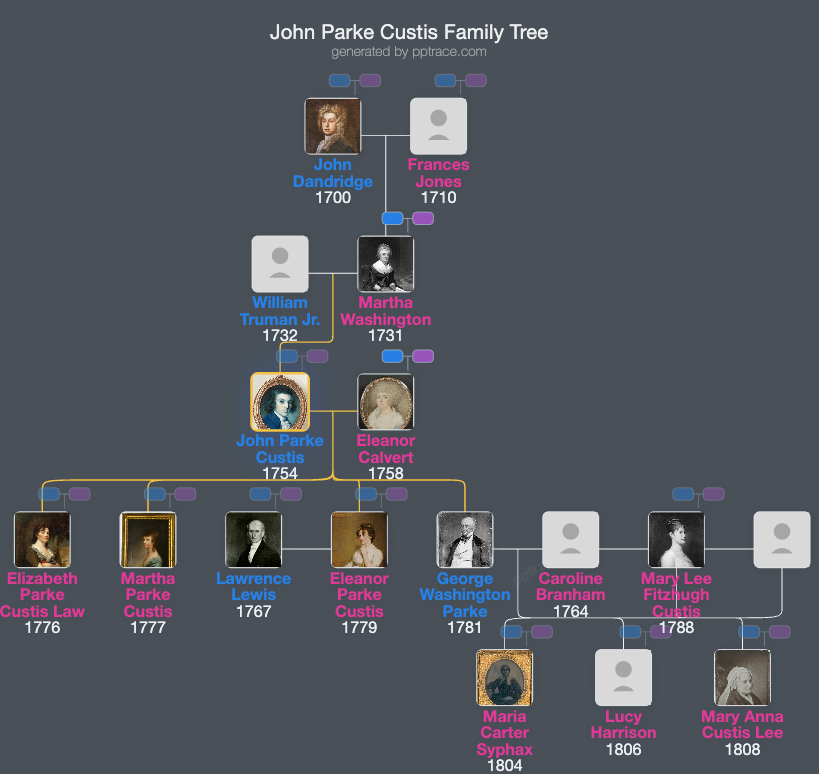
John Parke Custis was born on November 27, 1754, most likely at White House, his parents' plantation on the Pamunkey River in New Kent County, Virginia. He was the only surviving son of Daniel Parke Custis, a wealthy planter, and Martha Dandridge Custis, who later married George Washington. Following his father's death in 1757, Custis became an estate heir under Virginia law, which prompted a transatlantic legal dispute involving relatives in the Leeward Islands. His mother married George Washington in January 1759, and Custis was placed under Washington's guardianship, growing up at Mount Vernon alongside his younger sister Martha "Patsy" Custis.
Custis received early education supervised by Martha Washington and later privately tutored by Walter Magowan. In 1767, he attended a boarding school run by Reverend Jonathan Boucher. In May 1773, he began studies at King's College in New York City but left soon after his sister's death that same year.
At the age of 18, Custis announced his engagement to Eleanor Calvert, daughter of Benedict Swingate Calvert. The marriage took place on February 3, 1774, at Mount Airy estate in Prince George's County, Maryland. Custis and Eleanor had seven children, of whom four survived to adulthood: Elizabeth "Eliza" Custis, Martha "Patsy" Custis, Eleanor "Nelly" Custis, and George Washington "Washy" Custis. Two unnamed daughters died in infancy, and one son, also unnamed, died shortly after birth.
After marriage, Custis lived initially at his father's White House plantation. He later sold town property and several plantations, including land in Jamestown and Williamsburg, in favor of purchasing two plantations in northern Virginia: Arlington and Abingdon. Arlington, comprising about 1,100 acres, was acquired outright and later became Arlington National Cemetery. Abingdon, about 904 acres, was purchased with unfavorable mortgage terms, which strained Custis's finances. His financial management problems, compounded by wartime economic difficulties and complex land transactions, nearly bankrupted him by 1781. Following his death, his estate's debts were addressed over subsequent years, and his holdings included more than 600 slaves inherited by his children.
Custis was involved in politics, running for the Virginia House of Delegates from both New Kent County and Fairfax County in 1778. He served as one of Fairfax County's delegates alongside George Mason and was re-elected twice. Historical accounts suggest he did not serve in the Continental Army, partly due to opposition from his stepfather and mother, although some sources propose he may have served as a staff officer during the Siege of Boston.
In September 1781, Custis accompanied George Washington as a civilian aide-de-camp during the Siege of Yorktown. During the campaign, he contracted "camp fever," likely epidemic typhus or dysentery, which led to his death on November 5, 1781, at Eltham plantation in York County, Virginia. He was buried at his family's plantation near Williamsburg. His death occurred shortly after the surrender of Cornwallis, making him one of the first children of a U.S. president to die during military service.
Following his death, Custis's widow, Eleanor, remarried in 1783 to David Stuart, with whom she had additional children. Custis's estate, including the plantations and numerous slaves, remained in probate actions for over a decade, with full liquidation completed around 1811. His holdings, including the land that later became Ronald Reagan Washington National Airport, passed to his children.