Philip Morton Shand
| Name | Philip Morton Shand |
| Title | British writer and architecture critic |
| Gender | Male |
| Birthday | 1888-01-21 |
| nationality | — |
| Source | https://www.wikidata.org/wiki/Q7184109 |
| pptrace | View Family Tree |
| LastUpdate | 2025-11-12T00:50:57.785Z |
Family Tree
Tap  to expand more relatives
Introduction
Philip Morton Shand (21 January 1888 – 30 April 1960), known as P. Morton Shand, was an English journalist, architecture critic, wine and food writer, and businessman. He is recognized as the paternal grandfather of Queen Camilla.
**Early Life**
Shand was born in Kensington, London, the son of Alexander Faulkner Shand, a writer and barrister, and Augusta Mary Coates. He received education at Eton College and King's College, Cambridge, where he studied history and obtained a Master of Arts degree in 1914. Additionally, he studied at the Sorbonne in Paris and in Heidelberg, Germany. During World War I, Shand served with the Royal Fusiliers and was appointed superintendent of German prisoners’ camps in France due to his fluency in French and German. In 1914, he translated Arthur Schnitzler’s play *Liebelei* into English under the title *Playing with Love*.
**Career**
After the war, Shand established a reputation as an architecture critic, contributing to the *Architectural Review*, where he influenced the publication's support for modernist architecture. In the early 1920s, while residing in Lyon, France, he was invited by the editor of the *Architectural Association Journal* to review the 1925 Exposition Internationale des Artes Décoratifs in Paris. During this review, he coined the term "Swedish grace" to describe Scandinavian design of the time, exemplified in the works of Gunnar Asplund. He published *Modern Theatres and Cinemas* in 1930, examining cinemas as a distinct architectural typology, particularly in Germany.
Shand was involved with key modernist architects and movements. He attended the first CIAM (Congrès International d'Architecture Moderne) congress in 1928 and became a founding member of the MARS Group (Modern Architectural Research Group), operating from 1933 to 1937. His writings, including a series of articles titled *Scenario for a Human Drama* in the *Architectural Review* during 1934–1935, documented contemporary European architecture.
He translated Walter Gropius’s *The New Architecture and the Bauhaus* into English in 1930. Shand also facilitated Gropius’s emigration to the United Kingdom in 1934 with the assistance of furniture designer Jack Pritchard. He maintained correspondence and relationships with prominent modernist figures such as Le Corbusier, Giedion, Behrens, and Aalto.
In the 1930s, Shand faced financial difficulties and was declared bankrupt in 1933. Despite this, he co-founded Finmar, a company importing Finnish furniture designed by Alvar Aalto into the UK. He visited Finland in 1935 to observe Aalto’s work firsthand. He and Aalto remained in contact, exchanging letters, and during the war, Aalto commented that Shand had acted as a British spy behind German lines—a claim Shand never publicly confirmed.
Later in his life, Shand's views on modern architecture became more critical. By the late 1950s, he expressed concerns about the dehumanized and aggressive forms that modern architecture had taken.
**Food and Wine Writings**
Shand was also known for his expertise in food and wine, publishing articles and books such as *A Book of Food* (1927), which emphasized personal preferences in cuisine. Other notable works include *A Book of French Wines* (1925), *A Book of Other Wines* (1929), and *Bacchus or Wine To-Day and To-Morrow* (1929).
**Death and Family**
Shand died on 30 April 1960 in Lyon, France, at the age of 72. His obituary was supplemented by tributes from the poet John Betjeman and wine expert André Simon.
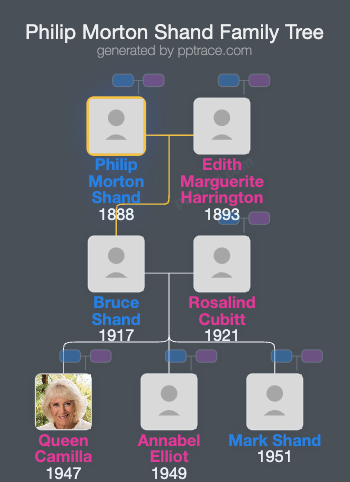
He was married four times. His first marriage to Edith Marguerite Harrington in April 1916 produced a son, Bruce, who was the father of Queen Camilla. The couple divorced in 1920. His second marriage was to Agatha Alys Fabre-Tonnerre; they had a daughter, Sylvia Doris Rosemary, and divorced in 1926. His third marriage to Georgette Thérèse Edmée Avril took place in 1926 and ended in divorce in 1931. His fourth marriage was to Sybil Mary Sissons in 1931, with whom he had a daughter, Elspeth, who married Geoffrey Howe, later Baron Howe of Aberavon.
**Works and Translations**
- *A Book of French Wines* (1925)
- *A Book of Food* (1927)
- *A Book of Other Wines – Than French* (1929)
- *Bacchus or Wine To-Day and To-Morrow* (1929)
- *Modern Theatres and Cinemas* (1930)
- *Building: The Evolution of an Industry* (1954)
Translations include Arthur Schnitzler’s *Playing with Love* and Walter Gropius’s *The New Architecture and the Bauhaus* (1930).