
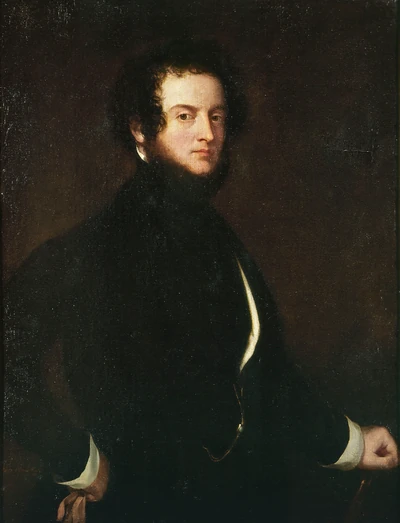
Alfred D'Orsay
| Name | Alfred D'Orsay |
| Title | French artist and dandy (1801-1852) |
| Gender | Male |
| Birthday | 1801-09-04 |
| nationality | France |
| Source | https://www.wikidata.org/wiki/Q2622452 |
| pptrace | View Family Tree |
| LastUpdate | 2025-11-26T23:30:00.570Z |
Family Tree
Tap  to expand more relatives
Introduction
Alfred Guillaume Gabriel Grimod d'Orsay, comte d'Orsay, was born on 4 September 1801 in Paris, France, and died on 4 August 1852 in Chambourcy, France. He was a French amateur artist, known for his work in painting and sculpture, and was also recognized as a dandy and man of fashion during the early to mid-19th century.
Family Background:
He was the second son of Albert Gaspard Grimaud, Comte d'Orsay, who served as a Bonapartist general, and Baroness Eleonore von Franquemont. His mother was an illegitimate daughter of the Duke of Württemberg and Anne Franchi, an Italian adventuress. His elder brother died during infancy.
Military Service and Stay in London:
In 1821, d'Orsay joined the French army under the restored Bourbon monarchy, despite personal Bonapartist tendencies. During this period, he attended the coronation of George IV of Britain in London and remained there until 1822. He served as a Garde du Corps to Louis XVIII. While in London, he formed an acquaintance with Charles Gardiner, 1st Earl of Blessington, and Marguerite, Countess of Blessington, which developed into a close relationship. Scholars have speculated about the nature of his relationship with the Countess, but evidence remains inconclusive. In 1823, d'Orsay and the Blessingtons visited Valence and toured Italy at the invitation of the Earl.
Meeting Lord Byron and the Blessingtons:
In the spring of 1823, d'Orsay met Lord Byron in Genoa. Byron’s correspondence from that period references d'Orsay’s talents and personality, as well as his peculiar relationship with the Earl and Countess of Blessington. D'Orsay had previously kept a diary during his London visit, which Byron praised for its insights into manners and observations. He had also met Lord and Lady Blessington in 1822 and showed romantic interest in Lady Blessington. To divert his attention from his wife, Lord Blessington reportedly wrote a will leaving Irish property to one of his daughters if she married d'Orsay; he ultimately married Lady Harriet Gardiner, the daughter of the Earl of Blessington, on 1 December 1827.
Marriage and Unhappiness:
The marriage to Lady Harriet Gardiner was considered unhappy and ended in legal separation in 1838. Lady Harriet paid over £100,000 to d'Orsay’s creditors, although this sum did not fully cover his debts, in exchange for the relinquishment of all claims to the Blessington estate.
Residence at Gore House:
After Lord Blessington’s death in 1829, the widowed Countess Blessington returned to England with d'Orsay. Their residence, Gore House, became a popular salon for London's literary and artistic elites. D'Orsay’s artistic talents were evident in portraits and statuettes of his friends, characterized by vigor and truthfulness. At Gore House, he encountered figures such as Benjamin Disraeli and Edward Bulwer-Lytton. D'Orsay and Disraeli shared a close friendship; Disraeli even asked d'Orsay to be his second in a duel with Morgan O'Connell, which he declined. Disraeli’s novel "Henrietta Temple" features a character modeled after d'Orsay. A fervent Bonapartist, d'Orsay frequently hosted Prince Louis-Napoleon Bonaparte at Gore House.
Financial Decline and Later Life:
In 1849, d'Orsay declared bankruptcy, leading to the breakup of Gore House. Lady Blessington sold most possessions and moved to Paris with d'Orsay, where she died shortly after. In Paris, d'Orsay attempted to support himself through portrait painting and became involved in political circles, advising the prince-president Louis-Napoléon Bonaparte. However, relations soured after Louis-Napoléon’s 1851 coup d’état. Subsequently, the prince-president appointed d'Orsay as surintendant of the Beaux-Arts School.
Death:
D'Orsay contracted a spinal infection and died on 4 August 1852 at the house of his sister, Ida, duchesse de Gramont, in Chambourcy. He had designed a pyramidal grey stone tomb for Lady Blessington at Chambourcy; he was interred there beside her. Among the mourners at his funeral was Napoleon III.
Cultural References and Archives:
The mascot of The New Yorker magazine, Eustace Tilley, was based on an engraving of d'Orsay by Rea Irvin. His correspondence with Benjamin Disraeli, Lady Blessington, and others is archived in the Bodleian Library, Oxford, as well as in other institutions like the Hertfordshire Archives and Local Studies.
