Maria Feodorovna
| Name | Maria Feodorovna |
| Title | Empress consort of Russia from 1881 to 1894 |
| Gender | Female |
| Birthday | 1847-11-26 |
| nationality | Russian Empire |
| Source | https://www.wikidata.org/wiki/Q153601 |
| pptrace | View Family Tree |
| LastUpdate | 2025-11-12T01:18:40.947Z |
Family Tree
Tap  to expand more relatives
Introduction
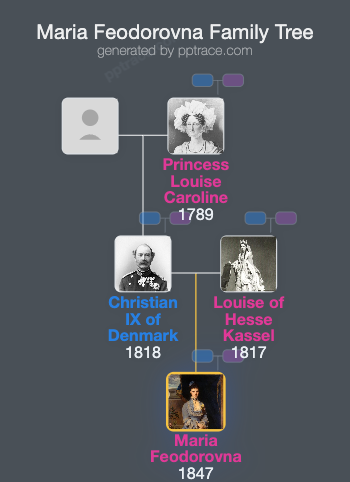
Maria Feodorovna (Russian: Мария Фёдоровна, romanized: Mariya Fyodorovna; 26 November 1847 – 13 October 1928) was a member of the Danish royal family by birth and became Empress of Russia through her marriage to Emperor Alexander III. Born as Princess Dagmar of Denmark, she was the fourth child and second daughter of Christian IX of Denmark and Princess Louise of Hesse-Kassel. Her marriage to Alexander III was arranged in the context of European royal alliances, and she converted from Lutheranism to Russian Orthodoxy prior to her marriage, adopting the name Maria Feodorovna.
Her early life was spent in Copenhagen, at her family’s residence in the Yellow Mansion near Amalienborg Palace. She received a comprehensive education, including housekeeping, music, painting, language skills in French, English, and German, and physical education. Her childhood was characterized by a modest and happy environment, and she maintained close bonds with her family, especially her eldest sister Alexandra, who married the future King Edward VII of the United Kingdom.
In late 1864, Dagmar was engaged to Nicholas Alexandrovich, Tsesarevich of Russia. The engagement followed their meeting during Nicholas’s visit to Denmark and was announced shortly thereafter. She traveled to Russia in 1866, where she was received with enthusiasm. She converted to Orthodoxy and became Grand Duchess Maria Feodorovna, married the future Emperor Alexander III in November 1866 in Saint Petersburg, and moved into the Anichkov Palace. Their marriage was regarded as sincere and devoted, producing several children, among whom Nicholas, later Nicholas II, was the last Emperor of Russia.
Following the assassination of Alexander II in 1881, Maria Feodorovna became Empress consort. Her tenure was marked by her active involvement in philanthropy, patronage of charitable institutions, and social functions. She was considered highly popular among the Russian people, earning the nickname "the Guardian Angel of Russia." She sought to learn about Russian culture and language, and she played a significant role in court life and in the upbringing of her children.
She bore six children, including Nicholas II and his siblings. Her relationship with her successor, Empress Alexandra, was complex and marked by tensions, partly due to differences in personality and views, especially concerning the influence of Rasputin and political decisions leading up to the 1917 Russian Revolution.
After her father-in-law Alexander III’s death in 1894, Maria Feodorovna became the Dowager Empress and maintained influence in court affairs, particularly in advising her son Nicholas II. She was present during critical periods of Russian history, including the First World War, during which she served as president of the Russian Red Cross.
In 1917, following the abdication of Nicholas II, she traveled from Kiev to Crimea and eventually left Russia for exile. She settled in Denmark, living in Copenhagen at Hvidøre estate, and later in London. Despite reports of her surviving her son’s family, she refused to accept confirmed accounts of their fate, maintaining the belief that her son and his family survived the revolution. She returned to Denmark in 1919 and lived there until her death in 1928 at the age of 80.
Maria Feodorovna was interred in Roskilde Cathedral after her death, and her remains were later reinterred in Saint Petersburg’s Peter and Paul Cathedral in 2006, in accordance with her wishes. Her legacy includes various geographical names and a depiction in popular culture, notably in films and television series about the Romanovs. She was recognized with several honors during her lifetime, including orders from Russia, Denmark, and other European nations.