James Balfour
| Name | James Balfour |
| Title | Scottish businessman, landowner and Tory politician (1790–1845) |
| Gender | Male |
| Birthday | 1775-00-00 |
| nationality | United Kingdom of Great Britain and Ireland |
| Source | https://www.wikidata.org/wiki/Q17308768 |
| pptrace | View Family Tree |
| LastUpdate | 2025-11-26T12:48:31.706Z |
Family Tree
Tap  to expand more relatives
Introduction
James Balfour (circa 1775 – 19 April 1845) was a Scottish landowner and politician. He was the son of John Balfour (1739–1813), an advocate and owner of Balbirnie House near Glenrothes in Fife. His elder brother was Robert Balfour, who inherited Balbirnie and became a Lieutenant-General in the British Army. The Balfour family lineage traced back to George Balfour, who purchased Balbirnie in the late 16th or early 17th century. The estate historically included profitable mines in the Fife Coalfield.
Balfour initially studied book-keeping and accountancy in Edinburgh before traveling to Madras in March 1795 to serve as a writer for the British East India Company. During his early years in India, he held various posts, but was recalled to Britain following a disciplinary issue. He returned to India in 1802, establishing himself as a merchant in partnership with James Baker. Their business achieved a significant breakthrough in 1806 when they secured a contract with the Victualling Commissioners of the Royal Navy to supply provisions throughout the East Indies. This contract had previously been held by Hon. Basil Cochrane, who returned to England in 1806 due to health issues and intended to appoint Balfour and Baker as his agents. However, due to the Navy reviewing Cochrane's accounts and the loss of documentation, the contract was ultimately transferred directly to Balfour and Baker. The partnership was later dissolved, with Balfour holding the contract independently. By the time he left India, Balfour had accumulated an estate valued at approximately £300,000 (equivalent to £34.4 million in 2023). The family's assets grew substantially over subsequent decades, reaching around £3 million (equivalent to £344 million in 2023).
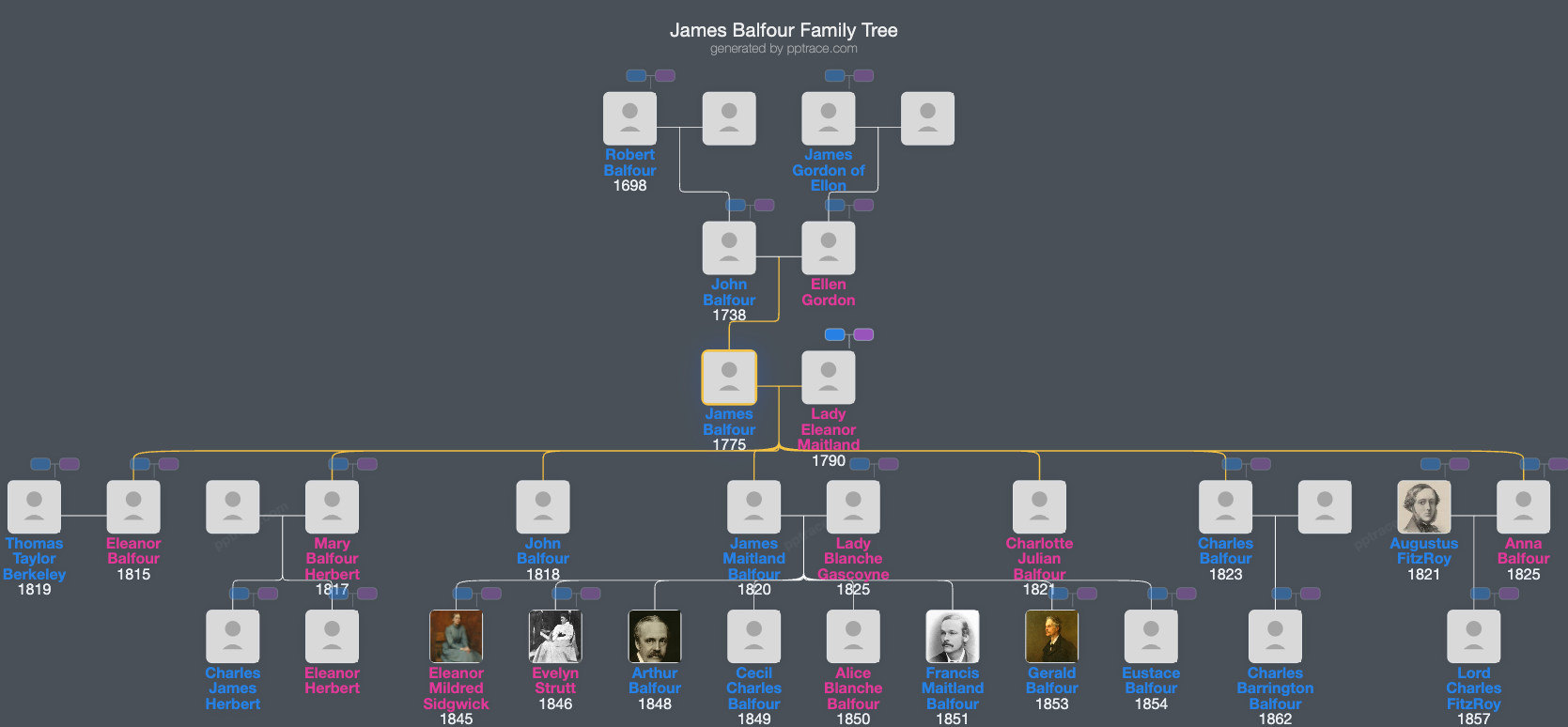
Returning to Scotland in 1815, Balfour married Lady Eleanor Maitland (1790–1869), daughter of James Maitland, 8th Earl of Lauderdale. They had seven children, with three predeceasing them. Their eldest son was killed in a fire in 1822.
Soon after marriage, Balfour acquired estates, including a sporting estate with a shooting lodge in Ross-shire and the Whittingehame estate in Haddingtonshire, which he purchased in 1817 for £11,000 in net rental income. He also purchased a townhouse at No. 3 Grosvenor Square in London. In the 1820s, he employed architect Robert Smirke to design a classical mansion at Whittingehame, which was later expanded and altered by William Burn in 1827. The estate also featured modeled villages and a reconstructed local church. His residence was built of pale cullalo stone and featured French furniture and Sèvres china.
Balfour served as a justice of the peace and was appointed Deputy Lieutenant of Haddingtonshire around 1822. In approximately 1823 or 1824, he acquired the Balgonie estate in Fife from the 10th Earl of Leven, which included coal mines and ironworks.
His political career included attempts to enter Parliament. In 1820, he unsuccessfully contested the Berwick-upon-Tweed by-election, losing by nine votes. He later sought election for the Anstruther Burghs in 1826, successfully securing support from three of the five burghs. Balfour demonstrated support for the Roman Catholic Relief Bill in 1829 by presenting petitions but voted in favor of the bill. In 1830, he was elected as MP for Haddingtonshire, representing it until his retirement from Parliament in 1834. During his tenure, he generally opposed the Reform Bills.
James Balfour died at Whittingehame in April 1845 at approximately 70 years of age. He was survived by his wife and four children, with additional offspring predeceasing him. His estate was valued at over £1 million at his death. His widow received a legacy and life annuity, while his estates and properties were distributed among his children. His descendants include notable figures such as Arthur Balfour, who served as Prime Minister of the United Kingdom from 1902 to 1905.