Sir Thomas Aylesbury, 1st Baronet
| Name | Sir Thomas Aylesbury, 1st Baronet |
| Title | English baronet |
| Gender | Male |
| Birthday | 1576-00-00 |
| nationality | Kingdom of England |
| Source | https://www.wikidata.org/wiki/Q7529036 |
| pptrace | View Family Tree |
| LastUpdate | 2025-11-12T01:14:50.344Z |
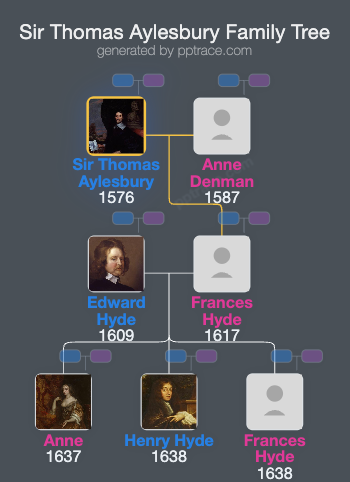
Family Tree
Tap  to expand more relatives
Introduction
Sir Thomas Aylesbury, 1st Baronet (1576 – 1657), was an English civil servant involved in naval and minting administration during the early 17th century. He served as Surveyor of the Navy from 1628 and was jointly appointed Master of the Mint in 1635.
Born in London in 1576, Aylesbury was the second son of William Aylesbury and Anne Poole. He was educated at Westminster School and subsequently attended Christ Church, Oxford, where he earned a Bachelor of Arts degree in 1602 and a Master of Arts in 1605. After completing his education, he became secretary to Charles Howard, 1st Earl of Nottingham, who was the Lord High Admiral of England.
His position was retained by George Villiers, 1st Duke of Buckingham, during Buckingham’s tenure as Nottingham's successor in 1619. Buckingham was an active supporter of Aylesbury, facilitating his appointment as one of the Masters of Requests, and granting him the title of baronet on 19 April 1627. In 1628, Aylesbury began his four-year term as Surveyor of the Navy, and in 1630, he served as a naval commissioner inspecting the fleet at Portsmouth alongside Phineas Pett.
In 1635, Aylesbury, together with Ralph Freeman, formed a commission that exercised the powers traditionally associated with the Master of the Mint. This arrangement was prompted by the exclusion of Robert Harley from the position in favor of Randal Cranfield, who died soon after his appointment.
During the English Civil War, Aylesbury remained a supporter of the monarchy. In 1642, he was stripped of his estate and positions due to his royalist sympathies. He initially retired to Antwerp, and later moved to Breda in 1652, where he lived until his death in 1657 at the age of 81.
He was married twice; his second wife was Anne Denman, with whom he had five children: William, Thomas, Frances, Anne, and Barbara. Frances married Edward Hyde, 1st Earl of Clarendon, and was the mother of Queen Anne Hyde, the first wife of King James II of England. Consequently, Aylesbury was the great-grandfather of Queen Mary II and Queen Anne.
Aylesbury was a patron of scholarly activity, supporting scholars through pensions and maintaining some at his country estate, Cranbourne Lodge, near Windsor. He also hosted scholars in London and collaborated with some on scientific work. His dependants included Walter Warner, who wrote on coinage and alloys at Aylesbury's request, and Thomas Allen, an Oxford scholar recommended to Buckingham. Warner also provided an account to John Pell regarding experiments on Snell's law carried out at Aylesbury’s residence.
He was involved in supporting the publication of Thomas Hariot's posthumous work, Artis Analyticae Praxis, during the 1620s, possibly providing financial assistance. Hariot's papers, along with other manuscripts and his library, were largely lost or sold during the English Civil War. Among his possessions was the only known manuscript of the Ormulum, which apparently belonged to Aylesbury before passing into the hands of Jan van Vliet.
References:
- This article incorporates information from the "Dictionary of National Biography" (London: Smith, Elder & Co., 1885–1900)
- John Craig, "The Mint: A History of the London Mint from A.D. 287 to 1948" (Cambridge University Press, 1953)