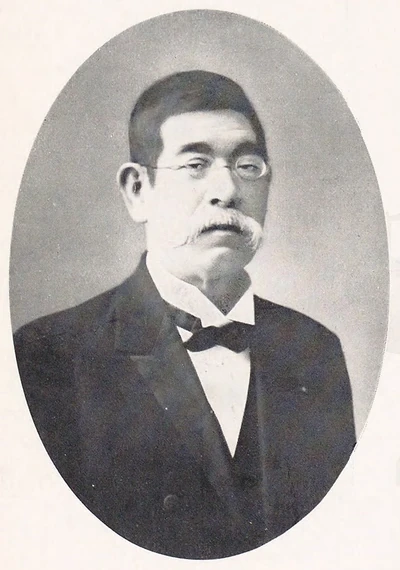
Suematsu Kenchō
| Name | Suematsu Kenchō |
| Title | Japanese politician (1855-1920) |
| Gender | Male |
| Birthday | 1855-09-30 |
| nationality | Japan |
| Source | https://www.wikidata.org/wiki/Q1058300 |
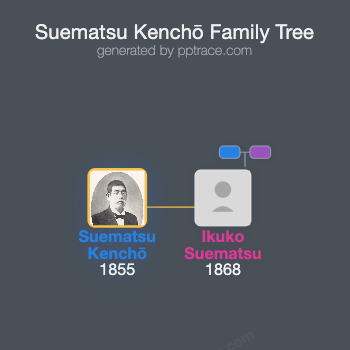
| pptrace | View Family Tree |
| LastUpdate | 2025-11-17T10:07:29.549Z |
Family Tree
Tap  to expand more relatives
Introduction
Viscount Suematsu Kenchō (末松 謙澄; September 30, 1855 – October 5, 1920) was a Japanese politician, intellectual, and author active during the Meiji and Taishō periods. His activities encompassed government service, literature, and diplomatic efforts concerning Japan's international relations.
Suematsu was born in the hamlet of Maeda in Buzen Province, which is currently part of Yukuhashi in Fukuoka Prefecture. He was the fourth son of Suematsu Shichiemon, the village headman (shōya). His given name was originally Ken'ichirō (謙一郎), which he later shortened to Kenchō. At age ten, he enrolled in a private school focused on Chinese studies (kangaku).
In 1871, Suematsu moved to Tokyo to pursue further education, studying with Ōtsuki Bankei and Kondō Makoto. In 1872, he briefly attended the Tokyo Normal School but soon left. Around this time, he met Takahashi Korekiyo. In 1874, at age 20, Suematsu began working as an editorial writer for the Tokyo Nichi Nichi Shimbun, a predecessor of the Mainichi Shimbun, under the pen name Sasanami Hitsuichi (笹波篳一). During his tenure at the newspaper, he befriended its editor, Fukuchi Gen'ichirō.
In 1878, Suematsu traveled to London as part of the Japanese embassy delegations. He enrolled at Cambridge University in 1881, attending St. John's College, where he earned a law degree in 1884. He returned to Japan in 1886.
In the political sphere, Suematsu was elected to the Imperial Diet in 1890. He served as Communications Minister in 1898 and as Home Minister in 1900–1901 during the administration of his father-in-law, Itō Hirobumi. Suematsu married Itō's second daughter, Ikuko, in 1889, when he was 35 and she was 22. His marriage was humorously described as "taking a hostage" due to their respective clan histories from the Kokura and Chōshū clans, which had been in conflict during the 1860s.
Suematsu contributed to the development of Moji port in 1889, seeking financing from Shibusawa Eiichi. He also promoted cultural initiatives, including efforts to improve moral standards in Japanese theatre and establishing a society for drama criticism. He was elevated to the peerage as a baron (danshaku) in 1895 (kazoku).
Between 1904 and 1905, Suematsu was dispatched by the Japanese government to Europe to counteract anti-Japanese propaganda related to the "Yellow Peril" and to advocate Japan's position during the Russo-Japanese War. In 1907, he was promoted to viscount (shishaku).
As a writer, Suematsu produced several works on Japanese culture and history in English, including the first English translation of "The Tale of Genji," which he authored while at Cambridge. Other notable publications include "A Fantasy of Far Japan; or, Summer Dream Dialogues" (1905) and "The Risen Sun" (1905). His literary efforts contributed to cross-cultural understanding of Japan in the West.
Suematsu Kenchō passed away in 1920.