Hiranuma Kiichirō
| Name | Hiranuma Kiichirō |
| Title | Japanese politician (1867-1952) |
| Gender | Male |
| Birthday | 1867-09-28 |
| nationality | Japan |
| Source | https://www.wikidata.org/wiki/Q379996 |
| pptrace | View Family Tree |
| LastUpdate | 2025-11-17T10:09:05.955Z |
Family Tree
Tap  to expand more relatives
Introduction
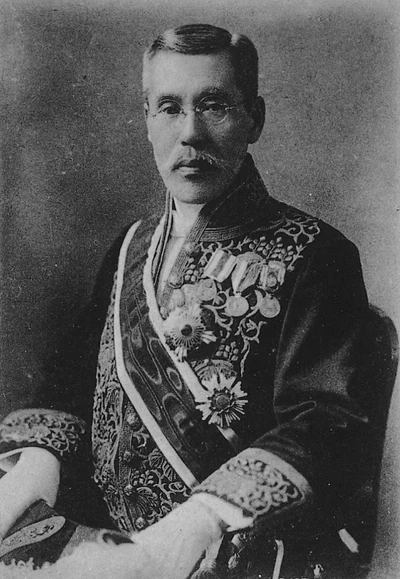
Baron Kiichirō Hiranuma (平沼 騏一郎; born 28 September 1867 – died 22 August 1952) was a Japanese lawyer and politician who held various positions in the government of Japan, including Prime Minister in 1939.
**Early Life and Education**
Hiranuma was born in Tsuyama City, Okayama Prefecture, Japan, in a family of a low-ranking samurai from the Tsuyama Domain of Mimasaka Province. His early education emphasized bushido and the study of Chinese classics. He graduated from Tokyo Imperial University in 1888 with a degree in English law. His political principles were influenced by Confucianism, particularly the teachings of the Mito School, emphasizing the concept of kokutai, which centers on the moral and spiritual unity of Japan linked to the Emperor. He was opposed to Westernization that overlooked Japanese cultural values.
**Career in the Ministry of Justice**
After graduation, Hiranuma joined the Ministry of Justice, where he established a reputation as an opponent of corruption and handled several high-profile cases. He served as director of the Tokyo High Court, public prosecutor of the Supreme Court, and Director of the Civil and Criminal Affairs Bureau. Notably, in 1909, he secured the conviction of 25 members of the Diet of Japan for accepting bribes.
Hiranuma was outspoken against political corruption, socialism, and liberal democracy. In 1911, he served as chief prosecutor during the High Treason Incident, overseeing the trial of socialist-anarchists connected to a plot to assassinate the Meiji Emperor, which led to the execution of 12 defendants, including prominent anarchists and feminists. He was Vice Minister of Justice in 1911 and Prosecutor General in 1912. In 1915, he influenced the resignation of Home Minister Ōura Kanetake over suspected bribery during the Ōura scandal.
**Judicial and Political Roles**
In 1921, Hiranuma was appointed Chief Justice of the Supreme Court. Following the Great Kantō earthquake in September 1923, he served as Minister of Justice under Prime Minister Yamamoto Gonnohyōe, but resigned in January 1924 due to the Toranomon incident, an assassination attempt on Crown Prince Hirohito. The event heightened his vigilance against subversive ideologies, leading him to form the Kokuhonsha, a political organization advocating for the kokutai.
In February 1924, he was appointed to the Privy Council, where he influenced policies tailored to conserve traditional Japanese values. He was promoted to baron (danshaku) in 1926 under the Kazoku peerage system, which was abolished in 1947.
**Policy Positions and Influence**
Hiranuma opposed Prime Minister Wakatsuki Reijirō’s efforts at economic reform and the ratification of the London Naval Treaty of 1930. He supported Japan's military actions in Manchuria and the creation of Manchukuo, advocating for withdrawal from the League of Nations. During the 1930s, he was considered a potential candidate for Prime Minister, though opposition from Prince Saionji, a genrō, hindered this. Saionji viewed Hiranuma’s association with the Kokuhonsha and influence on nationalist policies unfavorably.
**Prime Ministership (1939)**
Hiranuma served as Prime Minister from 5 January to 30 August 1939. His government’s primary concern was Japan's foreign alliances; he favored an anti-communist pact with Germany but was cautious about a broader military alliance due to Japan’s commitments elsewhere. His cabinet resigned following the signing of the German-Soviet Non-Aggression Pact and Japan’s military setbacks in Mongolia during the Nomonhan Incident.
**Later Political Activities**
Hiranuma returned to government service under Prime Minister Fumimaro Konoe, serving as Home Minister in December 1940. He opposed the Imperial Rule Assistance Association and sought to curtail its influence, advocating for the preservation of the prerogatives of the Emperor and traditional state rites. He also opposed the Tripartite Pact signed in September 1940 and was involved in efforts to moderate Japan’s diplomatic stance prior to World War II.
**World War II and Postwar**
During World War II, Hiranuma served as an adviser, or jushin, to Emperor Hirohito. After Japan's surrender, he was prosecuted for war crimes by the International Military Tribunal for the Far East and sentenced to life imprisonment. He died in 1952.