Yehenara Huizheng
| Name | Yehenara Huizheng |
| Title | zaichun |
| Gender | Male |
| Birthday | 1805-01-01 |
| nationality | — |
| Source | https://www.wikidata.org/wiki/Q8172466 |
| pptrace | View Family Tree |
| LastUpdate | 2024-11-13T16:20:32Z |
Family Tree
Tap  to expand more relatives
Introduction
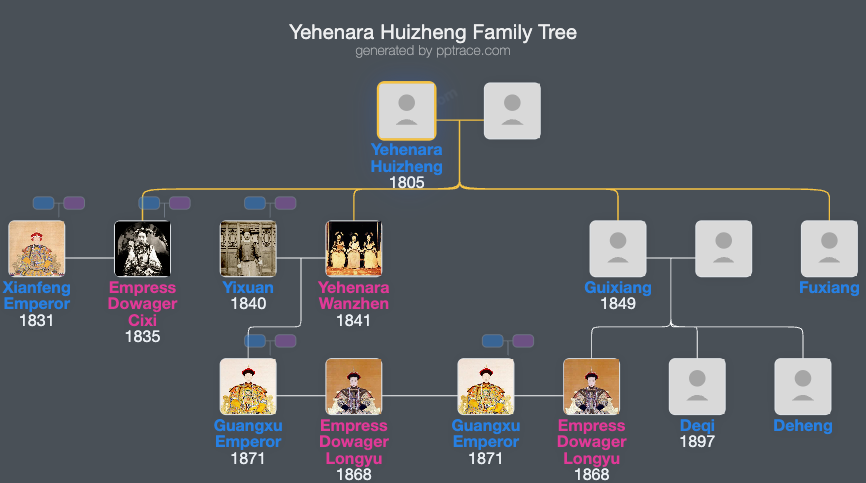
Hui Zheng, born in 1805, was from the Yehenara clan, Manchu banner of the Mural banner. He was a Qing dynasty official and an in-law of the imperial family. He was the father of Empress Dowager Cixi, the grandfather of the Tongzhi Emperor and Guangxu Emperor, and the grandfather of Empress Dowager Longyu. His younger brother was Hui Chun. Coming from a jiansheng (graduate scholar) background, his official career began with the jin tie shi (literary degree-serving official) and gradually advanced through promotions.
In the 11th year of Daoguang (1831), he served as jin tie shi; in the 14th year of Daoguang (1834), he was officially recognized through court inspection as a second-class official of the Ministry of Personnel; in the 19th year of Daoguang (1839), he was promoted to an eighth-grade jin tie shi; in the 23rd year of Daoguang (1843), he was again classified as a first-class official of the Ministry of Personnel through court inspection. In the 26th year of Daoguang (1846), he served as an editor of the Wenxuan Department of the Ministry of Personnel; in the 28th year of Daoguang (1848), he was promoted to a SQLangkong (foreign language official) of the Verification Department of the Ministry of Personnel; at the beginning of the 29th year of Daoguang, he was confirmed as a first-class official in court inspection and entered the record of the Military Secretariat, to be used in the Daofu (administration). In the leap month of the 29th year of Daoguang (1849), on the 17th day of the lunar month (June 7, 1849), the cabinet commissioned Hui Zheng by imperial edict to serve as the daoyuan (circuit commissioner) of Shanxi Gui Sui Circuit, stationed in Guihua City (present-day Hohhot, Inner Mongolia). After taking office, he was known for his financial management. Governor-General Gong Yu of Shanxi praised him that “although serving only a few months, he was earnest in handling affairs,” and suggested that “he be entrusted with specific responsibilities,” which Emperor Daoguang approved, remarking “the Ministry of Revenue is aware.”
On the sixth day of the second lunar month in the second year of Xianfeng (March 26, 1852), Hui Zheng was transferred to serve as the daoyuan of Ningchi Taiguang Circuit in Anhui, based in Wuhu. On the eighth day of that same lunar month (March 28, 1852), Empress Dowager Cixi was selected as a Miao Nu (candidate) for the imperial harem; on the eleventh day, a eunuch from the Jing Shi Fang (Respectful Service Department) conveyed the imperial edict establishing Cixi as a Lan Gui Ren (Lady of the Orchid Pavilion) and ordered her to enter the palace in May of that year. Hui Zheng was busy with this matter. After sending off his daughter, he took up his post in Wuhu in July of the same year. Less than half a year into his tenure, he was forced to hand over 4,000 to 5,000 taels of silver. The Taiping Army successively captured Changsha and Hubei, causing chaos in Anhui. Hui Zheng was ordered to personally lead the local navy to patrol ships and suppress the rebellion among the populace. Anhui governor-general Jiang Wenqing, in a year-end review, praised him as “clear-minded, detailed in work, and diligently leading patrol ships to arrest bandits, without sparing effort.”
In December of the second year of Xianfeng (1852), the Taiping Army captured the three cities of Hubei's Wuhan and advanced westward along the Yangtze River. The Qing court appointed Lu Jianying, then Governor-General of Liangjiang, as the imperial commissioner, increasing defenses in Jiangxi and Anhui. After suffering setbacks at Wu Xue in Hubei, Lu Jianying summoned Hui Zheng and Chen Shengyuan to discuss going to Liangshan to handle grain supplies. Hui Zheng brought his family to Jing County, Ningguo Prefecture, carrying seals and silver remittances, and with Chen Shengyuan headed to Dongliang Mountain. On the 17th day of the first month of the third year of Xianfeng (February 24, 1853), the Taiping Army captured Anqing, leading to worsening conditions around Dongliang Mountain. Hui Zheng, under the pretense of escorting grain remittances, escaped to Nanjing with 10,000 taels of silver but was turned away at the city gates. He then headed to Zhenjiang and was taken in by Jiangsu Province's governor-general Yang Wending, who assigned him to manage supplies and grain. After the Taiping Army captured Nanjing, Hui Zheng was arranged to go to Dantu to manage grain supplies there.
Emperor Xianfeng was greatly angered by the defection and loss of territory by local officials in battle, ordering Li Jiaduan to investigate strictly. Other officials also became involved, and Hui Zheng was suspected of “escaping the responsibilities and assignments.” On July 8, 1853 (the third day of the sixth lunar month of Xianfeng's 3rd year), Hui Zheng died in Zhenjiang Prefecture. On August 9 of the same year, Li Jiaduan reported that he had died of illness and could not be questioned. Emperor Xianfeng approved the report with the remark “understood.”
In the first year of the Tongzhi era (1862), in August, Hui Zheng was posthumously promoted to the third rank of Cheng’en Gong (Duke Who Supports Benevolence), with the posthumous name Duanke (Endeavoring and Virtuous).