Christopher Hatton, 1st Baron Hatton
| Name | Christopher Hatton, 1st Baron Hatton |
| Title | English aristocrat and politician |
| Gender | Male |
| Birthday | 1605-06-28 |
| nationality | Kingdom of England |
| Source | https://www.wikidata.org/wiki/Q5112504 |
| pptrace | View Family Tree |
| LastUpdate | 2025-11-26T12:25:34.670Z |
Family Tree
Tap  to expand more relatives
Introduction
Christopher Hatton, 1st Baron Hatton, KB, PC, FRS (28 June 1605 – 4 July 1670), was an English nobleman and politician during the 17th century. He was a first cousin twice removed of Sir Christopher Hatton, an Elizabethan politician.
Born in Barking, Essex, Hatton was the son of Sir Christopher Hatton and Alice Fanshawe, daughter of Thomas Fanshawe. He received his education at Jesus College, Cambridge, and trained for the law at Gray's Inn. As an antiquarian, Hatton compiled the "Book of Seals," a volume of 529 medieval charters, which includes 240 facsimiles drawn by a skilled draftsman. The volume was published in 1950 under the editorship of Lewis C. Loyd and Doris Mary Stenton.
Hatton's political career began in 1625 when he entered Parliament as the Member of Parliament for Peterborough, despite being legally too young to sit. In 1626, he served as MP for Clitheroe. Upon reaching the age of 21 in 1626, he was created a Knight of the Bath, following the precedent set by his father. In 1640, Hatton was elected to the Long Parliament for both Higham Ferrers and Castle Rising, choosing to sit for Higham Ferrers, where he served as High Steward. His election was notably supported by Queen Henrietta Maria.
During the English Civil War, Hatton supported King Charles I. In 1643, he was elevated to the peerage as Baron Hatton of Kirby. He acted as comptroller of the royal household and represented the king at the negotiations at Uxbridge in 1645. After the outbreak of the Civil War, he spent several years in France. Following the Restoration of the monarchy, he was appointed a privy councillor and governor of Guernsey.
From around 1648, Hatton employed George Jeffreys as his steward in charge of Kirby, Northamptonshire. Many letters from Jeffreys, part of the Hatton–Finch correspondence, span nearly forty years and provide insight into Hatton’s management and relationships. In 1663, Hatton became a founding Fellow of the Royal Society.
He died at Kirby, Northamptonshire, on 4 July 1670, and was buried at Westminster Abbey.
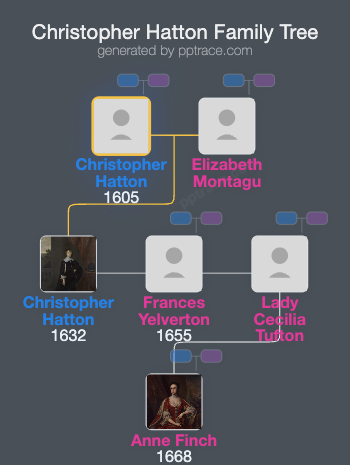
Family-wise, Hatton married Elizabeth Montagu, the eldest daughter and coheiress of Sir Charles Montagu of Boughton, Northamptonshire, at Hackney, Middlesex, on 8 May 1630. Elizabeth died in 1672 when lightning struck a powder magazine at Castle Cornet in Guernsey. They had two sons—Christopher Hatton, who became the 1st Viscount Hatton, and Charles Hatton—along with three daughters. Charles married Elizabeth Scroggs, the daughter of Sir William Scroggs, as her second husband.
References for Hatton’s life include entries from the Dictionary of National Biography and scholarly works on the Long Parliament and the Book of Seals.