William Cavendish, 7th Duke Of Devonshire
| Name | William Cavendish, 7th Duke Of Devonshire |
| Title | British landowner, benefactor and politician (1808-1891) |
| Gender | Male |
| Birthday | 1808-04-27 |
| nationality | United Kingdom of Great Britain and Ireland |
| Source | https://www.wikidata.org/wiki/Q337626 |
| pptrace | View Family Tree |
| LastUpdate | 2025-11-26T23:22:31.462Z |
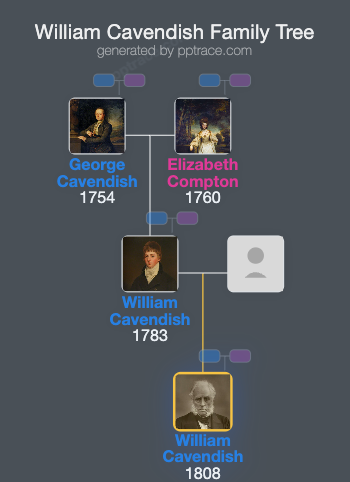
Family Tree
Tap  to expand more relatives
Introduction
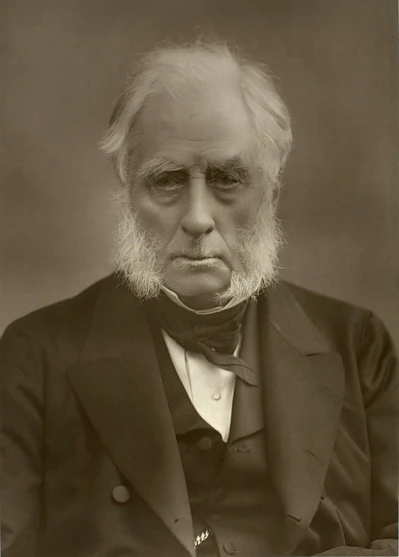
William Cavendish, 7th Duke of Devonshire, was born on 27 April 1808 and died on 21 December 1891. He was an English aristocrat, landowner, property developer, industrialist, benefactor, and political figure.
Early Life:
Cavendish was the son of William Cavendish (1783–1812) and the Honourable Louisa O'Callaghan (d. 1863). His paternal grandfather was Lord George Cavendish, who was created the 1st Earl of Burlington in 1831; Lord George Cavendish was the third son of the 4th Duke of Devonshire and Lady Charlotte Boyle, daughter of the 3rd Earl of Burlington and 4th Earl of Cork. His maternal grandfather was the 1st Baron Lismore. He was educated at Eton College and Trinity College, Cambridge, where he attained the position of Second Wrangler and received the Smith's Prize in mathematics.
Titles and Early Political Career:
Initially styled Lord Cavendish of Keighley from 1831, when the earldom of Burlington was revived for his grandfather, he became known as Earl of Burlington in 1834 upon succeeding his grandfather. He was a Member of Parliament for Cambridge University starting in 1829 until 1831; he then briefly represented Malton from July to September 1831, before returning to Parliament as MP for North Derbyshire in 1832. In 1834, he succeeded to his grandfather's earldom and entered the House of Lords.
Peerage and Public Roles:
Cavendish inherited the Dukedom of Devonshire in 1858 after the death of his cousin. He served as Lord-Lieutenant of Lancashire from 1857 until 1891 and as Lord-Lieutenant of Derbyshire from 1858 until 1891. He held academic administrative positions: Chancellor of the University of London (1836–1856), Chancellor of the University of Cambridge (1861–1891), and Chancellor of Victoria University (1880–1891). He endowed the Cavendish Professorship of Physics at Cambridge and funded the construction of the Cavendish Laboratory.
Business and Contributions:
He invested extensively in heavy industry at Barrow-in-Furness, although these ventures were ultimately unsuccessful. His nearby estate, Holker Hall, was rebuilt after a fire in 1871. He was a founding member of the Royal Agricultural Society in 1839 and served as its president in 1870. On 26 July 1871, he was appointed a trustee of the British Museum.
Property and Urban Development:
The Duke inherited significant property holdings, notably in Eastbourne, from his grandfather and wife Elizabeth Compton of Compton Place. He played a role in developing Eastbourne, contributing to its parks, baths, and squares, and is commemorated by a statue at the top of Devonshire Place. Additionally, he was involved in establishing Eastbourne College, purchasing land for its construction, and commissioning Henry Currey to design the school's chapel and College House.
Personal Life:
In 1829, Cavendish married Blanche Georgiana Howard (1812–1840), daughter of George Howard, 6th Earl of Carlisle, and Lady Georgiana Cavendish, sister to the 6th Duke of Devonshire. Blanche was his favorite niece, and their marriage was marked by his fondness for her and their children. They had five children:
- William Cavendish, Lord Cavendish of Keighley (1831–1834), who died six days after his great-grandfather.
- Spencer Cavendish, later the 8th Duke of Devonshire (1833–1908), married Countess Louisa von Alten.
- Lady Louisa Caroline Cavendish (1835–1907), married Admiral The Hon. Francis Egerton.
- Lord Frederick Charles Cavendish (1836–1882), married The Hon. Lucy Lyttelton; served as Chief Secretary for Ireland and was murdered in Phoenix Park, Dublin.
- Lord Edward Cavendish (1838–1891), MP, married The Honorable Emma Lascelles; among their children was Victor Cavendish, 9th Duke of Devonshire.
Death and Estates:
William Cavendish died at Holker Hall, in Cumbria, after a prolonged illness. At the time of his death, he owned approximately 198,000 acres, including holdings in Derbyshire, Lancashire, County Cork, and County Waterford.
Descendants:
His lineage includes children and grandchildren who married into other noble families. Through his daughter Lady Louisa, he was grandfather to William Francis Egerton (1868–1949), who married Lady Alice Osborne, daughter of the 9th Duke of Leeds, and was father to Captain Francis Egerton.