Motonaru Higashizono
| Name | Motonaru Higashizono |
| Title | 12 Jul 1851 - 10 Nov 1920 |
| Gender | Male |
| Birthday | 1851-12-07 |
| nationality | Japan |
| Source | https://www.wikidata.org/wiki/Q120691426 |
| pptrace | View Family Tree |
| LastUpdate | 2025-11-28T20:17:05.102Z |
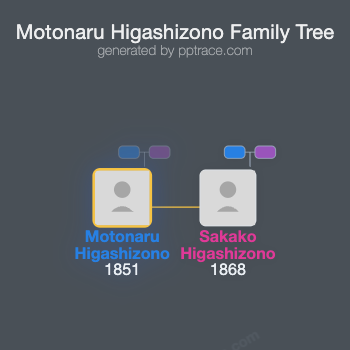
Family Tree
Tap  to expand more relatives
Introduction
Motona Higasizono (born June 14, 1851 (Kaei 4), July 12, 1851 (Gregorian), – November 10, 1920 (Taishō 9)) was a Japanese court noble and aristocrat who held the title of Viscount. The Higasizono family possessed the court rank of Hanringake, and Motona was the 12th head of the family.
Life
Early Life and Childhood
Born on July 12, 1851 (Kaei 4), as the eldest son of Motanori Higasizono. His mother was a daughter of Yamamoto, from the Kamo Uji family. He was granted court rank on May 15, 1852 (Kaei 5), and on March 27, 1852, he received his nobility title. On December 20, 1859 (Ansei 6), he came of age, was permitted to wear court insignia, and was promoted to the Junior Fifth Rank, Upper Grade.
Service as an Attendant to Emperor Meiji
From 1868 to 1873, he served as an attendant to Emperor Meiji.
In January 1868, he was ordered to serve as the court official in charge of state affairs records, and in April, he accompanied Emperor Meiji’s visit to Osaka.
On June 11, 1868 (Uruur 4), he became a close attendant to the emperor, and in October, he was appointed as a court page (Jiji), with permission to wear the purple cord insignia.
From autumn 1868 through the following year, he accompanied Emperor Meiji during his eastern journey (Higashi no Miyuki), visits to Ise Shrine, and the re-visit to Tokyo.
In 1869, he was appointed as a temporary riding official and received the duty of supervising sacred music performances.
In 1870, he was dismissed from his role as a court page, downgraded to a secondary attendant, and subsequently served as a riding official.
In 1871, he was reappointed as a court attendant and accompanied the emperor during his travels.
Inspection of Sakhalin and Diplomatic Missions
In 1873, following the incident involving clashes between the Russian army and Japanese forces in Hakodate, he was dispatched to patrol and inspect Sakhalin.
The following year, he conducted surveys around Sakhalin and Hokkaido, using Kusuki as a base, and visited various locations on Sakhalin.
During these inspections, he met officials working in Sakhalin as envoys, offered words of encouragement, and presented gifts.
He also inspected the Soya region and other parts of Hokkaido.
Personal Life and Succession
In 1874, he received a portrait of Empress Shōtō (Empress Dowager Eishō) and his eldest son Motoki was born.
Beginning in 1876, he served as an attendant during the Ōu (Oshu) imperial pilgrimage.
Inheritance and Death
He succeeded to the family headship in 1876; however, detailed records of his subsequent career and family circumstances are not available.
He died on November 10, 1920.
Details regarding references, sources, and family composition mentioned in external documents are not included within this summary.