Tom Major-Ball
| Name | Tom Major-Ball |
| Title | British entertainer |
| Gender | Male |
| Birthday | 1879-05-18 |
| nationality | United Kingdom |
| Source | https://www.wikidata.org/wiki/Q7816689 |
| pptrace | View Family Tree |
| LastUpdate | 2025-11-26T13:03:07.370Z |
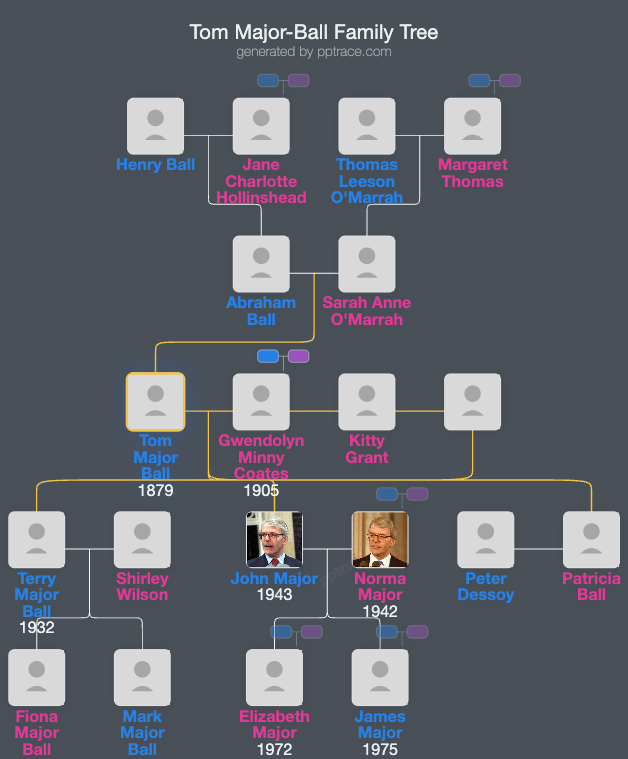
Family Tree
Tap  to expand more relatives
Introduction
Tom Major-Ball was born Abraham Thomas Ball on 18 May 1879 in Bloxwich, Staffordshire, England. His parents were Abraham Ball, a bricklayer, and Sarah Ann Marrah or O'Marrah, who was of Irish and possibly Welsh descent. The family also included an adopted son named Alfred. When Major-Ball was five years old, his family emigrated to the United States, where he spent his early years in Pennsylvania. His father worked as a steelworker in Pittsburgh, Philadelphia, and Fall Hollow, a small village near Braddock.
During his youth, Major-Ball worked as a vaudeville performer and trapeze artist in traveling circuses. Around 1896, the family returned to the United Kingdom, settling in the Walsall area. Major-Ball developed a career in music hall performance, claiming to have performed at venues across England, Wales, Scotland, and Ireland.
In 1901, Major-Ball fathered an illegitimate child, Tom Moss, with Mary Moss, who was married at the time. His stage act primarily involved comedy and singing and dancing, often performing with a partner named Kitty Grant. The act was initially called "Drum and Ball," with Grant adopting the stage name Drum. Major-Ball later added "Major" to his stage name when the act was renamed "Drum and Major," and he sometimes performed under the name Tom Major.
Between July 1903 and 1904, Major-Ball and Kitty Grant toured South America for a year. During this period, he worked as a ranch-hand in Argentina and at a casino in Buenos Aires. He became involved in a civil war in Uruguay, where he was compelled to enlist in a militia. After returning to the United Kingdom in April 1904, he and Grant continued their music hall careers. In 1906, Major-Ball and Kitty Grant became founding members of the Variety Artistes' Federation at the Vaudeville Club in London. They married in 1910 following the death of Grant’s husband, David Grant.
Major-Ball was prevented from serving actively in World War I due to a heart condition. In 1923, he had an affair with Alice Maud Frankland, resulting in the birth of a daughter, Kathleen, on 6 October 1923. Kitty Grant died in June 1928 after being struck by a steel beam during a stage performance.
Following the decline of music halls and the increase in cinema popularity, Major-Ball retired from performing in 1930. He married dancer Gwendolyn (Gwen) Minny Coates on 4 May 1929, who had supported him during Kitty Grant’s final illness. The couple settled in Worcester Park, Surrey, where Major-Ball founded Major's Garden Ornaments, manufacturing garden gnomes and other garden ornaments.
Major-Ball and Coates had four children: Thomas Aston (born June 1929, died shortly after birth), Pat Major-Ball (later Dessoy; born in 1930), Terry Major-Ball (born July 1932), and John Major (born 29 March 1943). The family experienced financial difficulties during the 1950s when World War II adversely affected their business, leading to a move from Worcester Park to a rented flat in Brixton. Attempts to emigrate to Canada were impeded due to Major-Ball's poor eyesight. The garden ornament business was eventually sold in 1959, providing funds for a move to 80 Burton Road, Brixton.
Tom Major-Ball died on 27 March 1962. His son, John Major, later became Prime Minister of the United Kingdom, serving from 1990 to 1997. Following Major-Ball's death, his widow Gwen survived until September 1970. His background and career have been subject to media interest, with some cultural speculation linking his stage persona's name to the character Major Tom in David Bowie's song "Space Oddity."