Angelica Singleton Van Buren
| Name | Angelica Singleton Van Buren |
| Title | First Lady of the United States |
| Gender | Female |
| Birthday | 1818-02-13 |
| nationality | United States of America |
| Source | https://www.wikidata.org/wiki/Q233656 |
| pptrace | View Family Tree |
| LastUpdate | 2025-11-17T06:38:33.363Z |
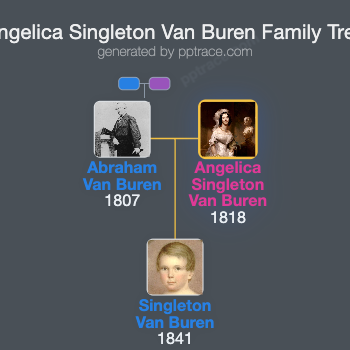
Family Tree
Tap  to expand more relatives
Introduction
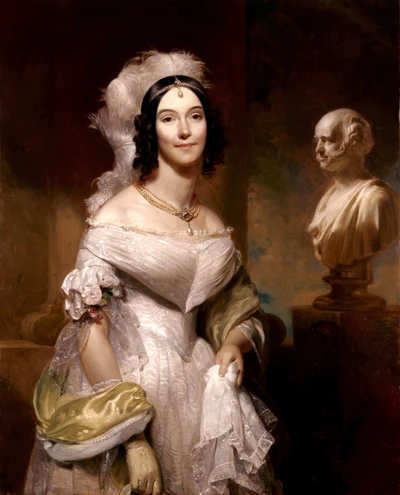
Sarah Angelica Singleton Van Buren (née Singleton) was born on February 13, 1818, in Wedgefield, South Carolina. She was the fourth of six children born to Richard Singleton and Rebecca Travis Coles. Singleton received education at the Columbia Female Academy in South Carolina and attended Madame Grelaud's French School in Philadelphia for five years. Her time at Madame Grelaud's school provided her with exposure to a diverse social environment.
In the winter of 1837-38, Singleton and her sister Marion stayed in Washington, D.C., residing with United States Senator William C. Preston, a cousin of their mother. During this period, they were introduced to Washington society through connections with Dolley Madison, a former First Lady and cousin of the family. In March 1838, Madison facilitated introductions for the sisters to the sons of President Martin Van Buren. Sarah Angelica Singleton became engaged to Abraham Van Buren II, the President's son, and they married on November 27, 1838, at her father's plantation in Wedgefield. The marriage coincided with Abraham Van Buren's thirty-first birthday.
Following her marriage, Singleton assumed the role of White House hostess, acting as the first lady following the death of Hannah Van Buren, the president's wife, as Martin Van Buren never remarried. Her tenure as hostess is notable for her success in this capacity and for her initiation into Washington social life. In 1839, the couple traveled to England, where her uncle, Andrew Stevenson, served as U.S. minister to the United Kingdom. During this European tour, she attempted to incorporate European customs and garden designs into White House functions, though these efforts were only partially realized.
In 1840, she experienced personal tragedy when her first child, Rebecca, was born and shortly died. That same year, she became pregnant again but did not resume her hostess duties afterward. Her popularity and influence during her time as acting first lady have been subject to historical assessment. In a 1982 survey by the Siena College Research Institute, she was ranked as the 36th most highly regarded first lady among 42 listed individuals; subsequent surveys have excluded acting first ladies from rankings.
After President Van Buren's defeat in the 1840 election, Singleton and her family moved to Sumter, South Carolina. In June 1841, she gave birth to her son Singleton. Later that year, the family relocated to Lindenwald, Van Buren's estate in Kinderhook, New York, where she managed household affairs and continued her social duties. The Van Buren family had three more sons: Martin Van Buren II, born in 1844; Travis Coles Van Buren, born in 1848; and she also became guardian to her niece Mary McDuffie.
During the Mexican-American War, her husband Abraham returned to military service from 1846 until 1854. In 1848, the family moved to New York City, where they resided until their deaths. In 1853, Singleton intervened to protect her sister Marion from an abusive marriage, though her efforts were hindered by political affiliations and legal obstacles.
Between 1854 and 1856, the family traveled through Europe, where Singleton was influenced by social reform literature and developed an interest in charity work. She dedicated herself to these causes upon returning to the United States.
Martin Van Buren died in 1862 at age 79, and Abraham Van Buren died in 1873. Singleton herself died on December 29, 1878, and was interred with her husband at Woodlawn Cemetery in New York.
References:
- James C. Welling (1914). "Martin Van Buren." In James Grant Wilson (ed.), The Presidents of the United States, 1789–1914.
External links:
- Angelica Van Buren biography at American Presidents Blog
- Angelica Singleton Van Buren Collection at the University of South Carolina