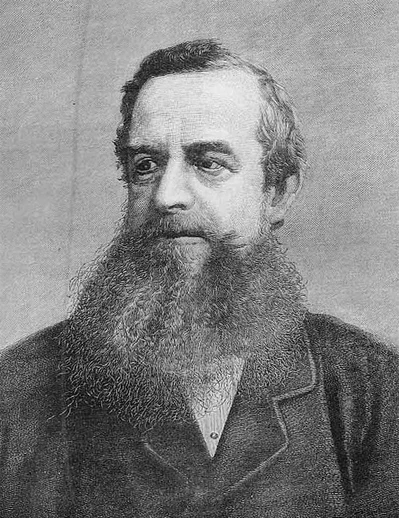
George Robinson, 1st Marquess Of Ripon
| Name | George Robinson, 1st Marquess Of Ripon |
| Title | British politician (1827–1909) |
| Gender | Male |
| Birthday | 1827-10-24 |
| nationality | United Kingdom of Great Britain and Ireland |
| Source | https://www.wikidata.org/wiki/Q333111 |
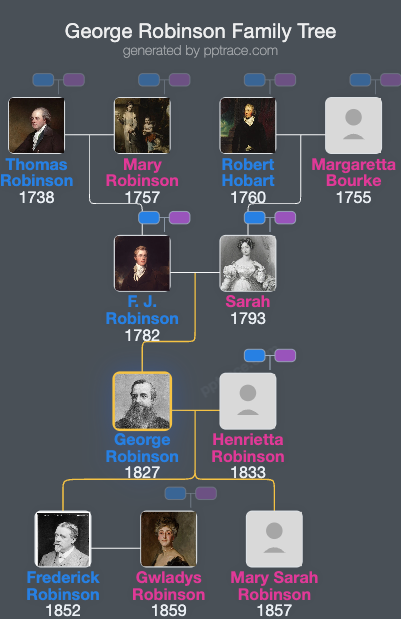
| pptrace | View Family Tree |
| LastUpdate | 2025-11-26T23:26:49.750Z |
Family Tree
Tap  to expand more relatives
Introduction
George Frederick Samuel Robinson, 1st Marquess of Ripon (24 October 1827 – 9 July 1909), was a British politician and colonial administrator. He was born at 10 Downing Street, London, as the second son of Prime Minister F. J. Robinson, 1st Viscount Goderich, who was later created Earl of Ripon in 1833. His mother was Lady Sarah Hobart, daughter of the Earl of Buckinghamshire. Robinson was privately educated and did not attend any formal school or college. In 1870, he was awarded an honorary Doctor of Civil Law degree by the University of Oxford.
Robinson's early diplomatic experience included participation in his uncle Sir Henry Ellis's British special mission to the Brussels Conference concerning Italian affairs during 1848–49. Politically, he initially aligned with the Whigs and later as a Liberal, despite his father's Tory affiliation.
He entered the House of Commons in 1852 as a member for Hull. In 1853, he and fellow MP James Clay were unseated after election petitions alleging widespread corruption, though they were exonerated of wrongdoing. Later that year, Robinson was elected as representative for Huddersfield, and in 1857, he represented the West Riding of Yorkshire. In 1859, he succeeded his father as the second Earl of Ripon and took his seat in the House of Lords. He also inherited the titles of Earl de Grey and Ripon, becoming Earl de Grey and Ripon.
Robinson served in various governmental positions. He was Under-Secretary of State for War under Lord Palmerston from 1859 to 1861 and again from 1861 to 1863. In 1861, he briefly served as Under-Secretary of State for India. He was appointed a Privy Counsellor in 1863 and became Secretary of State for War, serving under Palmerston and, later, Lord Russell after Palmerston's death. In 1866, he was Secretary of State for India. Under William Ewart Gladstone's first administration (1868–1873), he was Lord President of the Council.
In 1871, Robinson was created Marquess of Ripon in the County of York, following his role as chairman of the joint commission that drafted the Treaty of Washington concerning the Alabama Claims. He had been made a Knight of the Order of the Garter in 1869. In 1878, he served as President of the first day of the Co-operative Congress.
In 1880, upon Gladstone's return to power, Robinson was appointed Viceroy of India, serving until 1884. His tenure included proposing the Ilbert Bill, which aimed to extend legal rights to Indians, such as allowing Indian judges to try Europeans. The bill was opposed by European residents and was ultimately not enacted. During his administration, Robinson repealed the Vernacular Press Act of 1878 and promoted the Indian Famine Codes. He supported the expansion of forest conservation efforts in India and aided in reorganizing the Madras Forest Department.
Robinson's activities in India included participation in a shooting expedition organized by the Maharaja of Darbhanga in 1883. His legacy in India is reflected in landmarks such as the Ripon Building in Chennai, the town of Riponpet in Karnataka, and Ripon Street in Calcutta. Structures bearing his name also include the Ripon Building in Multan, Pakistan, and the Ripon Club in Mumbai.
Returning to Britain, Ripon supported the movement for Irish Home Rule. He held several prominent roles, including First Lord of the Admiralty in Gladstone's 1886 government, Secretary of State for the Colonies from 1892 to 1895, and Lord Privy Seal in 1905. He resigned his position as Leader of the House of Lords in 1908 when H. H. Asquith became Prime Minister.
Throughout his life, Robinson was active in public service and held numerous appointments. He was President of the Royal Geographical Society (1859–1860), Trustee of the National Gallery, and served as High Steward of Hull, Lord Lieutenant of the North Riding of Yorkshire (from 1873 to 1906), and Mayor of Ripon (1895–1896).
A member and leader within Freemasonry, he served as Provincial Grand Master of the West Riding, Deputy Grand Master of the United Grand Lodge of England, and later as Grand Master. His conversion to Catholicism in 1874 was notable, and he supported Catholic charitable and educational causes thereafter. He was president of the Society of St Vincent de Paul from 1899 until his death.
Robinson married Henrietta Anne Theodosia Vyner, his cousin, in 1851. They had a son, Frederick Oliver Robinson, who succeeded him as the 2nd Marquess of Ripon, and a daughter, Mary Sarah Robinson, who died in infancy. Lady Ripon died in 1907; Robinson died of heart failure at Studley Royal Park in July 1909 at age 81. His estate was valued at over £127,000 at probate.