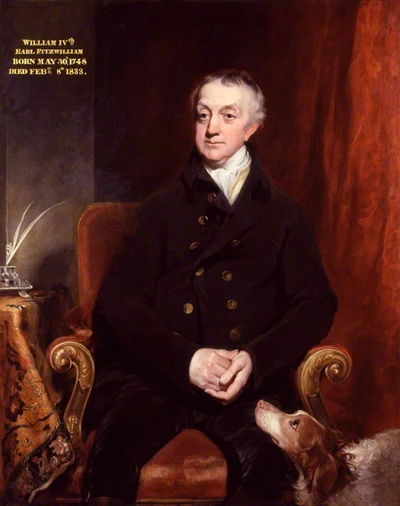
William Fitzwilliam, 4th Earl Fitzwilliam
| Name | William Fitzwilliam, 4th Earl Fitzwilliam |
| Title | British politician |
| Gender | Male |
| Birthday | 1748-05-30 |
| nationality | — |
| Source | https://www.wikidata.org/wiki/Q8009134 |
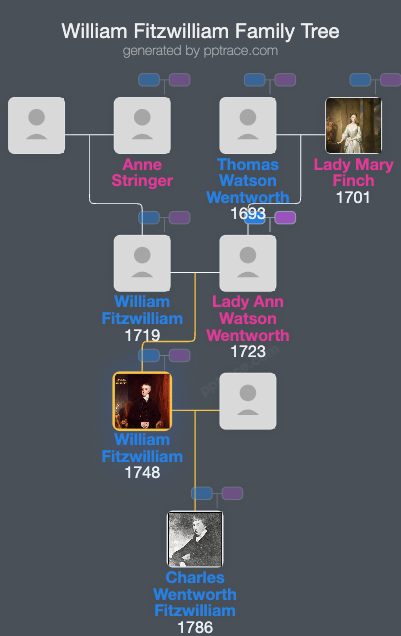
| pptrace | View Family Tree |
| LastUpdate | 2025-11-26T23:23:42.629Z |
Family Tree
Tap  to expand more relatives
Introduction
William Wentworth-Fitzwilliam, 4th Earl Fitzwilliam, was born on 30 May 1748 and died on 8 February 1833. He was styled Viscount Milton until 1756, when he inherited the earldoms of Fitzwilliam from his father, William Fitzwilliam, 3rd Earl Fitzwilliam. His mother was Lady Anne Watson-Wentworth, daughter of Thomas Watson-Wentworth, 1st Marquess of Rockingham. Fitzwilliam was a member of the British aristocracy and a notable Whig politician during the late 18th and early 19th centuries.
He was educated at Eton College, where he formed friendships with Charles James Fox and Lord Morpeth. His tutor there was Edward Young, who wrote positively about his intelligence and temper. In October 1764, Fitzwilliam embarked on a grand tour of Europe accompanied by Thomas Crofts, a clergyman nominated by Edward Barnard, headmaster of Eton. During this tour, which included France, Switzerland, Italy, and other parts of Europe, he was exposed to art and culture, collecting paintings and visiting galleries. He visited Italy between 1767 and 1768, where he appreciated artworks in Verona, Venice, Padua, Bologna, and Florence, guided by notable connoisseurs such as Sir Horace Mann and William Hamilton. He returned to England in January 1769 with a collection of paintings.
Fitzwilliam's financial circumstances prior to inheriting his uncle's estate were substantial but not extraordinary. His estate in Milton yielded about £3,000 annually; additional estates in Lincolnshire, Nottinghamshire, Yorkshire, and Norfolk, along with rents from Peterborough, contributed approximately £3,600 annually, totaling around £6,900 in 1768. He also inherited a debt of £45,000, which he cleared by selling Norfolk properties for £60,000. Upon his uncle Lord Rockingham’s death in 1782, Fitzwilliam inherited Wentworth Woodhouse, a large mansion, and extensive estates including the Wentworth estate, comprising 14,000 acres in South Yorkshire yielding nearly £20,000 annually, the Malton estate, and substantial Irish landholdings totaling 66,000 acres with rental income.
His landholdings and mineral rights, particularly coal mines, provided a significant income stream. In 1780, his collieries yielded a profit of £1,480; by 1796, this had increased to nearly £3,000, and by 1825, profits exceeded £22,000. The volume of coal production grew from over 12,500 tons in 1799 to more than 122,000 tons in 1823. His total net income from all estates was estimated at £115,000 in 1827.
As a landlord, Fitzwilliam managed his estates by reducing rents during hardship, forgiving arrears, and providing aid such as coal and blankets to the poor. He performed his duties in property maintenance, and his charitable activities included supporting friendly societies and savings banks. His lifestyle included country activities such as hunting and racehorse breeding. He was appointed deputy lieutenant of Northamptonshire on 18 February 1793.
Fitzwilliam became a prominent Whig politician following his uncle’s death. He participated actively in House of Lords debates, consistently opposing government policies, and supported figures like John Wilkes and the American colonies’ grievances. Notably, he proposed a remonstrance to the King in 1776 concerning the American conflict. He inherited the estates of the 2nd Marquess of Rockingham, making him one of the largest landowners in Britain, with nearly 100,000 acres and annual rents totaling approximately £60,000.
He supported political opposition and was involved with the Fox-North coalition government, advocating for American independence and other Whig policies. Fitzwilliam’s early political contributions included his first speech in the House of Lords on 30 June 1783. Throughout his life, he maintained a significant influence in Whig politics, embodying the responsibilities and interests of a major landowning aristocrat and political figure during this period.