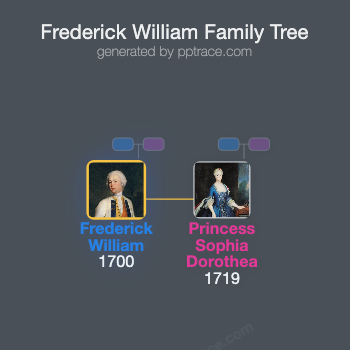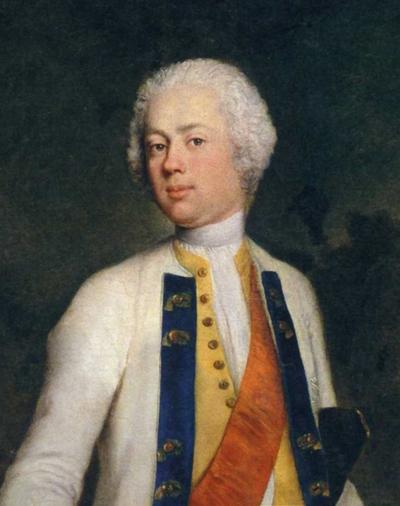
Frederick William, Margrave Of Brandenburg-Schwedt
| Name | Frederick William, Margrave Of Brandenburg-Schwedt |
| Title | German noble (1700-1771) |
| Gender | Male |
| Birthday | 1700-12-17 |
| nationality | Germany |
| Source | https://www.wikidata.org/wiki/Q689201 |
| pptrace | View Family Tree |
| LastUpdate | 2025-11-12T01:15:49.484Z |
Family Tree
Tap  to expand more relatives
Introduction
Frederick William of Brandenburg-Schwedt was born on 17 November 1700 at Oranienbaum Castle, located in what is now Oranienbaum-Wörlitz, Wittenberg. He was a member of the House of Hohenzollern, belonging to its junior branch, the Brandenburg-Schwedt line. His parents were Philip William, Margrave of Brandenburg-Schwedt, and Princess Johanna Charlotte of Anhalt-Dessau. Frederick William was the nephew of King Frederick I of Prussia.
He was granted the titles of Prince in Prussia and Margrave of Brandenburg, holding these titles from 1711 until his death in 1771, with the style "Royal Highness." In addition, he was made a knight of the Order of the Black Eagle. During the 19th century, historical references retrospectively referred to him as the Margrave of Brandenburg-Schwedt to distinguish his branch of the Hohenzollern family. He was the second holder of the Prussian secundogeniture of Brandenburg-Schwedt.
Frederick William was educated and raised initially by his uncle, King Frederick I of Prussia, followed by his cousin, King Frederick William I. His upbringing was marked by strict discipline, and he was known for a temperament characterized by severity and a short temper. His character inclined him to ridicule and persecute clergy and individuals engaged in idleness. He traveled during the Grand Tour to Geneva in 1715 and subsequently to Italy in 1716, returning to Prussia in 1719. Upon his return, he was awarded the Order of the Black Eagle by Frederick William I.
On 15 June 1723, Frederick William was promoted to major-general in Prussia, and on 10 July 1737, he attained the rank of lieutenant-general. His status as a prince of the bloodline of the Hohenzollern family and heir to the Brandenburg-Schwedt branch made him a potential threat to the Prussian monarchy. As a preventive measure, King Frederick William I involved himself in the management of the Schwedt family, acting as their guardian and later marrying Frederick William to his daughter, Princess Sophia Dorothea of Prussia, in 1734. This marriage was orchestrated at the king’s behest despite the misgivings of Sophia Dorothea, who was his first cousin once removed.
Frederick William's marriage to Sophia Dorothea produced five children: Sophia Dorothea (born 18 December 1736), Elisabeth Louise (22 April 1738), George Philip (10 September 1741), Philippine (10 October 1745), and George Frederick (born 3 May 1749). The couple's relationship was reportedly strained, often leading Sophia Dorothea to seek refuge with her brother, King Frederick II of Prussia. They ultimately lived apart, with Sophia residing in the castle Montplaisir, and Frederick William in the castle of Schwedt. The pair are believed to have reconciled shortly before her death in 1798, which occurred during her husband's lifetime.
Frederick William shared a familial relationship with notable European figures through his descendants. His daughter, Sophia Dorothea, married Frederick II Eugene, Duke of Württemberg; his daughter Elisabeth Louise married her uncle, Prince Augustus Ferdinand of Prussia; and his daughter Philippine married Frederick II, Landgrave of Hesse-Kassel. Through his daughter, he was an ancestor of Queen Mary of Teck, consort of King George V of the United Kingdom.
He fathered an illegitimate son, Georg Wilhelm von Jägersfeld (1725–1797). Frederick William died on 4 March 1771 at Wildenbruch Castle, where a severe cold had aggravated prior health issues. His death led to the inheritance of his titles and lands by his younger brother, Frederick Henry, who ruled from 1771 to 1788 due to Frederick William’s lack of surviving legitimate male heirs.