Kiyoura Keigo
| Name | Kiyoura Keigo |
| Title | Japanese politician (1850-1942) |
| Gender | Male |
| Birthday | 1850-03-27 |
| nationality | Japan |
| Source | https://www.wikidata.org/wiki/Q381739 |
| pptrace | View Family Tree |
| LastUpdate | 2025-11-17T10:08:28.229Z |
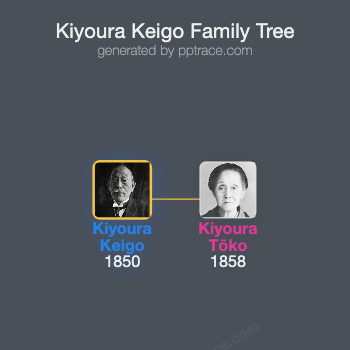
Family Tree
Tap  to expand more relatives
Introduction
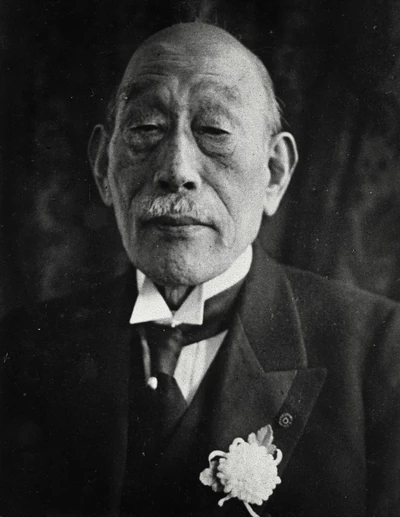
Count Kiyoura Keigo (Japanese: 清浦 奎吾; born Ōkubo Fujaku) was a Japanese politician born on either 14 February 1850 or 27 March 1850 in Kamoto, Higo Province (present-day Yamaga, Kumamoto). He was the fifth son of Ōkubo Ryōshi, who served as the abbot of Menshōji Temple.
Kiyoura received education at a private school operated by Hirose Tanso from 1865 to 1871. During this period, he established a friendship with Nomura Morihide, who later became Governor of Saitama Prefecture, and adopted the name "Kiyoura Keigo."
In 1873, Nomura Morihide was appointed governor of Saitama Prefecture, and Kiyoura was assigned to a junior civil service position there. In 1876, at the age of 26, Kiyoura joined the Ministry of Justice, where he served as a prosecutor and contributed to the drafting of Japan's first modern criminal procedure laws.
By 1884, Kiyoura's career advanced when Yamagata Aritomo appointed him head of police forces across Japan, despite his relatively young age of 34. He subsequently served as Vice Minister of Justice and later as Minister of Justice. During his tenure at the Ministry of Justice, he helped draft the Peace Preservation Law of 1887.
In 1891, Kiyoura was selected as a member of the House of Peers through Imperial nomination. A close associate of Yamagata Aritomo, he held multiple cabinet positions, including Justice Minister during the second Matsukata and Yamagata administrations and concurrently served as Minister of Agriculture and Commerce in the first Katsura administration.
Kiyoura was elevated to the peerage as a baron (danshaku) in the kazoku system in 1902. He received various honors: the First Class of the Order of the Sacred Treasures in 1903, the First Class of the Order of the Rising Sun in 1906, and in September 1907, his title was elevated to viscount (shishaku).
In 1914, while serving as a Privy Councillor, Kiyoura was appointed Prime Minister of Japan following Yamamoto Gonnohyōe; however, he declined the appointment due to controversies involving the Siemens scandal, and Ōkuma Shigenobu was appointed instead.
Kiyoura accepted a second imperial order in 1924 following the Toranomon Incident and assumed the office of Prime Minister. His premiership lasted for six months during which the opposition dominated the Lower House of the Diet. His tenure included overseeing the royal wedding of Crown Prince Hirohito (later Emperor Shōwa) to Nagako Kuniyoshi (later Empress Kōjun) on 26 January 1924.
In 1924, he dissolved the Lower House of the Diet after facing opposition from a coalition of three parties: Kenseikai, Rikken Seiyūkai, and Kakushin Club, which held a majority. The subsequent general election resulted in a significant defeat for his cabinet, leading to its resignation.
In November 1928, Kiyoura was elevated to the rank of Count (hakushaku). He was posthumously awarded the Grand Cordon of the Supreme Order of the Chrysanthemum in 1942.
Throughout his life, Kiyoura received multiple honors and decorations, including several classes of the Order of the Sacred Treasure and the Order of the Rising Sun, as well as the Order of the Chrysanthemum after his death. His peerages progressed from baron in 1902, to viscount in 1907, and ultimately to count in 1928.
He died on 5 November 1942.